PRINCE2 methodology

Key takeaways
PRINCE2 is a structured, tailorable method that keeps projects focused on benefits, products, and clear decision-making.
- PRINCE2 succeeds by maintaining continued business justification and stopping projects that no longer justify investment.
- Stage-based governance creates stop or continue decision points with updated forecasts, risks, and benefits.
- Manage by exception delegates authority within tolerances and escalates only when limits are threatened.
- Product-based planning clarifies what must be delivered before scheduling time and cost activities.
- Defined roles and tailored management products improve accountability, reporting, and stakeholder buy-in.
Introduction
What is the PRINCE2 methodology?
PRINCE2 is a globally recognised project management methodology [1] which is now in its 7thAgilePM Exam | Agile PM Exams | Knowledge Train edition . It is the best known of all project management methodologies .
PRINCE2 provides a structured, process-driven approach to managing projects , ensuring they deliver outcomes which realise a return on investment in the form of benefits.
Methodology
A ‘methodology’ is a structured system of practices and rules used by experts in a specific field. For project management, it’s a blueprint used by teams to start, plan, execute, and conclude projects, ensuring a systematic and successful project delivery .
What’s in the PRINCE2 methodology?
PRINCE2 is a methodology because of its thorough, procedural approach to project management . It offers a roadmap for any project, covering everything from start to finish.
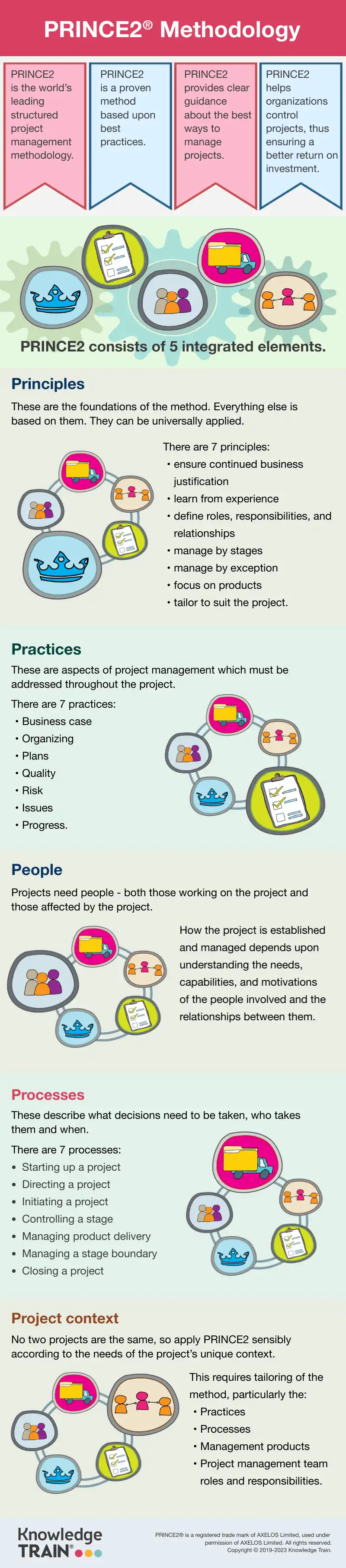
Underlying PRINCE2 are principles, people, practices, and processes that must be tailored to each unique project context to steer the team throughout the project.
The PRINCE2 methodology is structured to address typical project management needs and consists of 5 integrated elements:
- Principles
- People
- Practices
- Processes
- Project context.
The PRINCE2 manual ( Managing Projects Successfully with PRINCE2 ) describes in detail the five main elements within the methodology. They are described below.
Principles
PRINCE2’s principles serve as its foundational pillars, confirming if a project is genuinely managed using PRINCE2. They are universal, self-affirming, and enable effective project management practices .
Applying the PRINCE2 principles is a requirement if a project is to be a PRINCE2 project. The principles act as immutable laws that cannot be removed from a project.
The 7 principles within the methodology are described below.
Ensure continued business justification
A project is only successful if it realizes the expected benefits in return for its investment of money, time, and resources. Therefore, it is imperative that all investment decisions are based upon where the project is on course to achieve these objectives. If it isn’t, then it should be closed.
Learn from experience
The experience of previous projects should be used to guide the practices on the current, and later projects.
Define roles, responsibilities, and relationships
Everyone involved in the project management team must be clear what they are accountable and responsible for.
Manage by stages
A project is broken down into 2 more management stages which form ‘stop/continue’ decision points. Any decision to continue necessitates the commitment of money and resources to the next stage.
Manage by exception
Authority to take decisions is granted by a higher authority to a lower authority which is an efficient use of senior managers’ time. The higher authority can be kept informed of progress via regular reports, but at the same time, the lower management level can manage with the delegated boundaries. If these boundaries are forecast to be exceeded, this exception is escalated to the higher level for a decision.
Focus on products
Focusing on delivering on time and within budget cannot be done without first understanding what is to be delivered. All planning starts by focusing on products to understand what the plan should deliver.
Tailor to suit the project
Every project is different, therefore the methodology must be applied differently and sensibly in all situations.
People
Projects involve people , both direct participants and those impacted by a project. Recognizing their needs, skills, motivations, and the relationships among them is essential for setting up and managing the project effectively. The methodology describes how the people impacted by the project’s outcomes, must ‘buy in’ to the proposed changes, otherwise the changes will be unsuccessful, and the project will be a wasted investment.
Practices
The practices within the methodology are aspects of project management that are addressed throughout a project. They encompass areas like time, cost, risk, issues, quality, sustainability, and scope, common in other project management standards. These practices offer a decision-making framework, ensuring the project’s viability, desirability, and achievability from start to finish.
For anyone familiar with the Project Management Body of Knowledge (PMBOK) ® , the PRINCE2 practices are very similar to the knowledge areas of the PMBOK
with the day-to-day project management, who operates within set tolerances. The project manager, in turn, assigns work packages for delivery by a team manager.
The board operates on a ‘manage by exception’ principle, eliminating regular meetings with the project manager by receiving regular reports. Project assurance monitors project performance and advises both the project board and project manager.
Plans
PRINCE2 recommends distinct plans for each level of the project management team. The project board uses a high-level project plan to oversee project progress stage by stage. The project manager relies on a more detailed stage plan for in-stage progress, while team managers need detailed team plans to monitor their work package. Each plan is approved by the next highest management level.
For planning, PRINCE2 suggests using product-based planning, emphasizing the ‘focus on products’ principles to identify products before using activity-based tools like Gantt charts.
Plans outline the “what, when, who, and how much?” Once approved, plans are set as baselines and are subject to change control.
Quality
The project produces products which will later be used by users operating within the regular business operations. To achieve the expected outcomes and benefits, users need the correct products based on agreed specifications. PRINCE2 emphasizes planning to meet the anticipated quality standards, which must be actively overseen and managed.
Risk
Risks are uncertain events that can positively or negatively affect a project. Every project faces risks that need proactive identification and management. A risk management procedure should be set up to handle risks consistently. Risks surpassing the set tolerance level must be brought to senior management’s attention for resolution.
Issues
Projects inevitably face issues and changes, whether external, like new laws, or internal, such as shifting user requirements. PRINCE2 provides guidance for how issues can be managed to avoid them damaging the project, and how changes can be incorporated using cost-effective ways that contribute to the project’s outcomes and benefits.
Progress
Speaks for those designing, building, and testing the project’s specialized products.
Project assurance