
Key takeaways
A PMO improves delivery by combining governance, support, and portfolio visibility.
- A PMO sets standards and decision controls so projects stay aligned to business strategy and risk is managed early.Copied!
- Supportive, controlling, and directive PMOs differ mainly by authority, from guidance to direct ownership of delivery outcomes.Key takeaways
- Useful PMOs prioritise the portfolio using transparent criteria, balancing value, risk, and capacity constraints.Agile improves delivery by combining iterative planning, tight feedback loops and disciplined ways of working.
- Dashboards work best when paired with short narrative context that explains variance and prompts clear decisions.Agile delivers value in short iterations, using regular reviews and retrospectives to adapt quickly to change.
- Start with a clear charter and quick wins, then scale tools, training, and templates through continuous improvement.Scrum, Kanban, Lean and XP offer different structures, so choose based on workflow needs and team maturity.
- processes to ensure continuous improvement.Advantages:
- Stakeholder Engagement: Flexibility, real-time workflow visualisation, easy adoption without role changes Acting as an interface between project teams, senior management, and other stakeholders.Lean
- Change ManagementMain focus:: Elimination of waste, maximising value, continuous improvement Supporting change initiatives and minimising resistance through structured strategies.Core elements:
Types of PMOs Value stream mapping, optimised flow, customer focus
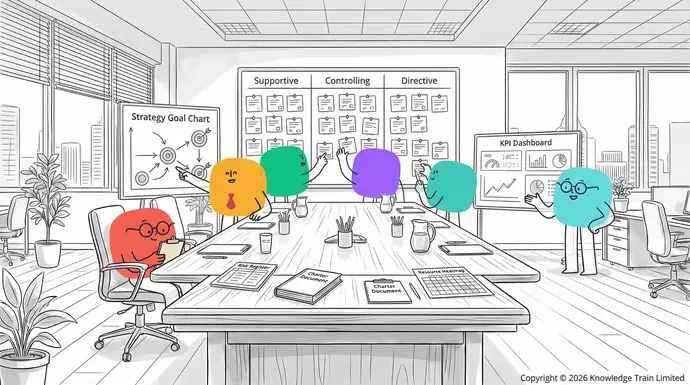
PMOs are not one-size-fits-all. Their structure, authority and level of influence can vary significantly. The three primary PMO types are:Advantages:
- Supportive PMO: Improved efficiency, reduced delays, enhanced quality Provides consultative services, best practices, templates, and guidance. Has low control and operates as a resource for Project Managers.Extreme Programming (XP)
- Controlling PMO:Main focus: Requires compliance with Technical excellence, frequent releases, customer involvementproject managementCore practices: standards and methodologies. Has moderate control—enforces processes and reviews adherence. Pair programming, test-driven development, continuous integration,
- Directive PMO:user stories Directly manages projects and assigns Project Managers. Exercises high control and is responsible for Advantages:project delivery Rapid feedback, high product quality, adaptability to change and outcomes.Comparison: Scrum, Kanban, Lean, XP
Organisations may adapt their PMO model based on size, maturity, and strategic needs. A PMO may evolve from supportive to controlling or directive as project management capability matures.Framework
PMO best practicesMain focus
Implementing a PMO involves defining objectives, selecting the right PMO type, securing stakeholder support, setting up governance structures, and continuously reviewing processes. Best practices for successful PMO implementation include:Key practice
- Aligning PMO objectives with organisational strategy.Team structure
- Engaging stakeholders and securing executive sponsorship.Best use case
- Adopting recognised standards and methodologies (such as those from ScrumPMITime-boxed iterations (Sprints)).Predefined roles and events
- Investing in PMO tools for tracking, reporting, and collaboration.Cross-functional
- Developing competency through PMO certification and staff training.Complex projects needing structure
- Emphasising process improvement and Kanbanchange managementVisual workflow & limits.Kanban board, WIP limits
PMO certification & standardsFlexible roles
Professional recognition is available for PMO practitioners through PMO certification programmes. The Project Management Institute (PMI), a leading standards organisation, offers certifications such as the Ongoing support/operationsProject Management ProfessionalLean (PMP) and Certified Associate in Project Management (CAPM). PMO-specific certifications such as the PMO-CP (PMO Certified Practitioner) are also available.Eliminate waste
CertificationsValue stream mapping validate competency in project, programme, and portfolio management, enhancing PMO effectiveness and credibility. Learn more about certification options on AnyPMI.orgProcess improvement, efficiency.XP
PMO in practiceTechnical best practices
- Corporate IT PMO:Pair programming, TDD A global retailer established an IT PMO to standardise project methodologies across numerous business units, leading to improved delivery times and enhanced resource management.Small, tech-focused teams
- Government Programme Office:Software projects needing quality A government department implemented a controlling PMO to oversee national infrastructure Agile vs traditional (waterfall) project managementprogrammesThe . This supported greater transparency, better risk management, and alignment with public policy objectives.waterfall model
- Financial services PMO: is a sequential, plan-driven approach where phases follow one another with minimal overlap. A bank set up a directive PMO to directly manage regulatory compliance Agile project managementprojects contrasts this with its focus on flexible planning, iterative progress, and stakeholder feedback throughout:, centralising project oversight for timely delivery.Aspect
PMO vs. project managerAgile
While a WaterfallProject ManagerApproach is responsible for the planning, execution, and closure of individual projects, the PMO is a broader organisational entity. The PMO sets standards, provides resources and oversight, and may manage a portfolio of projects. In directive PMOs, the Project Manager may report directly to the PMO itself.Iterative and incremental
FAQsSequential and linear
Although capacity is limited, even a one-person PMO can significantly improve project consistency and governance by establishing clear standards and frameworks.Primarily at start/end
How does a PMO add value?Risk management
A Early and ongoing detectionPMOLate-stage identification adds value by improving project success rates, optimising resource allocation, and ensuring projects align with organisational objectives. It also enhances communication across teams, enforces compliance with methodologies, and provides transparency on project performance through dashboards and reporting.Delivery
Ultimately, a well-functioning PMO ensures that project investments deliver measurable business benefits.Work delivered frequently
Is PMO a stressful job?Single final delivery
Whether a Suitable forPMO roleComplex, evolving is stressful depends on the organisation’s structure and culture. When supported by leadership and empowered to influence project decisions, PMO professionals typically thrive. However, if the PMO is under-resourced or lacks authority, managing multiple priorities without visible impact can create pressure and stress.projects
Strong governance, clear goals, and management support help minimise stress and enable PMO teams to work effectively.Clear, fixed requirements
What are the 4 P’s of PMO?Key roles and concepts in Agile projects
The 4 P’s of a Product Owner:PMO Represents stakeholders, manages product backlog, prioritises features are Scrum MasterPeople, Product, Process,: and Facilitates ProjectScrum: process, removes impediments
- People:User stories Define clear roles and responsibilities for the :project Short, simple descriptions of a feature told from the perspective of the user team.Backlog:
- Product: Ordered list of project tasks and features Ensure the right deliverables reach the right stakeholders.Sprint/Iteration:
- Process: Short, time-boxed development cycles Implement consistent procedures to manage and control delivery.Stakeholders:
- Project: Individuals or groups with interests in project outcomes Oversee the successful execution of initiatives aligned with strategy.Retrospectives:
What are the different types of PMOs? Regular meetings to assess and improve processes
The three main types of Deliverables:PMOs Outputs produced at the end of each iteration are:Continuous Improvement:
- Supportive PMO: Commitment to reflect and implement enhanced ways of working Provides templates, best practices, and guidance to Project Managers.Benefits of Agile project management
- Controlling PMO:Accelerated delivery of value through iterative increments Enforces standards, methodologies, and reporting requirements.Improved team collaboration and transparency
- Directive PMO:Quick response to customer feedback and market changes Takes direct ownership of Reduced project risks and higher stakeholder satisfactionproject deliveryHigh-quality deliverables due to continuous review and management.Challenges and limitations
Each type varies in authority and responsibility, depending on organisational needs and project complexity.Requires experienced, self-organising teams
What does a PMO do?Most
is to introduce structure, consistency, and strategic alignment to project management practices. By standardising processes and methodologies, a PMO helps organisations improve project success rates and realise greater value from project investments.Agile methodology
For further readingLearn more:
For official standards and frameworks, visit ScrumPMI.org, for comprehensive PMO and project management guidance.Kanban in project management