How to write a business case

Key takeaways
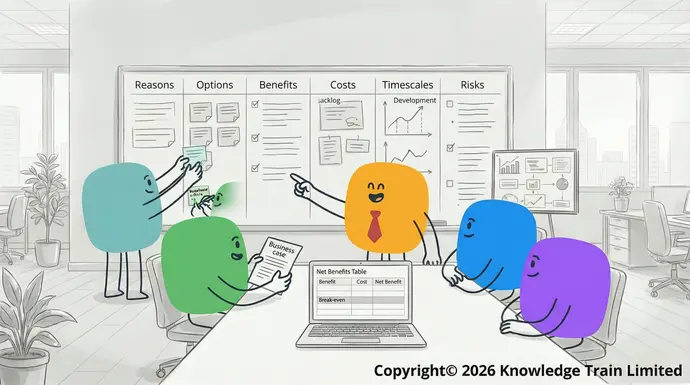
A business case helps decision-makers judge whether an investment is worth the time, money and risk.PRINCE2 Agile behaviours
- State the reason for the activity and ensure it aligns with organisational strategy.
- Compare realistic options, including doing nothing, and clearly justify the preferred choice.Simon Buehring
- Separate project costs and timescales from ongoing operational costs and benefit realisation timescales.19 Feb 2026
- Define benefits in measurable terms and distinguish outcomes from benefits so performance can be tracked.
- Include known dis-benefits and major risks, plus mitigations, to avoid one-sided decisions.Learn about the five key behaviours in PRINCE2 Agile that can enhance agility in your projects. Scroll down to read more.
- Use an investment appraisal, such as net benefits and break-even timing, to test viability.
IntroductionInterview with Madeleine Parsley
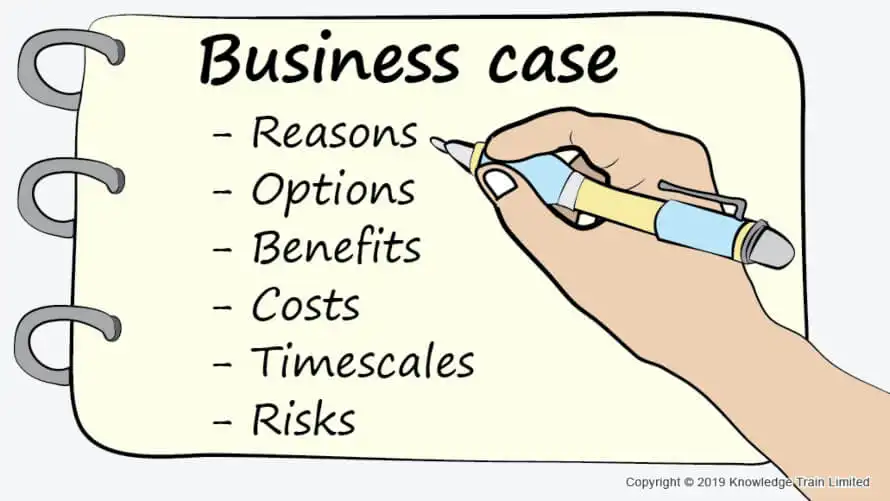
This article explains how to write a business case. It includes 2 business case examples and a free business case template for you to downloadSevcan Yasa.19 Feb 2026
You’re probably reading this article because you want to know how to write a business case. Perhaps your organisation is embarking on a major project to develop a new product. Or, perhaps you’re thinking of moving house so your family can enjoy a better life. In either case, you write a business caseIn this video, Madeleine Parsley describes how her career was helped by taking a PRINCE2 Foundation and Practitioner course with Knowledge Train. to ensure the investment is worthwhile.
In this article we’ll give you 2 business case examples, provide you with a simple business case template for you to use, and explain how to write a business case.
Business case examplesproject management courses
We will now give you 2 business case examples. The first example is one which you might find useful for taking decisions in your personal life. The 2nd business case example is more business focused project., a
Business case example 1: Moving homePRINCE2 course
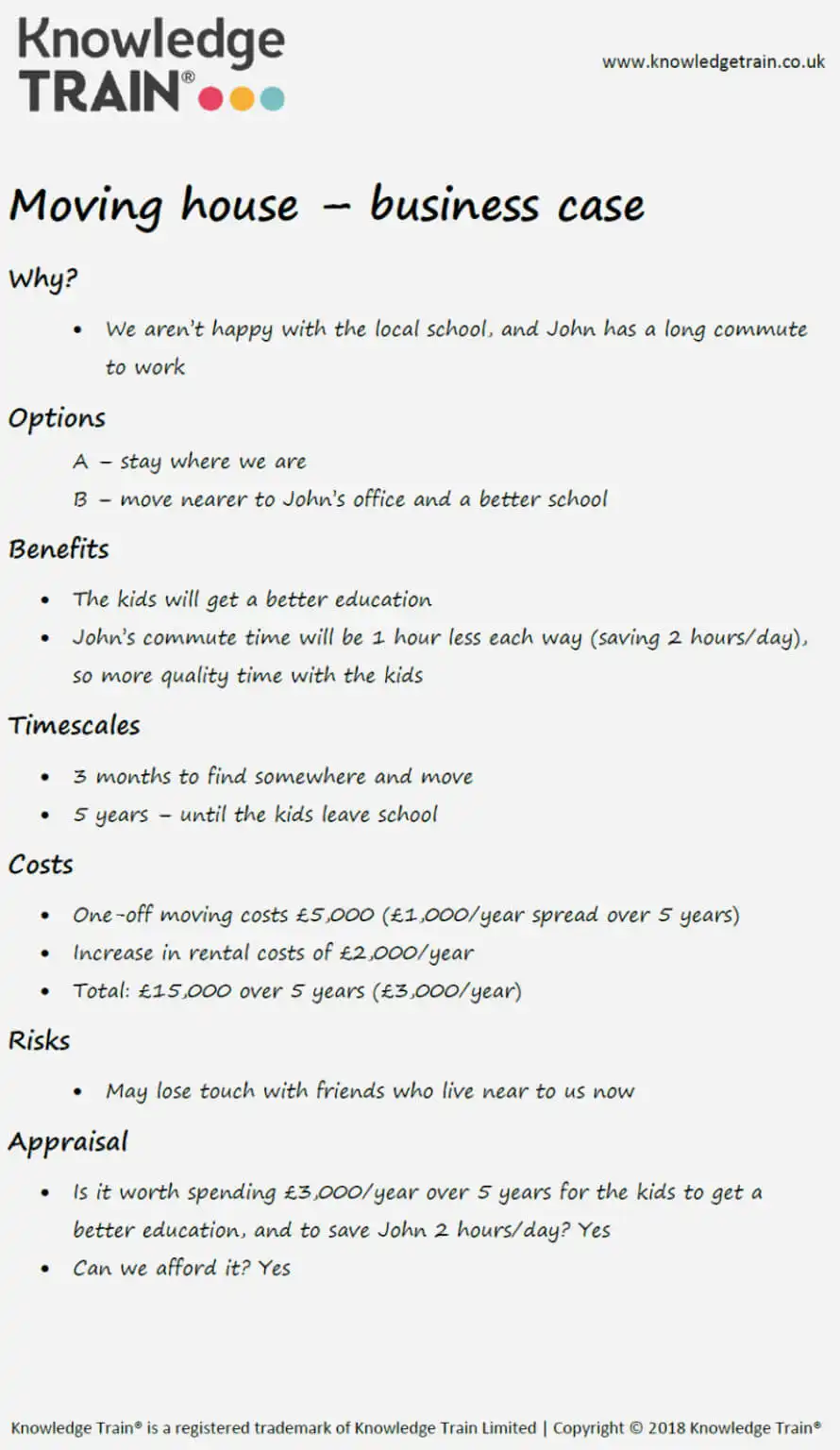
Suppose you and your spouse are considering moving to a new home. You will need to weigh up the pros and cons of moving. This is done using a business case. You might not call it that, but that’s what it is. Let’s look at an example., or an
Reasonagile project management course
As you can see from the example, the first thing to be clear about in a business case is the reason for doing the project or activity. In this example, the couple has answered the question to boost your career. Why?PRINCE2 In fact, there are two problems here – the local school and John’s long commute.®
Options considered, MSP
A business case should weigh up the competing options which have been considered. After all, there is usually more than one option. Perhaps an alternative option would have been for John to change his job to one nearer their current house. However, this wouldn’t solve the issue with the school.®
Benefits, ITIL
The benefits of a project or activity are the positive things you’re going to get back in return for your investment of time and money. In this case, the kids will get a better education, and John will save time each day.®
Timescales, P3O
It’s also important to understand how long the investment of resources will take. This is so that the organisation (or family in this case) knows when the resources will be freed up to work on other ®projects, PRINCE2 or activities.®
There are usually 2 timescales to consider. First, the timescale of the project or activity – in this case 3 months to find a new house and move there. Second, the time over which the benefits shall be realized. In this case it’s 5 years until the kids leave school. Agile, RESILIA
Costs®
The costs of doing the project or activity is the next important bit of information. On this project, the costs of moving to a new house will be £5,000. These are the project costs., and the Swirl logo are registered trademarks of the PeopleCert group. Used under licence from PeopleCert. All rights reserved. AgilePM
However, the couple will spend an additional £2,000/year for every year over which the business case is calculated. For a project in an organisation, this is usually referred to as the operational costs of maintaining and operating the projects outputs e.g. an IT system. At this point, the couple knows the total costs over the timescales when the benefits shall be realized.®
Risks and AgileBA
For any activity or project, it’s also important to understand the major risks involved. Risks are the uncertain things which may or may not happen during the period of the investment. There is only one risk identified here, which is the risk that the couple might lose touch with friends who live close to them right now.®
Investment appraisal are registered trademarks of Agile Business Consortium Limited. All rights reserved. The APMG International AgilePM and Swirl Device logo, APMG International AgileBA and Swirl Device Logo, APMG International Change Management and APMG International Better Business Cases and Swirl Device logo are trademarks of The APM Group Limited, used under permission of The APM Group Limited. All rights reserved. Better Business Cases™ is a trademark of Her Majesty’s Treasury. All rights reserved. DevOps Foundation
The next section is where the costs and timescales and risks are weighed up. For this project, it’s a simple decision for the couple to decide if it’s worth spending money over the next 5 years to give their kids better schooling and to save John 2 hours a day commuting.®
For an organisation to decide if an investment is worthwhile, however, there are several different ways in which it can decide about the investment. is a registered mark of the DevOps Institute. “PMI”, “PMBOK
Often in organisations there are rules defined to help business analysts or ®project managers Guide”, “PMP” and “CAPM” are registered marks of Project Management Institute, Inc. Knowledge Train Scrum Essentials™, Business Learning Library (BLL)™, Business Analysis Learning Library (BALL)™, Agile Learning Library (ALL)™, IT Learning Library (ITLL)™, and Compliance Learning Library (CLL)™ are trademarks of Knowledge Train Limited. All rights reserved. write what’s called an investment appraisal. In the next example, we’ll look at one example known as net benefits.Knowledge Train Ltd is an Introducer Appointed Representative of NewDay Cards Ltd for the Newpay finance product provided by NewDay Ltd. NewDay Cards Ltd acts as a credit broker, not a lender. We will introduce you exclusively to Newpay finance products provided by NewDay Limited under this Introducer Appointed Representative arrangement. Finance available from other lenders is not covered by this arrangement. NewDay Ltd and Newday Cards Ltd are authorised and regulated by the Financial Conduct Authority (ref nos 690292 and 682417 respectively).
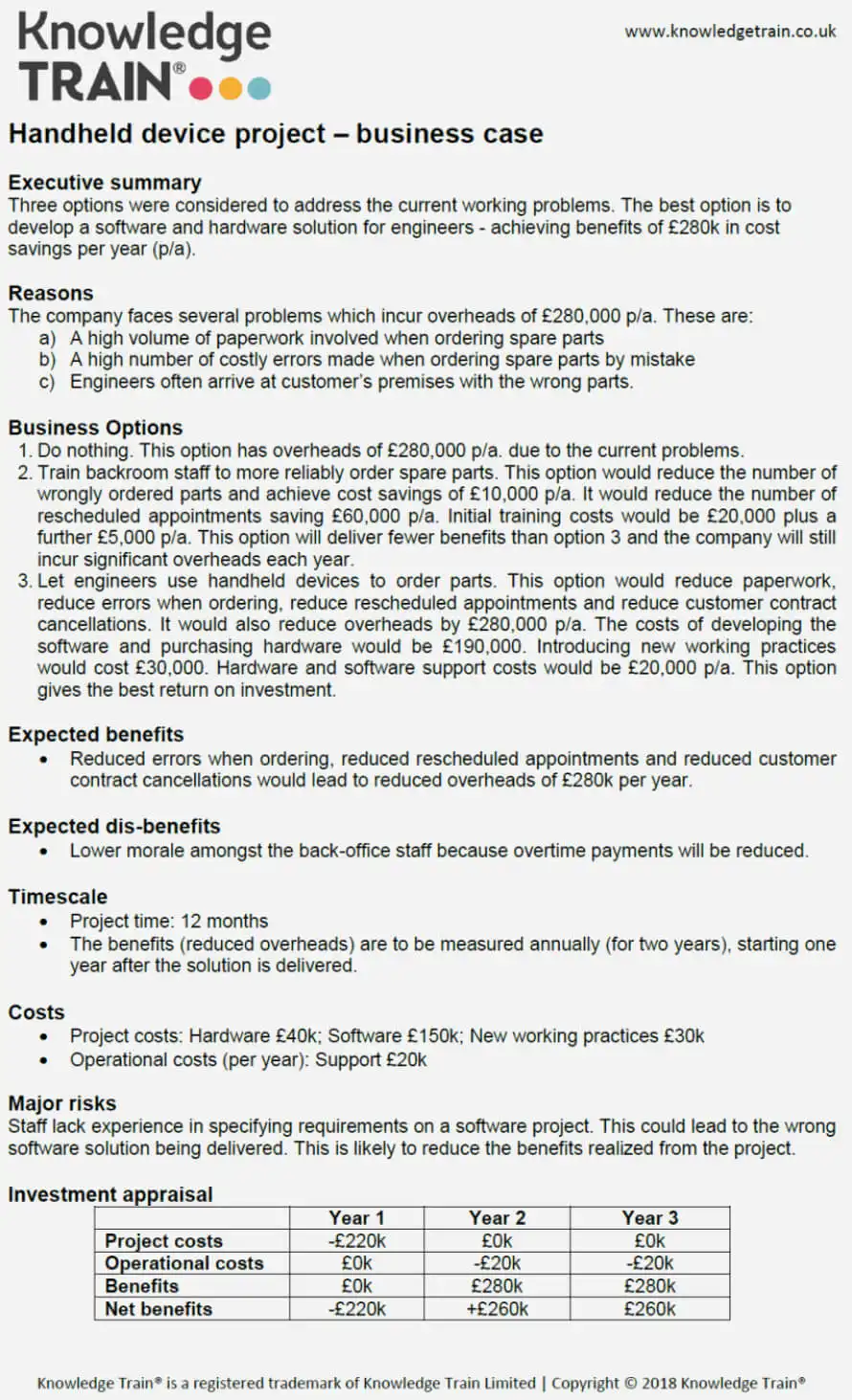
Business case example 2: Handheld device project
Imagine a heating repair services company that uses a paper-based set of forms filled in by an engineer during site visits. The spare parts required to fix the heater are recorded on a form which is given to staff to process back in the office. They then order the parts, and schedule a follow-up visit for the engineer to fix the heater.
SummaryStatistics
A business case is the most important document on any project. That’s because it justifies the investment.
It helps an organisation be clear about why a project is needed, and what the results of the investment will be. This is crucial because no organisation has unlimited funds to spend on an unlimited number of projects. Therefore, a business case gives confidence to senior managers when deciding to invest in one project rather than another.
However, as you have seen in this article, a business case is something which you can find useful when taking major decisions in your own personal life. Remember – a business case doesn’t need to be a lengthy document. It could easily be a few notes scribbled on the back of something or even sent in an email.
Whatever form your business case takes, remember one thing – it will help you or your organisation take sensible decisions about committing time and resources to a project or activity.Statistics
Remember, if you want to learn more about developing a business case, and learn many of the techniques useful for assessing business problems, consider attending a classroom business analyst course .
Business case FAQsRead more about these purposes
Who approves a business case?
Usually on a project, the project sponsor (the person or people who are committing the funds) will approve a business case. Before approving it, they need to have confidence that the problems have been addressed and the right solution has been selected, that the benefits are achievable and realistic, when the investment will pay off, and how big will the return on investment be.Accept
What makes a good business case?
As you have seen in this article, there’s several important bits of information which goes into a business case. Don’t spend unnecessary time though adding information which isn’t required. Your project sponsor will have to read your business case before they approve it, and you don’t want to make their job any harder than it already is!Deny
There are several things you can use to check whether your business case is adequate or not. Here’s a checklist of 13 questions to ask yourself before you submit your business case to your sponsor for approval:
Statistics
The purpose of a business case is simple – it’s used to justify an investment in an activity. Typically, in an organisation this activity is a project. It helps give confidence to management that their investment is worthwhile and will realize benefits for the organisation.
Who owns a business case?
tive.
By owning the business case, it means this person is accountable for ensuring that any investment decisions which are taken based upon the information within the business case are worthwhile.