
Key takeawaysSimon Buehring
Business analysis turns business needs into clear requirements and evidence-based decisions.19 Feb 2026
- Business analysis aligns strategic goals with delivery by bridging stakeholders and technical teams.
- Clear requirements and validation reduce project risk and improve solution fit, cost and feasibility.New to Scrum? Our visual guide explains the methodology clearly. Download the accompanying poster to share with your team.
- Techniques like SWOT, gap analysis, process modelling and data analysis expose opportunities and bottlenecks.
- Embedding analysis in governance strengthens planning, transparency and measurable outcomes.
- Rigour can be maintained alongside speed by using consistent standards, templates and lightweight frameworks.
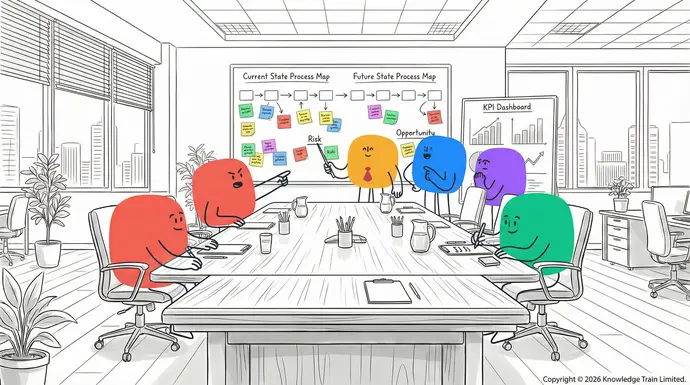
Business analysis: definition and overview
Business analysis is a professional discipline that involves understanding business needs and problems, eliciting and documenting requirements, and proposing solutions that drive process improvement and deliver value. It acts as a bridge between stakeholders and technical teams, ensuring that strategic objectives are aligned with operational execution. Reputable bodies such as the International Institute of Business Analysis (IIBA)
The objectives and value of business analysis
- Identifying business needs and opportunities for improvement
- Supporting stakeholders in achieving strategic goals
- Facilitating change management processes
- Reducing project risk through clear requirements and solution assessment
- Ensuring solutions are feasible, cost-effective, and aligned with business requirements
Business analysts enable informed decision-making, increase process efficiency, and help organisations remain competitive.
Key responsibilities of a business analyst
The business analyst plays a critical role throughout project lifecycles and change initiatives. Their main responsibilities include:
- Requirements elicitation: Facilitating workshops, interviews, and surveys to gather needs from stakeholders
- Requirements documentation:Give us a call Creating clear business and technical requirements using various formats (e.g., user stories , use cases)+44 (0)207 148 5985
- Gap analysis and feasibility studies: Assessing current and desired future states to highlight improvements and evaluate solution viabilityOr chat with us using the link at the bottom of the screen.
- Stakeholder engagement:Contact us with questions about the courses on this page, or about which project management certification or training is best for you. Communicating with diverse stakeholders to ensure requirements are validated and alignedFinance FAQs
- Process mapping and Contactbusiness process modellingCookies:Privacy Visualising workflows for process improvement opportunitiesTerms
- Solution assessment and validation:Customer Support Reviewing proposals to ensure solutions address documented requirements[email protected] and deliver valueJoin Our Team
- Change management :[email protected] Supporting the transition of solutions into the business and managing effects on people and processes Copyright © 2005-2026 Knowledge Train Limited.
Main business analysis processes Registered in UK: 5566983.
| Process Registered VAT: GB872413526. | Description Knowledge Train |
|---|---|
| Requirements elicitation® | Gathering information from stakeholders using interviews, workshops, observation, and document analysis is a registered trademark of Knowledge Train Limited. |
| Requirements documentation 20 Old Bailey, London, EC4M 7AN, England, United Kingdom. | Capturing business and technical requirements in written formats, such as Knowledge Train are experts in project management, PRINCE2, agile and change management training and certification. Choose from a full range of instructor-led and self-paced user storiesproject management courses |