
Key takeaways Agile
Business analysis turns business needs into clear requirements and evidence-based decisions.Foundation
- Business analysis aligns strategic goals with delivery by bridging stakeholders and technical teams.Learn the fundamentals of the PRINCE2 Agile method.
- Clear requirements and validation reduce project risk and improve solution fit, cost and feasibility.Practitioner
- Techniques like SWOT, gap analysis, process modelling and data analysis expose opportunities and bottlenecks.Includes Foundation & Practitioner combined option.
- Embedding analysis in governance strengthens planning, transparency and measurable outcomes.AI Project Governance Framework (AIPGF)
- Rigour can be maintained alongside speed by using consistent standards, templates and lightweight frameworks.Foundation
Business analysis: definition and overviewFoundation
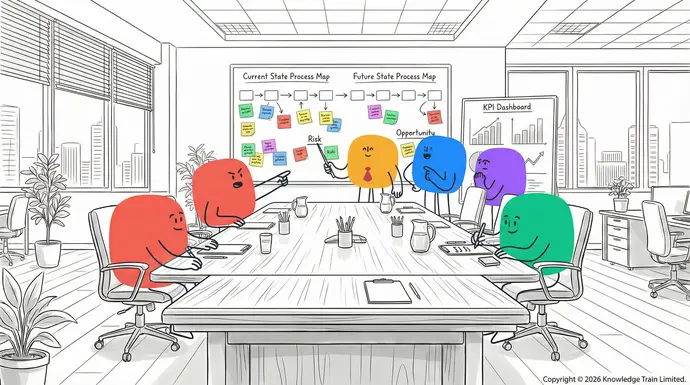
Business analysisLearn the fundamentals of the governance framework. is a professional discipline that involves understanding business needs and problems, eliciting and documenting requirements, and proposing solutions that drive Practitioner process improvementIncludes Foundation & Practitioner combined option. and deliver value. It acts as a bridge between stakeholders and technical teams, ensuring that strategic objectives are aligned with operational execution. Reputable bodies such as the International Institute of Business Analysis (IIBA)Workshops define business analysis as the practice of enabling change in an organisational context by defining needs and recommending solutions that yield benefits for key stakeholders.AI in Project Management
- Scrum Product Owner
- Stakeholder engagement:Choose Scrum Alliance or Scrum.org Product Owner training courses. Communicating with diverse stakeholders to ensure requirements are validated and alignedAgileBA
- Process mapping and ®business process modelling – Agile Business Analysis:Foundation Visualising workflows for process improvement opportunitiesLearn the fundamentals of Agile Business Analysis.
- Solution assessment and validation:Practitioner Reviewing proposals to ensure solutions address documented 4-day course including Foundation.requirementsLean Six Sigma and deliver valueYellow Belt
- Change managementSelf-paced training course to gain LSS Yellow Belt.:PMI Supporting the transition of solutions into the business and managing effects on people and processes®
Main business analysis processesPMI-ACP
| ProcessSelf-paced course to prepare you for the exam (exam not included). | DescriptionKanban |
|---|---|
| Requirements elicitationEstimating for Agile Foundation | Gathering information from stakeholders using interviews, workshops, observation, and document analysisAgile Learning Library (ALL)™ |
| Requirements documentationBUSINESS ANALYSIS | Capturing business and technical requirements in written formats, such as BCS Business Analysisuser storiesBusiness Analysis Foundation , use cases, or requirement specificationsLearn the fundamentals of business analysis. |
| Requirements validationModelling Business Processes | Ensuring requirements are accurate, feasible, and aligned with business goalsGain practitioner certificate in modelling business processes. |
| Stakeholder engagementBusiness Analysis Practices | Building relationships with all parties affected by the change to ensure their needs are metGain practitioner certificate in business analysis practices. |
| Process improvementRequirements Engineering | Analysing existing workflows and recommending enhancements for efficiencyGain practitioner certificate in requirements engineering. |
| Solution assessmentBusiness Analysis International Diploma | Evaluating potential solutions against requirementsAll 4 courses bundled into this Diploma certification package. |
| Change managementAgileBA | Supporting successful adoption of new processes or systems® |
Common business analysis techniques – Agile Business Analysis
- SWOT analysisFoundation training :Learn the fundamentals of Agile Business Analysis. Identifying strengths, weaknesses, opportunities, and threats related to a business area or solutionPractitioner
- Gap analysis:4-day course including Foundation. Comparing current and target states to identify improvement areasPMI
- Use case modelling:® Mapping user interactions with systems to define requirementsPMI-PBA
- : An iterative methodology focusing on flexibility, frequent delivery, and collaboration (often using user stories)
- Waterfall methodologySpecialist: CDS :3-day ITIL Specialist: Create, Deliver and Support (CDS) course. A linear, phased project approach suitable for well-defined requirementsIT Learning Library (ITLL)™
Choosing the right methodology depends on project size, risk, stakeholder needs, and desired adaptability.BUSINESS LEARNING LIBRARY (BLL)™
Essential skills and competencies for business analystsAgile Learning Library (ALL)™
- Analytical and critical thinkingBusiness Analysis Learning Library (BALL)™
- Effective communication and stakeholder engagementCompliance Learning Library (CLL)™
- Attention to detail in requirements documentationIT Learning Library (ITLL)™
- Problem-solving and solution assessmentBusiness solutions
- Knowledge of business and technical requirements_blank
- Proficiency in process improvement and data analysisAbout
Certification and career progression_blank
BCSBlog offers globally recognised certifications, such as EXPLORE SUBJECTSBusiness Analysis FoundationSelect your preferred subject., International Diploma in Business AnalysisPROJECT MANAGEMENT QUALIFICATIONS & WORKSHOPS, Practitioner certificates in Select your preferred qualification or workshop.
Select your preferred training course below: or change management qualificationsP3O COURSES to support broader career progression.Select your preferred training course below:
FAQs
What is business analysis?AGILE PROJECT MANAGEMENT COURSES
Business analysis is the systematic investigation and evaluation of business needs to recommend solutions that achieve organisational objectives. It includes requirements gathering, stakeholder engagement, and process optimisation.Select your preferred training course below:
What does a business analyst do?
A business analyst identifies business problems, elicits requirements, engages stakeholders, and ensures that proposed solutions align with business goals. They act as a bridge between business and IT functions.PRINCE2 AGILE COURSES