Ultimate guide to business analysis careers

Key takeaways
Business analysis enables change by clarifying needs and shaping solutions that deliver stakeholder value.
- A business analyst acts as a liaison across the organisation, turning stakeholder needs into clear requirements and workable processes.
- Strong technique skills such as interviewing, workshops, modelling, gap analysis, and cost-benefit and risk analysis improve decision-making and outcomes.
- Projects rely on business analysis to keep delivery focused on the most critical business needs and reduce financial and operational risk.
- Career paths span many titles, with progression driven by experience, communication, and analytical capability.
- BCS-accredited certification can strengthen employability and support advancement into senior and leadership roles.

Business analysis in a nutshell
Business analysis is the “process of enabling change in an organisational context, by defining needs and recommending solutions that deliver value to stakeholders” [1] . It involves learning an organisation’s business processes and operating procedures, so that problems can be identified and solutions can be formulated to help the organisation achieve its business goals. Projects are normally planned upon successful completion of business analysis activities.
The value of business analysis lies in the identification of benefits, discovering new opportunities, modelling the organisation, and improving how an organisation carries out its projects.
So, what’s a business analyst then?
If you’re a business analyst (BA) you’ll work as a “liaison among stakeholders in order to understand the structure, policies, and operations of an organisation, and to recommend solutions that enable the organisation to achieve its goals” [2] .
As a BA, you’re expected to perform these duties across all levels of an organisation. This means that you will be involved in determining the strategy that will be used and identifying the requirements and processes necessary for the accomplishment of a project.
Business analysis techniques
As a business analyst you’ll require a lot of tools and techniques in your toolkit to help you analyse business needs, evaluate options, define requirements and help to deliver changes. Some of the common business analysis techniques which you’ll need include interviewing, observation, workshops, mind maps, spaghetti maps, fishbone diagrams , gap analysis, business processes modelling, activity analysis, cost-benefit analysis, investment appraisal techniques, impact analysis and risk analysis [3] .
You can learn about all these techniques and more by studying the BCS Foundation Certificate in Business Analysis course.
Business analysts on projects
It’s common for companies to focus on the development of information systems to improve their business operations. Business analysts help ensure that technical specialists deliver the business solutions required by stakeholders.
They also help with creating of the overall business vision and help to implement it within projects. Projects therefore depend on business analysts because they help keep projects on track by focusing the project team on delivering solutions that meet the most critical business needs. This increases the quality of solutions delivered, and the ability of the business to make good use of these solutions [4] .
Without business analysts, stakeholders will find it difficult to take the correct decisions when choosing the best information systems for their organisation. They will then inevitably fall into serious financial and business risks.
Business analysis career opportunities
It is probably clear to you by now that, due of the diverse nature of the job, a business analysis career isn’t just limited to a business analyst role. It extends to other job roles too. Many industries depend on business analysis, so there’s no need to worry about your options when it comes to job titles. But what exactly are the other job titles available within business analysis?
Job titles
Job titles requiring business analysis skills include the process analyst, business systems analyst, systems analyst, enterprise analyst, product manager, product owner, requirements engineer, business architect, data scientist, management consultant and business intelligence analyst. These are just a few of the possible jobs that you can land if you choose to enter business analysis.
Experience counts
Like other jobs, you can begin with entry-level positions in business analysis and later move to junior business analyst positions. This can obviously only be achieved if you have enough experience and a good record of performance. As a tip, “some choose instead to return to school to get master’s degrees before beginning work as business analysts in large organizations or consultancies” [5] for a higher chance of getting promoted or landing a better job title in the industry. Gradually, you can take bigger roles and move into high-level management positions in other organisations.
Qualifications
Regarding qualifications, employers in the UK can sometimes demand at least a bachelor’s degree in business-related disciplines. However, it is still possible to succeed with a business analyst certifications , such as BCS Business Analysis Foundation or the more advanced BCS Business Analysis Diploma .
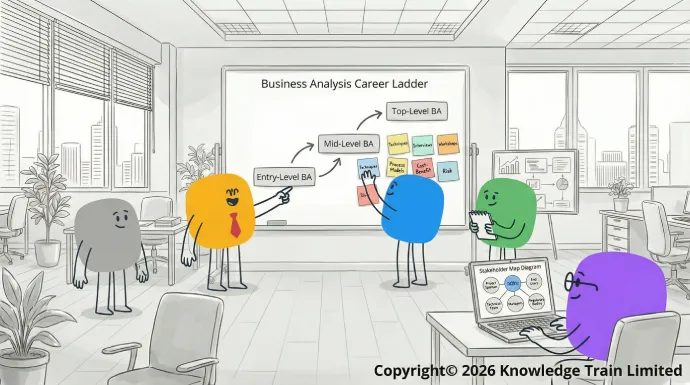
To know more about career opportunities, we’ve prepared a summary of entry level job roles, mid-level job roles, and top-level job roles with average salary, skills, experience, and qualifications needed, to give you an idea of your potential career in business analysis. Read on for more.


Project Risk Single Certificate Level 1 projectsEnhance your project risk management skills.®
If you aspire to level up in your career as a business analyst, here’s what you need to know about being an IT business analyst and senior/lead business analyst: – Agile Project Management
Average salaryFoundation : £46,458 – £85,000 per year (IT Business Analyst)Learn the key principles of Agile Project Management.[8]Practitioner , £55,936 – £98,000 per year (Senior Business Analyst)Includes Foundation & Practitioner combined option.[9]PRINCE2
Skills®: IT business analysts need systems and data analysis skills, alongside impressive interpersonal and communication skills. This is because IT business analysts function as a communication channel between the team and the stakeholders. Analytical skills, problem-solving skills and knowledge about current technologies are also useful if you intend to pursue this job. Current knowledge will ensure that the organisation is using the latest technology, which will lead to more successful projects. Although this job sounds technical, creativity is very useful too, as it will aid in finding solutions when problems arise. Agile
When it comes to the senior business analyst role, knowledge of internal or external business issues is necessary. You must also be knowledgeable of financial processes and of handling finance reference data. Again, although the job may sound technical, strong communication skills will give you an edge in this role since you will be communicating with stakeholders.Foundation
ExperienceLearn the fundamentals of the PRINCE2 Agile method.: 3-8 years of experience. As a senior business analyst, you will be operating at a senior management level and will be expected to have experience of change and stakeholder management. As an IT business analyst, relevant experience working in a similar industry is always a plus. If you have any experience when it comes to managing stakeholders, this will surely give you an advantage too.Practitioner
QualificationsIncludes Foundation & Practitioner combined option.: A business-related bachelor’s degree is a great advantage for both the IT business analyst and senior business analyst. For the IT business analyst, a degree in computer science or any related field is always a plus. Employers will also look favourably on those who possess professional business analyst certification, especially those awarded by the BCS. Relevant AI Project Governance Framework (AIPGF)BCS business analysis qualificationsFoundation include Learn the fundamentals of the governance framework.BCS Business Analysis FoundationPractitioner and Includes Foundation & Practitioner combined option.BCS Business Analysis DiplomaBetter Business Cases.™

Top-level business analysis rolesFoundation
If you have experienced working as a quality assurance expert or as an IT business analyst, and you believe that you’ve gained enough experience in the world of business analysis, then maybe it’s time to take the leap to a top-level business analysis role!Learn the fundamentals of Better Business cases.
As you acquire more skills, knowledge and experience along the way, you become more equipped to take bigger roles in the industry. Here are some of the top-level job roles that you can consider as you progress in your career: business requirements analyst, process analyst, decision analyst, business systems analyst, systems analyst, functional analyst and agile analyst.Practitioner
If you plan to take leadership roles in business analysis, here are the career paths that you can pursue: BA project lead, BA program lead, BA practice lead, relationship manager, enterprise architect and business architect.Includes Foundation & Practitioner combined option.
Let’s find out more about the average salary, as well as the skills, experience, and qualifications required for these top-level business analysis roles:P3O
Average salary®: £37k – £117k per year (senior decision analyst)Foundation [10]Learn the fundamentals of the P3O project management office., £34k – 88k (senior business systems analyst)Practitioner [11]Includes Foundation & Practitioner combined option., £46, 226 per year (relationship manager)Workshops[12]Introduction to Project Management