The 5 skill categories for staying relevant in the AI economy, study reveals

Key takeaways
This new study reveals which skill categories appear most resilient as AI reshapes work, challenging assumptions about which jobs are safest long term.
- The strongest long-term potential in the AI economy can be found in skill categories related to training and education, medicine & healthcare, and psychology, therapy, counselling.
- The strongest pressure from AI automation can be seen in skill categories related to business processes, management of material resources, and resource management.
- The strongest skill categories in the AI economy all share the same foundation: communication, contextual judgment, and adaptability.
- Programming remains one of the most sought-after technical skills globally, but higher AI exposure kept it outside the study's top-ranked skill categories.
Introduction
There’s no denying that artificial intelligence is changing the global economy, along with the skills workers need to stay relevant in it.
We’ve already seen that AI is effective at handling structured, repetitive, and information-heavy tasks. As many jobs rely heavily on these types of tasks, the transition into the AI economy feels uncertain for millions of workers.
But the change does not mean human input is becoming less valuable. If anything, our study revealed that the most valuable skills for job security are the skills that double down on uniquely human capabilities.
To identify which skills are likely to remain most valuable in the AI era, the Knowledge Train team cross-referenced Organisation for Economic Co-operation and Development labour “Skills for Jobs” data with the Stanford University’s AI Occupational Exposure framework.
The final ranking revealed labour market skill categories and subskills that had the best balance of:
- persistent global labour shortages, and
- lower exposure to AI automation.
Skills alone do not automatically translate into stable careers, so the study also identified the professions relying most heavily on skills that remain both globally scarce and comparatively difficult to automate through AI.
Key findings
- The strongest long-term potential in the AI economy can be found in skill categories related to:
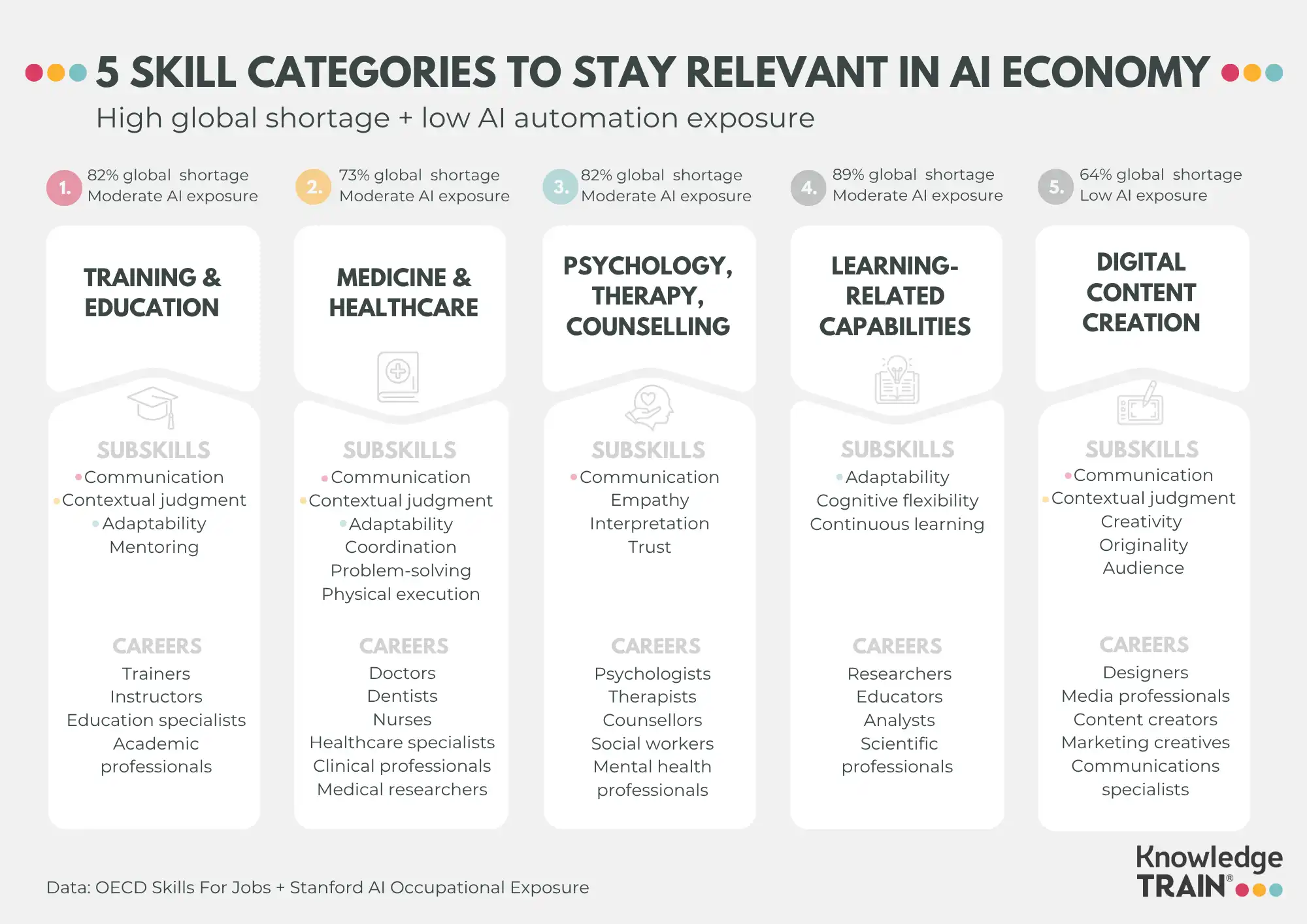
- Training and education (in shortage in 82% of economies, moderate AI exposure)
- Medicine & healthcare (in shortage in 73% of economies, moderate AI exposure)
- Psychology, therapy, counselling (62% labour shortage, moderate AI exposure)
- The strongest pressure from AI automation can be seen in skill categories related to:
- Business processes (oversupplied in 80% of economies, high AI exposure).
- Management of material resources (oversupplied in 77% of economies, high AI exposure).
- Resource management (oversupplied in 68% of economies, high AI exposure).
- Medicine and healthcare (combining the OECD categories “Medicine knowledge” and “Medicine and dentistry”) is the most difficult skill category for employers to fill globally, with shortages reported in 73% of economies and the highest shortage intensity overall
- The strongest skill categories in the AI economy all share the same foundation: communication, contextual judgment, and adaptability
- Programming remains one of the most sought-after technical skills globally, but higher AI exposure kept it outside the study’s top-ranked skill categories.
Why human-centered skills are winning in the AI economy
At first glance, the study’s highest-ranking skill categories may not seem to have much in common. Education, healthcare, counselling, learning-related, and digital content creation are very different fields.
Yet beneath the surface, they all rely heavily on the same underlying abilities:
- Communication
- Contextual judgment
- Adaptability.
Key takeaway: The AI economy isn’t reducing the value of human work. It’s placing a growing premium on communication, adaptability, and judgment.
This helps explain why these skills continue to outperform many traditionally “safe” office-based capabilities.
AI has become remarkably good at processing information, following instructions, and producing predictable outputs. But most real-world work is rarely that straightforward. Teachers need to adapt lessons to different students. Healthcare professionals make decisions with incomplete information. Counsellors interpret emotions and build trust. Content creators constantly adjust to changing audiences and contexts.
In other words, the skills rising in value are often the ones that require people to understand people.
The 5 skill categories most likely to thrive in the AI economy
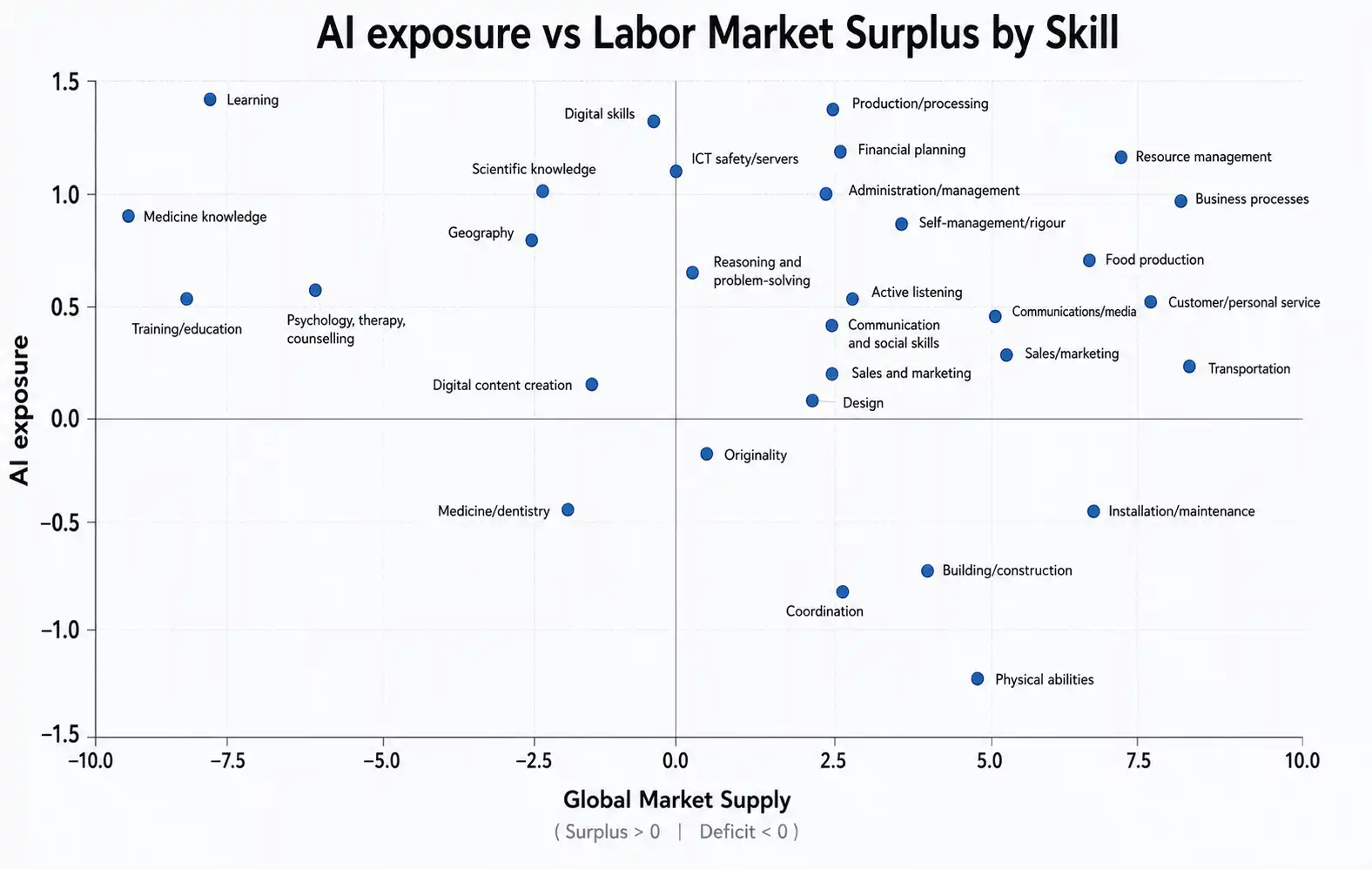
To identify the skill categories best positioned for long-term success, each OECD skill category was assigned a Skill Resilience Index (SRI), combining two factors: labour market shortages and exposure to AI automation. Higher scores indicate skills that remain difficult for employers to find while showing lower exposure to AI capabilities.
The chart below shows how OECD skill categories performed across both dimensions. For reporting purposes, the article combines the OECD categories “Medicine knowledge” and “Medicine and dentistry” into a broader “Medicine & Healthcare” category, while the chart displays the original OECD categories separately.
1. Training and education (SRI: 0.75)
Training and education-related skills are becoming increasingly difficult for employers to find, with shortages reported in 82% of economies.
Some of the strongest career opportunities in the years ahead are expected in teaching, training, and education. While AI can deliver information instantly, people help others understand, apply, and build confidence. Whether it’s helping a student overcome a learning barrier, explaining a concept in a different way, or motivating someone to keep going, the work relies heavily on communication, adaptability, judgment, and mentoring.
The strongest labour shortages in this skill category were recorded in the Netherlands.
2. Medicine & healthcare (SRI: 0.70)
Medicine and healthcare-related skills are in shortage across 73% of economies and recorded the deepest shortages overall, making them the most difficult skill category for employers to fill globally. At the same time, AI is becoming more reliable in delivering diagnostics, and administrative support. But what AI systems can’t replace is the human factor that healthcare relies on. Whether it’s reassuring a worried patient, making decisions when symptoms don’t tell the full story, or responding calmly in an emergency, the work relies heavily on judgment, communication, trust, and real-world decision-making.
Some of the strongest opportunities are expected among doctors, nurses, healthcare specialists, and other care professionals.
The strongest shortages in this category were recorded in Denmark.
3. Psychology, therapy and counselling (SRI: 0.68)
Psychology, therapy, and counselling-related skills are in shortage across 82% of economies, making them the second most resilient skill category in the AI economy. We might find some of the strongest career opportunities among psychologists, therapists, counsellors, and mental health professionals.
When people are struggling, they rarely need more information delivered by an automated system. They need understanding. Throughout grief, anxiety, burnout, relationship problems, or a major life change, the value comes from consulting a real person that can relate. That’s what makes psychology, therapy, and counselling highly resilient to AI automation.
Belgium showed the highest shortages in jobs highly related to this skill category.
4. Learning-related capabilities (SRI: 0.60)
Learning seems broad, but ultimately it reflects a person’s ability to adapt when the world around them changes. Ironically, the rise of AI may make learning more valuable rather than less. After all, AI systems themselves depend on constant training and refinement to stay efficient.
Some of the highest value opportunities are expected in professions like researchers, scientists, educators, analysts, engineers, and other knowledge-intensive professionals.
The strongest shortages in this category were recorded in Italy.
5. Digital content creation (SRI: 0.59)
Digital content creation may be one of the most surprising categories in the study. Generative AI is becoming increasingly capable of producing text, images, and videos, yet shortages were still reported across 70% of economies.
The reason is simple: creating content that connects with people requires more than production. Understanding an audience, developing original ideas, and making creative decisions remain difficult to automate. While many mid-level content roles may come under pressure, professionals who double down on originality will become even more valuable in an economy increasingly flooded with AI-generated content.
Some of the strongest opportunities are expected among designers, content creators, media professionals, and communications specialists.
The strongest shortages in this category were recorded in Finland.
The ‘safest’ skill categories are no longer what workers expect
For decades, office-based, knowledge-intensive careers were seen as the safest career choices. But the findings suggest that this assumption is no longer true, as the most vulnerable skill categories are:
- Business processes (skill resilience index: 0.10, oversupplied in 80% of economies, high AI exposure)
- Management of material resources (skill resilience index: 0.14, oversupplied in 77% of economies, high AI exposure)
- Resource management (skill resilience index: 0.19, oversupplied in 68% of economies, high AI exposure)
Just as the most resilient skill categories shared a common set of human-centered capabilities, the lowest-ranking categories shared a common weakness: they are built around systems, processes, and workflows that can be replicated.
Business processes, resource management, and material resource management all depend heavily on organizing information, following established procedures, coordinating activities, and producing predictable outputs. These are precisely the types of tasks AI is becoming increasingly effective at handling.
The findings suggest workers should focus less on chasing the latest technology and more on developing skills that complement it.
For workers, that doesn’t necessarily mean changing careers. It may simply mean investing more heavily in the human aspects of their profession, the skills that help them teach, persuade, create, mentor, interpret, and solve problems in complex real-world situations.
How the study identified the most valuable skills
To identify which skills are best positioned for long-term success in the AI economy, the analysis combined two independent datasets.
The first was the Organisation for Economic Co-operation and Development labour “Skills for Jobs” data, which measures labour market imbalances across economies and identifies skill categories that employers struggle to fill. The second was Stanford University’s AI Occupational Exposure framework, which measures how exposed different workplace skills are to current AI capabilities.
To compare skill categories, the analysis created a Skill Resilience Index (SRI). The index combines labour market demand and AI exposure into a single score, with higher values assigned to skills that remain difficult for employers to find while showing lower exposure to AI automation. The SRI was used to rank skill categories according to their long-term resilience in the AI economy.
To estimate global labour market supply, OECD shortage and surplus indicators were aggregated across reporting economies for each skill category, producing a single measure of global shortage or surplus pressure.
Each OECD skill category was evaluated against two factors:
- The extent of labour shortages across global economies
- Its level of exposure to AI automation.
Skill categories received higher resilience scores when they remained difficult for employers to find while also showing lower exposure to AI capabilities.