Artificial Intelligence (AI): Definition, how it works, types, examples, benefits, and risks

Key takeaways
AI is a broad field covering multiple methods and real-world uses, with clear strengths and important trade-offs.
- Artificial intelligence is an umbrella term that includes machine learning, deep learning, large language models, and robotics in some cases.
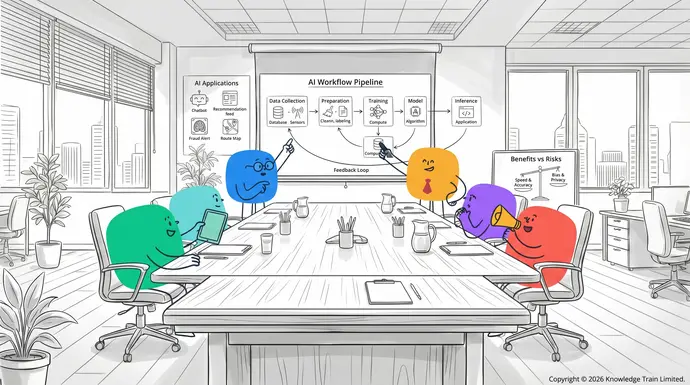
- Most AI follows a workflow of data collection, preparation, training, inference, and continuous improvement through feedback.
- Generative AI creates new content by learning patterns from large datasets, but it can still produce confident errors.
- Nearly all practical systems today are narrow AI, not artificial general intelligence.
- AI can improve speed, scale, and consistency, but it needs strong governance to manage bias, privacy, transparency, and misuse.
What is artificial intelligence?
Artificial intelligence (AI) is the field of computing that develops systems able to perform tasks associated with human intelligence. These tasks include reasoning, pattern recognition, learning, problem-solving, natural language processing, computer vision, planning, and decision-making.
In practice, AI includes a wide range of methods and systems. Traditional expert systems used rules created by human specialists. Modern AI more often relies on machine learning, deep learning, neural networks, and large language models trained on large datasets. AI also overlaps with robotics when software intelligence controls physical machines.
AI is best understood as an umbrella term. It includes subfields such as machine learning, deep learning, generative AI, natural language processing, computer vision, speech recognition, knowledge representation, and robotics.
Artificial intelligence in everyday life
Many people use AI every day without noticing it. Common examples include search ranking, email spam filtering, recommendation systems, fraud detection, digital assistants, route planning, predictive text, translation, image recognition, and customer service chatbots.
Common misconceptions about AI
- AI is not the same as machine learning. Machine learning is a subset of AI.
- Not all AI is generative AI. Many AI systems classify, predict, optimise, or detect rather than generate.
- Artificial general intelligence does not yet exist as a proven real-world system.
- Robotics is not always AI, and AI is not always robotics.
How does AI work?
AI works by combining data, algorithms, statistical methods, and computing resources to build models that can recognise patterns and produce outputs. A simple way to think about AI is that systems are trained on examples, then used to make predictions, decisions, or generate responses on new inputs.
A beginner-friendly AI workflow usually includes the following stages:
- Data collection: The system gathers text, images, audio, video, sensor data, transactions, or other information.
- Data preparation: Data is cleaned, labelled, organised, and formatted for training.
- Training: Algorithms learn statistical relationships from examples. This stage is often called data training or model training.
- Model creation: The result is a trained model that can classify, predict, recommend, or generate outputs.
- Inference: The model applies what it learned to new inputs.
- Feedback loop: Performance is monitored, corrected, and improved with more data or fine-tuning.
Key concepts explained simply
- Algorithm: A set of computational rules or procedures.
- Model: The learned system produced after training.
- Neural networks: Layered mathematical systems inspired by the structure of the brain, widely used in deep learning.
- Deep learning: A machine learning approach that uses many-layered neural networks.
- Inference: The stage where a trained model is used on new data.
- Feedback loop: A process for evaluating outputs and improving the system over time.
How generative AI works
Generative AI is designed to create new content such as text, images, audio, video, or code. Systems such as ChatGPT and other tools built on large language models are trained on very large collections of text to predict likely sequences of words. Similar techniques are used for image generation, code generation, summarisation, and content creation.
Types of artificial intelligence
Artificial intelligence can be classified in more than one way. The most common taxonomy separates AI by capability and by function.
Types of AI by capability
| Type | Definition | Status | Example |
|---|---|---|---|
| Narrow AI | AI designed for specific tasks | Exists today | Recommendation engines, voice assistants, fraud detection |
| Artificial general intelligence | AI with human-level general problem-solving ability across domains | Theoretical and debated | No confirmed real-world example |
| Superintelligence | Hypothetical AI that exceeds human intelligence in most areas | Speculative | No real-world example |
Narrow AI is the form used today. It can perform specific tasks very well, but it does not possess broad human understanding. Artificial general intelligence, often shortened to AGI, refers to a machine with flexible intelligence across many domains. Superintelligence is a hypothetical level beyond AGI.
Types of AI by function
| Functional type | Definition | Practical status |
|---|---|---|
| Reactive machines | Systems that respond to current inputs without memory of past events | Conceptually useful, limited in practice |
| Limited memory | Systems that use past data for decisions | Common in modern AI |
| Theory of mind | Hypothetical systems that understand emotions, beliefs, and intentions deeply | Not achieved |
| Self-aware AI | Hypothetical systems with consciousness or self-awareness | Not achieved |
Most modern AI systems are best described as limited memory systems. They use stored data, historical patterns, and training examples to make outputs.
AI vs machine learning vs deep learning
AI, machine learning, deep learning, and generative AI are related but not identical. AI is the broadest category, while machine learning and deep learning are increasingly specific technical approaches within it.
| Term | Definition | Methods | Inputs | Outputs | Examples |
|---|---|---|---|---|---|
| Artificial intelligence | The broad field of systems performing intelligent tasks | Rules, search, optimisation, machine learning, expert systems | Data, rules, sensor signals, user input | Predictions, decisions, actions, content | Robotics, route planning, fraud detection |
| Machine learning | A subset of AI that learns from data | Supervised, unsupervised, reinforcement learning | Structured and unstructured data | Classifications, predictions, recommendations | Spam filters, credit scoring |
| Deep learning | A subset of machine learning using multilayer neural networks | Neural networks with many layers | Images, audio, text, video | Recognition, translation, generation | Speech recognition, computer vision |
| Generative AI | AI focused on creating new content | Large language models, diffusion models, transformers | Prompts, text, images, code, audio | Generated text, images, code, summaries | Chatbots, image generation, code assistants |
Related entities explained
- Natural language processing: AI methods that help computers understand and generate human language.
- Computer vision: AI methods that help systems interpret images and video.
- Neural networks: The mathematical architecture used widely in deep learning.
- Large language models: Very large neural network models trained on vast text corpora to predict and generate language.
- Robotics: The engineering of machines that can sense, act, and sometimes use AI to make decisions.
Examples of AI
Artificial intelligence appears in many consumer and business systems. The best examples are narrow AI applications designed for a clear task.
5 common examples of AI
- Virtual assistants and chatbots that answer questions in natural language.
- Recommendation systems that suggest films, products, songs, or articles.
- Computer vision tools that detect objects, faces, or defects in images.
- Fraud detection systems that identify unusual transactions in finance.
- Navigation and traffic prediction tools that optimise routes.
Examples of generative AI
- Text generation for drafting emails, reports, and articles.
- Summarisation tools that condense documents.
- Code generation assistants that help programmers write or explain code.
- Image generation systems that create visuals from prompts.
- Conversational AI systems such as ChatGPT.
Applications of AI by industry
AI is used across many industries because it can improve speed, consistency, and insight when tasks involve data. The exact application depends on the sector, data quality, regulation, and operational goals.
Healthcare
In healthcare, AI supports medical imaging analysis, triage, drug discovery, risk prediction, scheduling, documentation, and personalised treatment research. Computer vision and machine learning are especially important for diagnostics.
Finance
In finance, AI is used for fraud detection, anti-money laundering checks, risk modelling, algorithmic trading, customer support, and credit scoring. Explainability is important because financial decisions can affect access to services.
Transportation
In transport, AI supports route optimisation, fleet management, driver assistance, predictive maintenance, logistics planning, and autonomous vehicle research.
Retail
Retailers use AI for product recommendations, demand forecasting, inventory planning, dynamic pricing, search, and customer service automation.
Education
Education uses AI for adaptive learning, marking support, tutoring systems, accessibility tools, plagiarism detection, translation, and content summarisation.
Manufacturing
Manufacturing applies AI to predictive maintenance, quality inspection, robotics, supply chain optimisation, energy monitoring, and process automation.
Customer service
AI in customer service includes chatbots, call routing, sentiment analysis, summarisation, and support agents that retrieve answers from knowledge bases.
Cybersecurity
Cybersecurity teams use AI to detect anomalies, prioritise threats, classify malware, monitor behaviour, and respond to attacks more quickly.
Entertainment
Entertainment companies use AI for recommendations, subtitles, dubbing support, audience analysis, game behaviour, visual effects, and generative media tools.
Benefits of AI
Artificial intelligence can deliver significant benefits when it is designed and governed carefully. Its strengths usually come from speed, scale, consistency, and pattern detection.
7 benefits of AI
- Automation: Reduces repetitive manual work.
- Efficiency: Processes large volumes of data quickly.
- Accuracy: Can reduce some forms of human error.
- Personalisation: Tailors recommendations and experiences.
- Availability: Enables services to operate continuously.
- Insight: Finds patterns that may be difficult for humans to spot.
- Scalability: Supports growth without proportionate increases in labour.
These benefits depend on context. Poor data, weak oversight, or unclear objectives can reduce value or create new risks.
Risks and ethical concerns
AI creates technical, social, legal, and ethical risks. Responsible development requires attention to fairness, accountability, privacy, security, and public safety.
6 risks of AI
- Bias in AI: Models can reflect or amplify unfair patterns in training data.
- Privacy concerns: AI may process personal or sensitive information.
- Hallucinations: Generative AI can produce false but confident answers.
- Lack of transparency: Some models are difficult to interpret or explain.
- Job displacement: Automation may change labour markets and roles.
- Safety and misuse: Systems can fail unpredictably or be used harmfully.
AI ethics and governance
AI ethics concerns the principles used to design, deploy, and monitor AI responsibly. Common themes include fairness, accountability, non-discrimination, privacy, transparency, explainability, human oversight, and security.
AI safety focuses on making systems reliable and controllable, especially in high-stakes settings. Governance may include testing, documentation, risk assessment, audit trails, model evaluation, incident reporting, and compliance with regulation.
In public policy, regulators and standards bodies increasingly examine data protection, intellectual property, product safety, discrimination law, and transparency requirements for AI systems.
History of AI
The history of artificial intelligence stretches from early theories of computation to modern generative AI. While current systems are highly capable in some tasks, the field has gone through cycles of optimism, disappointment, and rapid progress.
Key milestones in AI history
- Alan Turing: Helped lay the foundations of computer science and proposed questions about machine intelligence.
- Dartmouth workshop: The 1956 summer workshop is widely regarded as a founding event for AI as a formal field.
- John McCarthy: Helped organise the Dartmouth workshop and popularised the term artificial intelligence.
- Expert systems: Rule-based systems became influential in the late twentieth century.
- Machine learning growth: Improved data availability and computing power increased practical AI use.
- Deep learning breakthroughs: Advances in neural networks transformed image, speech, and language tasks.
- Modern generative AI: Large language models and image generators brought AI to mass public attention.
AI development has also been shaped by progress in statistics, optimisation, hardware, data storage, and the internet.
The future of AI
The future of AI will likely involve broader adoption, more specialised models, stronger regulation, and increasing integration into everyday software, devices, and services. Progress is expected in productivity tools, science, healthcare, robotics, and multimodal systems that combine text, images, audio, and video.
Important questions remain unresolved. Researchers and policymakers continue to debate artificial general intelligence, long-term AI safety, responsible deployment, ownership of training data, copyright, environmental cost, and the social effects of automation.
The most realistic near-term future is not a single superintelligent machine, but a growing ecosystem of narrow AI and generative AI systems embedded into work, education, communication, research, and public services.
Suggested supporting cluster pages
- Machine learning
- Deep learning
- Natural language processing
- Computer vision
- Generative AI
- Robotics
- AI ethics
- Artificial general intelligence
- AI use cases by industry
Suggested image assets
- Diagram with alt text: how AI works
- Diagram with alt text: types of AI
- Comparison graphic with alt text: AI vs machine learning
FAQs
What is artificial intelligence?
Artificial intelligence is a field of computer science that builds systems able to perform tasks that usually require human intelligence. These tasks include learning, reasoning, language understanding, perception, and decision-making. In practice, AI includes rule-based systems, machine learning, deep learning, natural language processing, computer vision, and generative AI.
How does AI work?
AI works by training algorithms on data so that models can recognise patterns and produce outputs. After training, the model performs inference on new inputs. Depending on the system, outputs may include classifications, predictions, recommendations, actions, or generated content. Feedback loops help improve performance over time.
What are examples of AI?
Examples of AI include chatbots, recommendation engines, spam filters, fraud detection tools, facial recognition, speech recognition, route planning systems, medical image analysis, predictive maintenance, and generative AI tools that create text, images, or code.
What is the difference between AI and machine learning?
AI is the broad field of making machines perform intelligent tasks. Machine learning is a subset of AI that learns from data instead of relying only on explicit rules. Deep learning is a further subset of machine learning that uses neural networks with many layers.
Is ChatGPT AI?
Yes. ChatGPT is an example of generative AI built on a large language model. It processes prompts, predicts likely word sequences, and generates responses in natural language. It is a form of narrow AI rather than artificial general intelligence.
What are the risks of AI?
Key AI risks include bias, privacy breaches, security misuse, false outputs, weak transparency, over-reliance, and job displacement. In high-stakes settings such as healthcare, finance, and public services, poor design or oversight can lead to unfair or harmful decisions.
What are the main types of AI?
The main capability-based types are narrow AI, artificial general intelligence, and superintelligence. Another classification groups AI by function into reactive machines, limited memory systems, theory of mind systems, and self-aware AI. Today, almost all practical AI is narrow AI with limited memory.
What is generative AI?
Generative AI is a category of AI that creates new content such as text, images, audio, video, and code. It typically uses advanced neural networks, including large language models and related architectures, trained on large datasets to generate outputs from prompts or other inputs.
Who invented artificial intelligence?
No single person invented artificial intelligence, but John McCarthy played a central role in naming the field, and the Dartmouth workshop in 1956 helped define it. Alan Turing also made foundational contributions to the theory behind machine intelligence.
Does artificial general intelligence exist today?
No confirmed example of artificial general intelligence exists today. Current systems are highly capable in narrow tasks, but they do not demonstrate the broad, flexible, human-level understanding that AGI implies across all domains.