- Regulated and high-compliance environments often prefer waterfall for traceability and control of change.
- Success depends on rigorous requirements capture, formal change control, and thorough testing and QA.{"@context":"https://schema.org","@type":"FAQPage","mainEntity":[{"@type":"Question","name":"What is change management?","acceptedAnswer":{"@type":"Answer","text":"Change management is the process of helping people and businesses adapt to new changes. It involves managing change in a way that ensures smooth transitions. This means using best practices to tackle challenges and guide teams through changes."}},{"@type":"Question","name":"Why do businesses need change management courses?","acceptedAnswer":{"@type":"Answer","text":"Businesses need change management courses to handle changes well. These courses teach effective ways for managing change and making sure transitions go smoothly. By learning proven methods, businesses can deal with changes without disrupting their work."}},{"@type":"Question","name":"What are the different types of change management programs?","acceptedAnswer":{"@type":"Answer","text":"Change management programs come in many forms to fit different learning needs. These courses can be for beginners or those looking for advanced skills. They include: Foundation and Practitioner courses: These cover both basic and intermediate change management skills. Training courses: Short-term courses that focus on specific parts of change management. They are good for focused learning. Management certification: These programs offer formal qualifications to show your expertise in change management."}},{"@type":"Question","name":"How do in-person and online change management courses compare?","acceptedAnswer":{"@type":"Answer","text":"When picking between online and in-person change management courses, think about what fits your learning style and schedule best. In-person courses: Allow face-to-face interaction with teachers and peers. Offer a structured environment, which helps in understanding and remembering information. Provide real-time feedback and quick answers to questions. Online courses: Let you learn at your own pace. Use formats like e-learning modules and virtual classrooms. Often have the latest materials and updates in programme management."}},{"@type":"Question","name":"How does certification impact career growth?","acceptedAnswer":{"@type":"Answer","text":"Having a certification can help you grow in your career faster. Certifications add important qualifications to your profile, making you look better on your business card. They boost your resume by showing you can use proven principles to manage and expand changes in an organisation. Finding the right certification can open new doors and chances for advancement."}},{"@type":"Question","name":"What are the recognised certifications in change management?","acceptedAnswer":{"@type":"Answer","text":"Here are some well-known certifications to help you become a skilled change manager: APMG International: Provides change management certification. These certifications are the best and most popular in change management. They each have a proven history of improving practitioner skills across different fields."}},{"@type":"Question","name":"What are the benefits of enrolling in change management courses for managers?","acceptedAnswer":{"@type":"Answer","text":"Change management courses help managers learn how to guide their teams through changes. They teach skills for handling staff behaviour, emotions, and values during changes. These courses also cover new technologies like AI and digital tools to make the process smoother."}},{"@type":"Question","name":"Can I study change management online through self-study options?","acceptedAnswer":{"@type":"Answer","text":"Yes, you can study change management online. We offer eBooks, digital badges, and other resources so you can learn at your own speed. You can also find relevant courses on platforms like Coursera and Google."}},{"@type":"Question","name":"Are there any professional bodies that recognise your change management courses?","acceptedAnswer":{"@type":"Answer","text":"Yes, our courses are recognised by various professional bodies. We align with standards set by Ofqual and other organisations to ensure high-quality education."}},{"@type":"Question","name":"What qualifications do I need to attend a change management foundation course?","acceptedAnswer":{"@type":"Answer","text":"No prior qualifications are usually needed for our foundation course in change management. However, having some understanding of HRM or managing roles can be helpful."}},{"@type":"Question","name":"How does neuroscience play a role in change management?","acceptedAnswer":{"@type":"Answer","text":"Neuroscience helps managers understand how people's brains react to change. This knowledge makes it easier to reduce resistance and stress among employees, improving overall leadership and transition processes."}},{"@type":"Question","name":"Do you offer classroom-based change management training?","acceptedAnswer":{"@type":"Answer","text":"Yes, we provide both classroom-based and virtual classroom training. You can choose the type that fits your learning style and schedule. Our training includes practical activities and real-world scenarios."}},{"@type":"Question","name":"Is there a focus on agile project management in your courses?","acceptedAnswer":{"@type":"Answer","text":"Yes, our courses include principles of agile project management. Managers learn how to use agile methods like Scrum to adapt quickly and improve project outcomes."}},{"@type":"Question","name":"Can HR managers benefit from change management courses?","acceptedAnswer":{"@type":"Answer","text":"Yes, HR managers can benefit a lot. These courses teach skills for managing workforce changes, understanding employment laws, and creating a supportive work culture."}},{"@type":"Question","name":"What kind of support can I expect during the course?","acceptedAnswer":{"@type":"Answer","text":"You will get full support during your training. This includes access to FAQs, discussions, and one-on-one sessions with instructors. We also offer eBooks and access to a knowledge base for continued learning."}},{"@type":"Question","name":"How do change management courses address issues in the digital age?","acceptedAnswer":{"@type":"Answer","text":"Our courses focus on adapting to the digital age. You will learn about using AI, data analytics, and other digital tools to manage change effectively."}},{"@type":"Question","name":"Do you offer qualifications that are recognised globally?","acceptedAnswer":{"@type":"Answer","text":"Yes, the qualifications from our courses are recognised worldwide. We work with accredited universities and professional bodies to ensure our certifications meet international standards."}},{"@type":"Question","name":"What kind of practical experience will I gain?","acceptedAnswer":{"@type":"Answer","text":"You will engage in case studies, simulations, and gap analysis. These activities help you use what you learn in real-world situations, improving your problem-solving and decision-making skills."}},{"@type":"Question","name":"Can I earn digital badges or other credentials upon completion?","acceptedAnswer":{"@type":"Answer","text":"Yes, after completing our courses, you can earn digital badges and other credentials. These badges show your skills and can be shared on professional platforms like LinkedIn."}},{"@type":"Question","name":"Do your courses cover risk management in change initiatives?","acceptedAnswer":{"@type":"Answer","text":"Yes, our courses include modules on risk management. You will learn how to identify, assess, and reduce risks linked to change initiatives to ensure smoother processes."}},{"@type":"Question","name":"How does change management impact organisational values?","acceptedAnswer":{"@type":"Answer","text":"Change management aligns organisational values with new goals. Our courses teach how to communicate effectively, manage staff behaviours, and support positive changes within the organisation."}},{"@type":"Question","name":"What industries can benefit from change management training?","acceptedAnswer":{"@type":"Answer","text":"Many industries like aerospace, healthcare, and IT can benefit. Our courses are designed to address the unique challenges and needs of different sectors."}},{"@type":"Question","name":"Are there any prerequisites for advanced change management courses?","acceptedAnswer":{"@type":"Answer","text":"For advanced courses, it's good to have some foundational knowledge or experience in managing teams or projects. Prior training in Agile project management or Business Analysis can also help."}},{"@type":"Question","name":"Can I customise the training for in-company sessions?","acceptedAnswer":{"@type":"Answer","text":"Yes, we offer customised in-company training sessions. These sessions ensure that the content is relevant and useful for your organisation's specific needs."}}]}
Introduction to the waterfall methodGive us a call
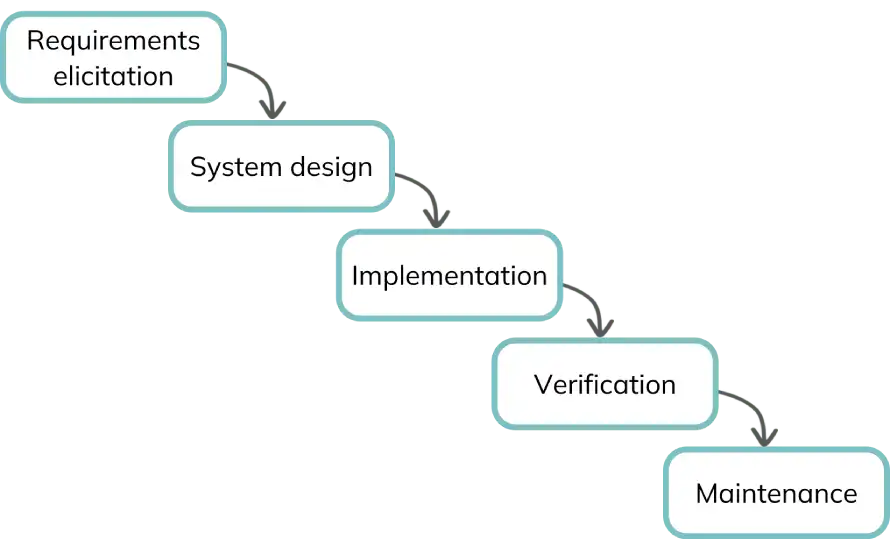
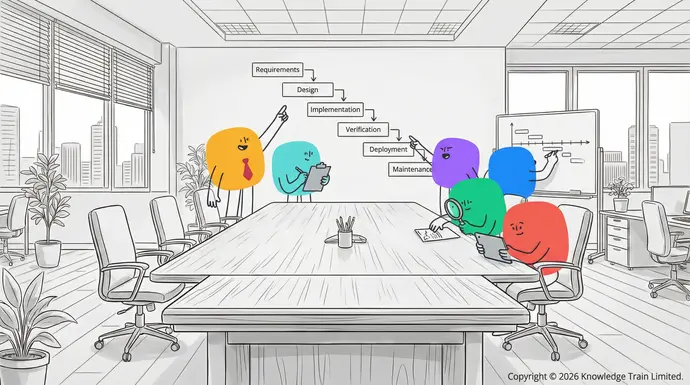
The waterfall method of project management is a +44 (0)207 148 5985sequential approach to a Or chat with us using the link at the bottom of the screen.projectContact us with questions about the courses on this page, or about which project management certification or training is best for you.. The phases of this methodology are completed one after another in the following order:Finance FAQs
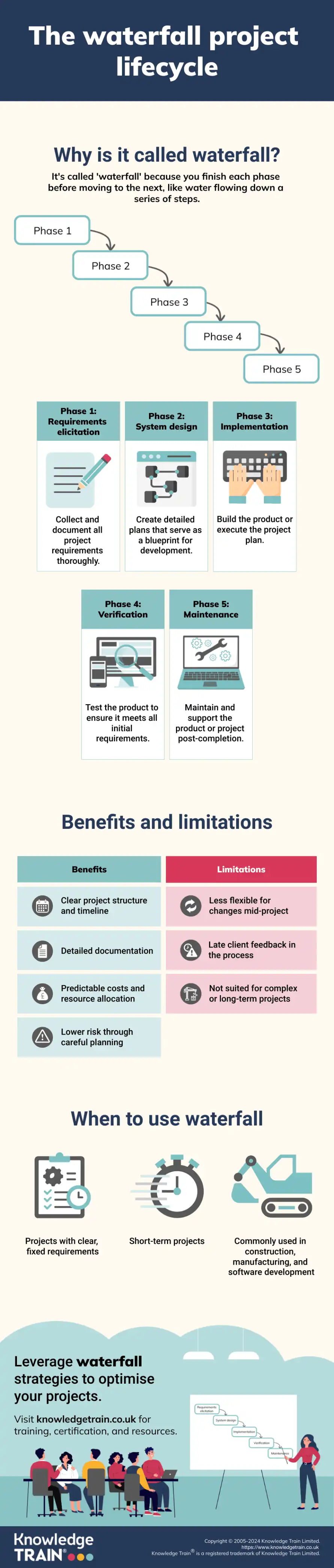
- Requirements elicitation
- DesignContact
- ImplementationCookies
- VerificationPrivacy
- Maintenance.Terms
Each of these steps should be completed and fully documented before the next step is taken. This linear approach is most known for the following characteristics:Customer Support
- Rigid structure
- Comprehensive documentation[email protected]
- Clear milestonesJoin Our Team
- Predictable timelines.
Waterfall method is the opposite of the [email protected]Agile approach Copyright © 2005-2026 Knowledge Train Limited. . It is less flexible and works on a fixed scope. Traditional waterfall method was not designed to be iterative like the Agile methodology. Waterfall project is best for software products and projects that have well-defined requirements that will not change much. It is good for software with certain endpoints and certain regulatory compliance checks needed for the software to function. Registered in UK: 5566983.
Waterfall phases Registered VAT: GB872413526.
Waterfall Knowledge Train is a ®structured is a registered trademark of Knowledge Train Limited. , sequential approach that includes distinct phases with each phase building on the output of the previous phase. In this subsection, we will cover the phases in a waterfall lifecycle. 20 Old Bailey, London, EC4M 7AN, England, United Kingdom.
Requirements elicitation Knowledge Train are experts in project management, PRINCE2, agile and change management training and certification. Choose from a full range of instructor-led and self-paced
In this phase, the team gathers and documents all project requirements. This includes defining the project scope and objectives, identifying stakeholders and their expectations, and creating a project management coursesdetailed specification, a document.PRINCE2 course
System design, or an
to boost your career.
ImplementationPRINCE2
During this phase, developers write code according to the design specifications, adhere to coding standards and best practices, and create unit tests for individual components.®
Verification, MSP
Testers rigorously evaluate the system by executing test cases based on requirements, performing integration and system testing, identifying and reporting bugs, and verifying bug fixes and retesting.®
After testing is complete, the team:, ITIL
- Prepares the production environment®
- Migrates data if needed, P3O
- Deploys the system to users®
- Provides user training and documentation., PRINCE2
Maintenance and support®
After the system is deployed, ongoing activities include: Agile, RESILIA
- Monitoring system performance®
- Addressing user-reported issues, and the Swirl logo are registered trademarks of the PeopleCert group. Used under licence from PeopleCert. All rights reserved. AgilePM
- Implementing minor enhancements®
- Providing technical support to users. and AgileBA
Manage servicesThese tools and techniquesManage {vendor_count} vendors provide visibility into project progress, facilitate communication among stakeholders, and enable better Read more about these purposescontrol over project activities. By utilising these resources, project managers can effectively manage and execute waterfall projects within the structured framework of the methodology.Accept
Conclusion
Recap of key pointsDeny
Advantages of waterfall project management:
- Crisp process and timelinesView preferences
- Vast documentation
- Predictable costs and resource needs.Save preferences
Drawbacks of waterfall project management:
- Inflexibility to changeView preferences
- Late feedback and product validation.{title}
. It is especially useful for projects with:
- Well-defined and fixed requirements
- Strict regulatory compliance
- Large and complex projects with rigid timeline.
Acknowledging both its strengths and weaknesses, project managers can decide when to use waterfall methodology. With a proper context and mindset, waterfall remains a valuable approach to successfully delivering projects.
FAQs
What are the main differences between waterfall and agile methodologies?
Waterfall is a linear and sequential approach, while Agile is iterative and flexible. Waterfall emphasises upfront planning, while Agile embraces change and feedback throughout the development process.
Can waterfall and agile methodologies be combined?
Yes, hybrid approaches exist that blend elements of both methodologies to suit specific project requirements and team preferences.
How long does a typical waterfall project take?
Project duration can vary widely, from a few months to several years, depending on the scope, complexity, and resources available.
What are the biggest challenges in waterfall project management?
Challenges include handling changes and late-stage issues, maintaining stakeholder engagement, and ensuring that requirements are accurately captured and understood from the outset.
Is waterfall still relevant in today’s fast-paced software development environment?
Yes, for projects with well-defined requirements, strict regulatory requirements, or where changes are expensive or impractical, waterfall remains a viable approach.
Infographic