Essential project management skillsUnited Kingdom

project management approaches, like Use or Reinforcementwaterfall to sustain new behaviours via celebration, metrics, regular reviews, and adaptive improvements., to inform the structure of your plan.
Effective time management techniques
Effective time management is crucial to maintaining control over a projectContents. Here are some techniques that you may want to utilise:
- Critical Path Method (CPM)
- Gantt chartsContents
- Time-boxing
- Progress tracking and reporting.Introduction to ADKAR
Risk management
Identifying potential risksFive elements of ADKAR
Risk management is an essential part of project managementImplementing ADKAR . To create a successful risk register, you should first identify possible threats to the project. Methods you could use include:
- SWOT analysisADKAR best practices
- Team brainstorming
- Review of similar past projectsConclusion
- Expert interviews.
Developing mitigation strategiesFAQs
As part of a good risk management strategy, you will need to develop risk responses. This involves determining an appropriate way to deal with each identified risk. The four main strategies are:
- Avoid: Remove the threat entirelyInfographic
- Mitigate: Decrease the likelihood or impactIntroduction to the ADKAR model
- Transfer: Allocate the risk to a third partyUnderstanding change management
- Accept: Recognise and monitor the risk.In today’s constantly changing organisational landscape,
Budgeting and cost controlchange management
Creating and managing project budgets is crucial. Organisations must adapt to remain competitive and relevant.
Accurate budgeting is vital for financial success. Consider these steps:Change management
- Estimate costs for each project element provides a structured approach to transitioning individuals, teams, and whole organisations from a current state to a desired future state. The goal is to minimise resistance and maximise engagement. Here, the
- Add contingency for unexpected expensesADKAR
- Get stakeholder approval for the budget model shines as a strategic framework. It offers a clear, step-by-step process that leaders can use to guide their teams through change effectively.
- Set a baseline for future comparisons.Origins and purpose of ADKAR
Monitoring and controlling expensesThe ADKAR model was developed by Jeff Hiatt, founder of Prosci, through research conducted from 1994 to 2002. This research analysed the change patterns of over 700 organisations, leading to a practical, results-oriented approach to managing change at the individual level. Prosci’s research revealed that successful change occurs when
Monitor expenses to stay within budget:organisational change management
- Use Earned Value Management (EVM) and individual change management intersect. It comprises five key elements:
- Review costs regularlyAwareness
- Leverage , project management softwareDesire for real-time tracking,
- Act quickly on variances to avoid overruns.Knowledge
Quality management,
Implementing quality assurance processesAbility
Ensure project deliverables meet required standards by:, and
- Defining clear quality metricsReinforcement
- Performing regular quality audits. Each element represents a milestone that individuals must achieve to embrace and sustain change thoroughly.
- Conducting peer reviews and inspectionsAwareness
- Using quality control tools (e.g., Pareto charts, control charts).: Recognising the need for change.
Continuous improvement strategiesDesire
Promote a culture of continuous enhancement:: Building the motivation to participate.
- Perform post-project reviewsKnowledge
- Encourage team feedback and : Acquiring the necessary information and skills.lessons learnedAbility
- Implement process improvements based on insights: Implementing new skills and behaviours.
- Stay informed on industry best practices.Reinforcement
By refining these technical project management skills, professionals can enhance their capabilities and increase the likelihood of delivering successful : Sustaining the change over time.projectsThese elements work in sequence, with each building upon the previous ones. For instance, it’s difficult to create genuine desire for change without first establishing awareness of why the change is needed. Similarly, knowledge can only be effectively absorbed once someone has the desire to learn. This sequential nature is crucial for successful implementation..This model’s purpose is to facilitate a smooth transition by focusing on the psychological aspects of change. By addressing these individual milestones, the ADKAR model reduces stress and enhances overall productivity. Its structured approach ensures that all critical elements of change are methodically covered, minimising confusion. Consequently, organisations can navigate the challenges of transformation with greater confidence and success.
Leadership and interpersonal skills: Conduct workshops to discuss the change, allowing for questions and feedback.
Project managers need to have These strategies help reduce uncertainty and foster a positive outlook towards change.strong leadershipElement 2: Desire and interpersonal skills, apart from the hard-core technical skills.The
CommunicationDesire
Verbal and written communication techniques element involves cultivating the motivation to participate in the change. It requires addressing both rational and emotional aspects to inspire individuals to engage willingly.
Effective communication is the foundation of successful project management. Enhance your verbal and written communication techniques by:Creating desire for change
- Tailoring your message to your audience and purposeTo inspire desire, organisations can:
- Utilising concise language and avoiding jargon or technical termsHighlight benefits
- Incorporating visual aids or graphics to emphasise key points: Clearly articulate the personal and organisational benefits of the change.
- Practising public speaking and presentation skills to deliver information clearly and confidently.Engage employees
Active listening and feedback: Involve them in planning and decision-making processes to create a sense of ownership.
Communication is a two-way process, and active listening plays a vital role in effective communication. Hone your active listening and feedback skills by:Recognise contributions
- Paying attention to the speaker without interruptions: Acknowledge and reward early adopters and change champions to motivate others.
- Asking clarifying questions to ensure understandingMeasuring desire levels
- Summarising the main points to confirm comprehensionUnderstanding the level of desire is essential for gauging readiness. This can be achieved through:
- Providing constructive feedback in a timely manner to facilitate improvement.Surveys and feedback
Team management: Gather input on employee sentiments towards the change.
Delegation and task assignmentObservation
Efficient team management often involves delegating tasks and responsibilities. Master the art of delegation and task assignment by:: Monitor engagement levels during change-related activities.
- Evaluating team members’ strengths, weaknesses, and workloadsInterviews
- Aligning tasks with individual skills and expertise: Conduct one-on-one discussions to explore individual concerns and motivations.
- Providing clear instructions, deadlines, and expectationsAssessing desire helps tailor support and interventions, ensuring greater engagement. It’s crucial to understand that while organisations can create an environment that fosters desire, the ultimate decision to participate in the change is a personal choice that cannot be forced. Leaders can influence desire by addressing the question ‘What’s in it for me?’ (WIIFM) but must recognize that genuine commitment cannot be mandated.
- Establishing accountability and setting up follow-up mechanisms for progress monitoring.Element 3: Knowledge
Motivating and inspiring team membersThe third element of ADKAR addresses the practical aspects of change implementation. The
A motivated team is more likely to be productive and engaged. Learn how to motivate and inspire team members by:Knowledge
- Recognising and celebrating individual and team achievements element focuses specifically on how to implement the change. This includes two critical types of knowledge: understanding how to change (the required skills, processes, and behaviours) and what to do during the transition state. This goes beyond just sharing information – it requires detailed training on new processes, systems, and roles that will be part of the change.
- Offering opportunities for professional growth and developmentKnowledge acquisition
- Encouraging open communication, collaboration, and idea-sharingTo facilitate knowledge acquisition:
- Leading by example with enthusiasm, commitment, and a positive attitude.Structured training
Conflict resolution: Provide comprehensive training programmes tailored to different learning styles.
Identifying and addressing conflictsMentorship
Conflicts are inevitable in teams, but effective conflict resolution can prevent them from escalating. Develop your conflict resolution skills by:: Pair employees with mentors to offer guidance and support.
- Recognising early warning signs of conflicts or disagreementsSelf-paced learning
- Addressing conflicts promptly and directly: Use e-learning platforms for flexible, on-demand knowledge access.
- Encouraging open and respectful communication between conflicting partiesTools for knowledge transfer
- Remaining impartial and focusing on finding mutually beneficial solutions.Effective tools include:
Negotiation and mediation techniquesWorkshops and seminars
Conflicts often require negotiation and mediation skills to reach a resolution. Acquire the necessary techniques by:: Offer hands-on experience and practical insights.
- Practising active listening to understand all perspectives involvedKnowledge repositories
- Identifying common ground and shared interests: Maintain accessible databases for quick reference.
- Proposing creative solutions that can benefit all partiesPeer learning
- Seeking win-win outcomes whenever possible.: Encourage knowledge sharing through peer networks.
Conflict resolutionThese tools ensure that employees have the required knowledge to succeed.
Identifying and engaging stakeholdersElement 4: Ability
Stakeholders play a critical role in project success, so it’s essential to manage them effectively. Learn to identify and engage stakeholders by:The
- Conducting a comprehensive stakeholder analysisAbility
- Developing a stakeholder engagement plan outlining communication strategy element represents the actual execution of the change – turning knowledge into action. Whilst Knowledge is about understanding how to change, Ability is about demonstrating performance in real-world conditions. This element often requires time for practice, coaching, and feedback as people develop proficiency in new skills or behaviours. Success in this element is measured by actual performance rather than just completing training.
- Establishing regular and appropriate communication channelsDeveloping ability
- Involving key stakeholders in decision-making processes when applicable.Developing ability involves:
Managing expectations and relationshipsPractical training
Maintaining positive stakeholder relationships is key to successful project management. Hone your skills in managing expectations and relationships by:: Conduct real-world exercises to build confidence.
- Clearly communicating project goals, timelines, and constraintsFeedback loops
- Providing regular updates on project progress, achievements, and challenges: Provide constructive feedback to refine skills.
- Promptly addressing concerns, issues, and expectationsSupportive environment
- Actively seeking feedback and incorporating valuable suggestions whenever possible.: Create a culture that encourages experimentation and learning.
By refining leadership and interpersonal skills, Training and support systemsproject managersTraining and support systems are vital for ability development: can create a positive team environment, foster collaboration, and lead projects to success through effective communication and stakeholder management.Ongoing training
Business acumen and strategic thinking: Offer continuous learning opportunities.
Effective project managers also have a deep understanding of business principles and strategic thinking. These competencies allow project managers to align projects with organisational objectives and drive value.Access to resources
Understanding organisational goals and objectives: Ensure availability of tools and materials needed for skill application.
Project managers can align their efforts with organisational success by:Peer support
- Becoming familiar with the organisation’s mission and vision: Foster a network of colleagues who can offer assistance and advice.
- Keeping up-to-date with industry trends and market conditionsThese systems bolster the ability to adapt successfully.
- Recognising the competitive landscape of the organisationElement 5: Reinforcement
- Periodically reviewing financial statements and key performance indicators (KPIs).The
Aligning projects with business strategyReinforcement
Ensuring that projects support the overall business strategy is crucial: element ensures that changes are sustained over time.
- Identify how each project aligns with and contributes to strategic goalsSustaining change
- Prioritise projects based on their strategic importanceTo sustain change:
- Communicate the strategic value of projects to stakeholdersCelebrate successes
- Adjust : Recognise achievements to reinforce positive behaviour.project plansContinuous feedback as necessary when business strategies change.: Provide regular updates and feedback to maintain momentum.
Decision-making and problem-solvingAdjust strategies
Technical proficiencyEvery organisation is unique, so customising the ADKAR model to fit specific needs is essential. Begin by analysing the organisational culture and existing processes. This understanding will guide how each element of the model is tailored.
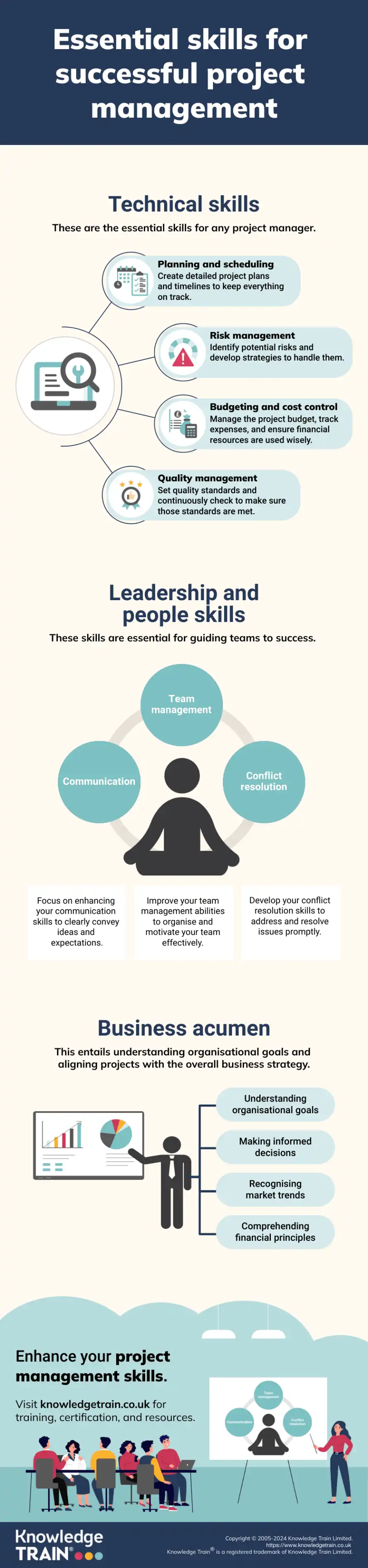
To efficiently work on projects as well as to effectively lead and manage teams, project managers need to have technical skills that are relevant to the digital world of today.Awareness
Project management software and tools: Adapt communication strategies to suit the organisation’s culture, ensuring messages resonate with employees.
Popular project management software optionsDesire
Familiarise with the top software tools used for project management. Some of the most popular ones are:: Identify key motivators for different employee groups and leverage these to build desire.
- Technical skills
- Leadership skills{"@context":"https://schema.org","@type":"ImageObject","contentUrl":"https://www.knowledgetrain.co.uk/training-courses/change-management-model-adkar-infographic-890x501.webp","description":"ADKAR change management model.","license":"https://www.knowledgetrain.co.uk/license","acquireLicensePage":"https://www.knowledgetrain.co.uk/license","creditText":"Knowledge Train","uploadDate":"2023-05-16T09:46:07.000Z","copyrightNotice":"© 2023 Knowledge Train Limited. All rights reserved.","creator":{"@type":"Organization","name":"Knowledge Train","url":"https://www.knowledgetrain.co.uk"}}