Project management lessons learnedDenmark

Key takeaways
A structured lessons learned cycle turns project experience into repeatable improvements.Simon Buehring
- Capture lessons in real time, at phase ends, and at project close to avoid losing detail.28 Apr 2026
- Use neutral facilitation, surveys, and focused questions to surface honest insights without blame.
- Standardise documentation with templates, input forms, and executive summaries so lessons stay usable.
- Analyse for root causes and patterns, then convert findings into specific, measurable actions.
- Store lessons in a central, searchable repository and review them at project kick-off to ensure reuse.
- Track impact with KPIs such as reuse rates, fewer repeat issues, and improved delivery outcomes.

Introduction
In the world of project management, one key element that often distinguishes success from failure is the ability to extract and apply valuable insights from past experiences. This practice, known as Business analysis: definition and overviewlessons learned , involves the identification, analysis, and subsequent utilisation of experiences to better inform future actions and decision-making.The objectives and value of business analysis
By leveraging the knowledge gained from past mistakes and successes, organisations and project managers can significantly improve their project outcomes, reduce risks, enhance team performance, and increase overall efficiency. In this article, we will embark on a comprehensive explorationKey responsibilities of a business analyst of lessons learned, delving into the process of their identification, documentation, analysis, storage, and application, as well as best practices and potential challenges..
After completing this reading, you will have a complete understanding of how to successfully incorporate a lessons learned system into your organisation, paving the way for continuous improvement and Main business analysis processesproject success.Common business analysis techniques
The lessons learned process
The lessons learned process is a structured approach designed to help project teams capture, document, analyse, and utilise valuable insights from past experiences. By adhering to this methodical process, project managers and their teams can enhance their project performance, learn from past mistakes, and increase the probability of project success.Business analysis tools and methodologies
Five steps of the lessons learned process
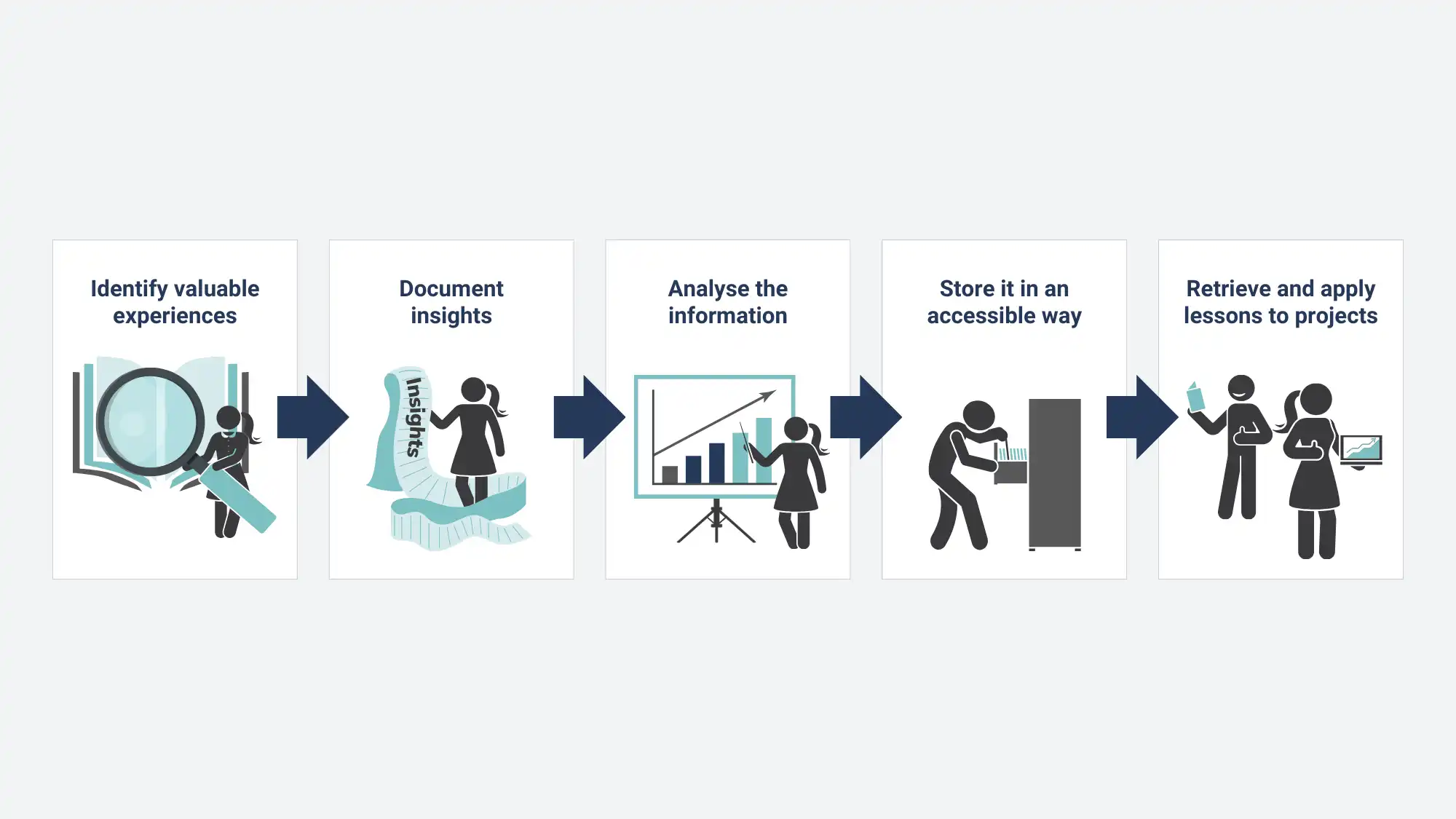
Essential skills and competencies for business analystsLessons learned process diagram
- IdentifyCertification and career progression: The first step in the process involves recognising and pinpointing valuable experiences and insights throughout the project life cycle. It is crucial to encourage team members to note successes and challenges as they occur.
- DocumentRelated concepts: Once identified, these lessons must be recorded in a clear, concise, and accessible manner, usually by using standardised templates or forms.
- AnalyseFAQs: The documented lessons should then be examined to understand the root causes, identify patterns, and determine potential implications for future Business analysis: definition and overviewprojectsBusiness analysis. is a professional discipline that involves understanding business needs and problems, eliciting and documenting requirements, and proposing solutions that drive
- Storeprocess improvement: The analysed lessons should be stored in a centralised, easily accessible location, such as a database, shared drive, or specialised knowledge management system. and deliver value. It acts as a bridge between stakeholders and technical teams, ensuring that strategic objectives are aligned with operational execution. Reputable bodies such as the
- RetrieveInternational Institute of Business Analysis (IIBA): Finally, the lessons should be retrieved and applied to current or future projects as needed. This step is essential to ensure the full value of the lessons learned process is realised. define business analysis as the practice of enabling change in an organisational context by defining needs and recommending solutions that yield benefits for key stakeholders.
When to capture lessons learnedThe objectives and value of business analysis
Capturing lessons learned is most effective when done at the following times:Identifying business needs and opportunities for improvement
- End of projectSupporting stakeholders in achieving strategic goals: Conducting a comprehensive review at the conclusion of the project allows for a holistic evaluation of the entire project life cycle. This timing can provide valuable insights into overall project performance and outcomes.Facilitating
- End of each phasechange management: Reviews at the end of each project phase enable teams to capture fresh insights and lessons while the information is still clear in everyone’s minds. processes
- Real-time learningReducing project risk through clear requirements and solution assessment: Encouraging the ongoing capture of lessons as they occur can help prevent valuable insights from being lost due to time lapses or fading memories.Ensuring solutions are feasible, cost-effective, and aligned with business requirements
By adhering to this structured approach and capturing lessons at these strategic moments, project teams can establish a robust knowledge base. This resource will be invaluable for improving project management practices, enhancing decision-making, and increasing the likelihood of project success.Business analysts enable informed decision-making, increase process efficiency, and help organisations remain competitive.
Remember, the lessons learned process is not a one-time event but a continuous cycle of improvement. Regularly practising and refining this process can lead to substantial advancements in Key responsibilities of a business analystproject management capabilitiesThe and overall organisational performance.business analyst
Identifying lessons learned plays a critical role throughout project lifecycles and change initiatives. Their main responsibilities include:
Effective identification of lessons learned is a crucial step in capitalising on the value of project experiences. This process requires careful preparation and skilled facilitation of lessons learned sessions.Requirements elicitation:
Preparing for lessons learned sessions Facilitating workshops, interviews, and surveys to gather needs from stakeholders
Project surveysRequirements documentation:
Before the session, team members should be asked to complete Creating clear business and technical requirements using various formats (e.g., project surveysuser stories. These surveys are designed to encourage reflection on project experiences and gather initial thoughts on successes, challenges, and other aspects of the project. They will also provide a foundation for more in-depth conversations during the lessons learned session., use cases)
Categorising lessons learnedGap analysis and feasibility studies:
Lessons should be organised into specific categories to help with analysis and future retrieval. Common lesson categories include: Assessing current and desired future states to highlight improvements and evaluate solution viability
- Project management processesStakeholder engagement:
- Technical challenges Communicating with diverse stakeholders to ensure requirements are validated and aligned
- CommunicationProcess mapping and
- Resource allocationbusiness process modelling
- Risk management:. Visualising workflows for process improvement opportunities
Conducting lessons learned sessionsSolution assessment and validation:
Facilitation techniques Reviewing proposals to ensure solutions address documented
Facilitating productive lessons learned sessions can be achieved by using the following techniques:requirements
- Employ a neutral facilitator to maintain objectivity and deliver value
- Encourage open and honest communicationChange management
- Use brainstorming techniques to generate ideas:
- Utilise visual aids such as mind maps or whiteboards to stimulate discussion and ideation. Supporting the transition of solutions into the business and managing effects on people and processes
Key questions to askMain business analysis processes
Facilitating deliberations can be guided by using the following essential questions:Process
- What went well in the project?Description
- What challenges did we face?Requirements elicitation
- How did we overcome these challenges?Gathering information from stakeholders using interviews, workshops, observation, and document analysis
- What would we do differently next time?Requirements documentation
- What unexpected events occurred, and how did we handle them?
By focusing on these questions, you can elicit valuable insights from your team members. Remember to create an environment where all participants feel comfortable and safe to share their experiences and observations.
ating recommendations for future use.Proficiency in process improvement and data analysis
Techniques for analysing lessons learned dataCertification and career progression
There are various approaches to maximise the value from your lessons learned data. Consider these techniques:BCS
- Root cause analysis : Delve deep to uncover the underlying reasons for successes and failures. offers globally recognised certifications, such as
- SWOT analysisBusiness Analysis Foundation: Identify Strengths, Weaknesses, Opportunities, and Threats that the lessons highlight.,
- Pareto analysisInternational Diploma in Business Analysis: Prioritise the 20% of factors that led to 80% of results., Practitioner certificates in
- Affinity diagrammingRequirements Engineering: Group related lessons to identify common themes.,

Modelling Business ProcessesSWOT analysis diagram, and
Identifying trends and patternsBusiness Analysis Practices
Search for recurring themes across several projects or stages. This can include comparing lessons from similar project types, looking at lessons across different timeframes, or analysing lessons by project role or department..
Consider using data visualisation tools like charts or heat maps to make these patterns more visible.The
Generating actionable insightsInternational Institute of Business Analysis (IIBA)
Once you’ve done the analysis, turn those insights into actionable recommendations: offers globally recognised certifications, such as ECBA, CCBA, and CBAP, based on the
- Prioritise insights based on potential impact and ease of implementation.BABOK Guide
- Create specific, measurable actions to address issues or replicate successes..
- Map the insights to existing processes or methodologies in your organisation.Certifications
- Set up a feedback loop to monitor how effective the implemented recommendations are. demonstrate expertise in requirements elicitation, stakeholder management, and business analysis best practices. Aspiring business analysts may also pursue
Remember that the point of the analysis is not just to understand what happened, but to shape future decisions. By using these techniques, you can take lessons learned from past projects and turn them into tools for improvement. This level of analysis and critical thinking will allow your organisation to continually adapt its project managementproject management approach or based on real-life experiences.change management qualifications
Storing and retrieving lessons learned to support broader career progression.
To effectively use lessons learned, you must have a system for storing and retrieving them. This section provides guidance on setting up an efficient process.Related concepts
Creating a centralised lessons learned repositoryProject management
A Requirements engineeringcentral repositoryChange management should be the single source of truth for all lessons learned in your organisation. When building this repository, it’s important to choose a platform that works well with your existing Quality assuranceproject management toolsSystems analysis. Use a consistent structure and categorisation system, so the lessons are well-organised. Plan for the repository to be scalable so you can add new projects and insights over time.FAQs
Implementing effective search and retrieval systemsWhat is business analysis?
Make sure that lessons are easily discoverable. This can be done by implementing a good search function with filters based on project type, date, and category. Use a tagging system to identify key themes and topics, which will allow users to find relevant information quickly. You can also add an option for users to rate the usefulness of a lesson to help surface the most valuable insights. These features will help increase the accessibility and usefulness of the stored knowledge.Business analysis is the systematic investigation and evaluation of business needs to recommend solutions that achieve organisational objectives. It includes requirements gathering, stakeholder engagement, and process optimisation.
Ensuring accessibility and usability of stored lessonsWhat does a business analyst do?
Encourage everyone to use the lessons learned repository by making it accessible and easy to use. This includes creating user-friendly interfaces on both desktop and mobile platforms. Role-based access control can help protect sensitive information while still providing appropriate access. Regularly curate the content to keep it up-to-date and valuable. Conduct training sessions on how to use the repository so that everyone can get the most out of this resource.A business analyst identifies business problems, elicits requirements, engages stakeholders, and ensures that proposed solutions align with business goals. They act as a bridge between business and IT functions.
Creating a well-organised, easily searchable, and accessible repository will ensure your organisation can effectively leverage past experiences. This will turn lessons learned from being static records into resources that actively improve decision-making and project outcomes across your organisation.What are the key techniques in business analysis?
Leveraging lessons learned for future projectsCommon
The real power of lessons learned lies in how they are applied to future projects. In this part, we’ll explore strategies and techniques for leveraging lessons learned effectively to improve project outcomes and drive organisational success.business analysis techniques
Incorporating lessons learned into project planning include
Incorporating lessons learned into your SWOT analysisproject planning, gap analysis, requirements elicitation, process mapping, use case modelling, and stakeholder analysis. process is a crucial step in ensuring that past experiences inform future work. To do this, review relevant lessons learned when starting a new project. Make a What are the main types of requirements in business analysis?lessons learned review Business analysts work with a standard part of project kick-off meetings and assign team members to research and present applicable lessons to the group. This practice ensures that lessons learned are not just documented but actively inform your project strategies.business requirements
Update project templates and checklists based on lessons learned to embed these insights into your standard operating procedures. (organisational goals),
Sharing lessons learned across the organisationstakeholder requirements
Maximising the value of lessons learned involves creating a culture that values , and knowledge sharingtechnical requirements and continuous learning. Establish regular forums or platforms for teams to exchange and disseminate key lessons learned. Integrate lessons learned into training programmes and new employee onboarding processes to spread valuable insights across the organisation. (system or IT needs).
Encourage and reward individuals and teams that actively apply and share lessons learned to reinforce their importance.What is the BABOK?
Continuous improvement through lessons learnedBABOK refers to the Business Analysis Body of Knowledge, a globally-accepted standard containing best practices, techniques, and competencies for business analysis, maintained by IIBA.
Continuous improvement is key to organisational growth and development. Implement a feedback loop to track the effectiveness of applied lessons learned. Regularly review and update your lessons learned repository to ensure it remains relevant and useful. Encourage teams to challenge existing practices and standards based on new insights and insights to promote innovation and adaptation.What qualifications or certification should a business analyst have?
Organisationally, use lessons learned data to inform strategic decision-making, ensuring that the company’s direction is shaped by real-world experiences and outcomes.Common
By actively leveraging lessons learned, you can turn past experiences into valuable assets for future success. This proactive approach to project management not only improves individual project outcomes but also cultivates a culture of continuous learning and improvement throughout the organisation.certifications
Remember, collecting lessons is just the first step; the real value lies in how you apply them systematically to drive tangible improvements in include BCS’s Business Analysis Foundation certificate, project practicesInternational Diploma in Business Analysis and outcomes., and Practitioner certificates in Business Analysis Practices, Requirements Engineering, and Modelling Business Processes.
To maximise the value of your lessons learned process, consider making it a continuous activity throughout the project lifecycle, rather than a one-time event. Involve all stakeholders in the lessons learned process, not just the project team, to gain a more comprehensive perspective. Use a variety of methods to collect lessons, such as surveys, interviews, and workshops, to capture a diverse range of insights. Ensure that documented lessons are specific, actionable, and relevant to future
FAQs
How often should lessons learned sessions be conducted?
Ideally, at the end of each project phase and upon project completion. For longer projects, consider quarterly sessions to capture insights while they’re fresh.
What’s the difference between lessons learned and project post-mortems?
Lessons learned focus on ongoing improvement throughout the project lifecycle. Post-mortems typically occur at project end and may have a broader scope, including overall project performance evaluation.
How can we encourage team members to actively participate in lessons learned sessions?
Create a blame-free environment, emphasise the value of learning, and demonstrate how insights are applied. Consider using anonymous submission methods for sensitive topics.What is a business analyst?
What are some effective tools for capturing lessons learned in real-time?
Project management softwareSimon Buehring with built-in features, dedicated mobile apps, or simple shared documents. The key is accessibility and ease of use for team members.19 Feb 2026
How can we ensure lessons learned are actually applied to future projects?
Integrate lessons review into project kick-off meetings, update project templates based on learnings, and assign responsibility for implementing specific lessons.Discover what a business analyst does and how they are pivotal in achieving company goals. Learn more about the role's importance here.
What role does leadership play in promoting a culture of lessons learned?
Leaders should actively participate in sessions, allocate resources for the process, and visibly apply insights in decision-making to demonstrate the value of lessons learned.
How can we make lessons learned sessions more engaging and productive?
Use varied formats like workshops or gamification, focus on specific themes, and ensure sessions result in actionable outcomes to maintain engagement.
What are some common pitfalls to avoid when implementing a lessons learned process?
Avoid treating it as a checkbox exercise, neglecting to follow up on actions, or allowing sessions to become blame games. Ensure the process is consistently applied across all projects.
Infographic
