
Key takeaways
Choose and run frameworks as adaptable structures that fit your project and organisation, not as rigid rules.
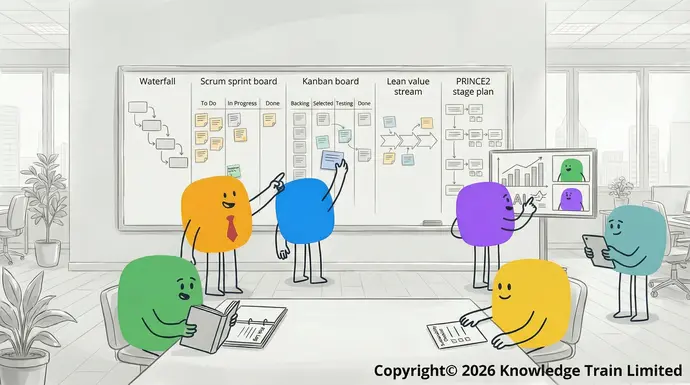
- Whether you’re starting your BA career or shaWaterfall is a sequential project management framework that progresses through a series of phases, such as requirements, design, implementation, verification, and maintenance. In the waterfall framework, each phase must be completed before the next one can begin, and testing is performed at the end of the project.
Pros and consrpening your skills for agile delivery, we make it easy to learn with confidence.
- Pros: Easy to understand, well documented Clear qualification routes
- Cons: Inflexible, difficult to change requirements, testing is performed too late.
Best use cases Choose a route that fits your role, with a clear pathway from beginner to advanced learning.
- Waterfall can be used for software development Expert trainers, practical learningprojects , where the requirements are well-understood and unlikely to change during the project, or for hardware development projects, such as those in the automotive industry. Learn from experienced trainers who keep the focus on real business analysis scenarios.
Agile frameworks Support throughout your learning
Scrum
Definition and key characteristics Get guidance and resources to help you stay on track from start to completion.
- Scrum Flexible study options is an iterative Agile framework for developing and delivering products. In Scrum, projects are divided into sprints, typically lasting two to four weeks, during which a minimum viable product (MVP) is developed and delivered.
Pros and cons Choose study options available across many courses, with clear routes to help you decide.
- Pros: Flexible, focuses on collaboration, fast delivery of working products Quality learning materials
- Cons: Requires skilled and experienced team members, difficult to scale.
Best use cases Use learning resources designed to build understanding quickly and help you apply what you learn.
- Scrum can be used in software development projects, product development projects, and other projects where the requirements are not well-defined or where there is a need for frequent updates and client feedback. Team training for organisations
Kanban
Definition and key characteristics Run private BA training for your team, aligned to your context, goals and timeline.
- Kanban is an Agile framework that visualises the workflow and helps teams optimise work in progress (WIP) by using a board with cards representing tasks or work items.
Pros and consTrusted by professionals at
- Pros: Visualise workflow, reduce WIP, increase efficiency
- Cons: May lack structure for complex projects, requires discipline to maintain.
Best use cases
- Kanban can be used in projects where work is continuous and there is a steady stream of tasks to be completed, such as support or maintenance work, or in projects where teams are trying to improve their current processes and workflows.
LeanFAQs
Definition and key characteristicsWhich business analysis qualification should I choose?
- Lean is a framework that aims to optimise value while minimising waste in project processes, with a focus on streamlining and simplifying the project workflow.
It’s important to note that these are just some of the most popular I work in agile teams - do I still need "traditional" business analysis?project management frameworks, and that there are many other frameworks available that may be more suitable for your specific project or organisation.
Choosing the right project management framework
Selecting the appropriate project management framework for your organisation is essential for successful project delivery. It provides a structured approach, guiding you through the various stages of a project. This article explores factors to consider when choosing a framework and provides a six-step process to help you make an informed decision.
Factors to considerName
- Project complexity and size : Larger projects may benefit from more structured frameworks like PRINCE2Phone, while smaller or less complex projects can thrive under Agile methodologies .Email
- Industry and technological environment : Consider the specific requirements of your industry and the technological landscape. Some sectors may demand more rigorous documentation and regulatory compliance, influencing your framework choice.
- Team experience and preferencesSubmit
. Research to see if there are any industry-specific frameworks that may benefit your organisation.
How can I measure the effectiveness of a project management framework?
You can measure the effectiveness of a project management framework by tracking key performance indicators (KPIs) such as project success rates, adherence to project timelines and budgets, stakeholder satisfaction, and team productivity.
What role does technology play in implementing a project management framework?The technical storage or access is strictly necessary for the legitimate purpose of enabling the use of a specific service explicitly requested by the subscriber or user, or for the sole purpose of carrying out the transmission of a communication over an electronic communications network.
Technology plays a crucial role in implementing a project management framework. Project management software can help automate processes, facilitate communication, and provide real-time data for better decision-making. Choose software that aligns with your chosen framework and meets your organisation’s needs.