Key takeaways
Strong project delivery depends on combining technical competence with human-centred skills.Key takeaways
- Soft skills such as communication, leadership, teamwork and problem-solving are essential for keeping teams aligned and projects on track.Business analysis turns business needs into clear requirements and evidence-based decisions.
- Clear, regular, non-emotive communication and active listening reduce confusion, rework and avoidable failure.Business analysis aligns strategic goals with delivery by bridging stakeholders and technical teams.
- Conflict is inevitable, so set expectations early and address disagreements quickly before morale and productivity drop.Clear requirements and validation reduce project risk and improve solution fit, cost and feasibility.
- Influence and negotiation work better than authority when managing senior stakeholders and cross-functional priorities.Techniques like SWOT, gap analysis, process modelling and data analysis expose opportunities and bottlenecks.
- A proactive, positive attitude improves decision-making under stress and encourages openness about risks and issues.Embedding analysis in governance strengthens planning, transparency and measurable outcomes.
- Reducing project risk through clear requirements and solution assessment
- Problem-solvingEnsuring solutions are feasible, cost-effective, and aligned with business requirements – being able to identify and analyze a problem on a project and creatively pose a solution.Business analysts enable informed decision-making, increase process efficiency, and help organisations remain competitive.
- Positive attitudeKey responsibilities of a business analyst – being calm under stress, learning from mistakes, and building relationships.The
- Strong work ethicbusiness analyst – having discipline, integrity, professionalism, and punctuality. plays a critical role throughout project lifecycles and change initiatives. Their main responsibilities include:
- LeadershipRequirements elicitation: – guiding teams to achieve project goals through vision, direction, and effective decision-making. Facilitating workshops, interviews, and surveys to gather needs from stakeholders
- Critical-thinkingRequirements documentation: – the ability to evaluate facts and form a rational judgement. Creating clear business and technical requirements using various formats (e.g.,
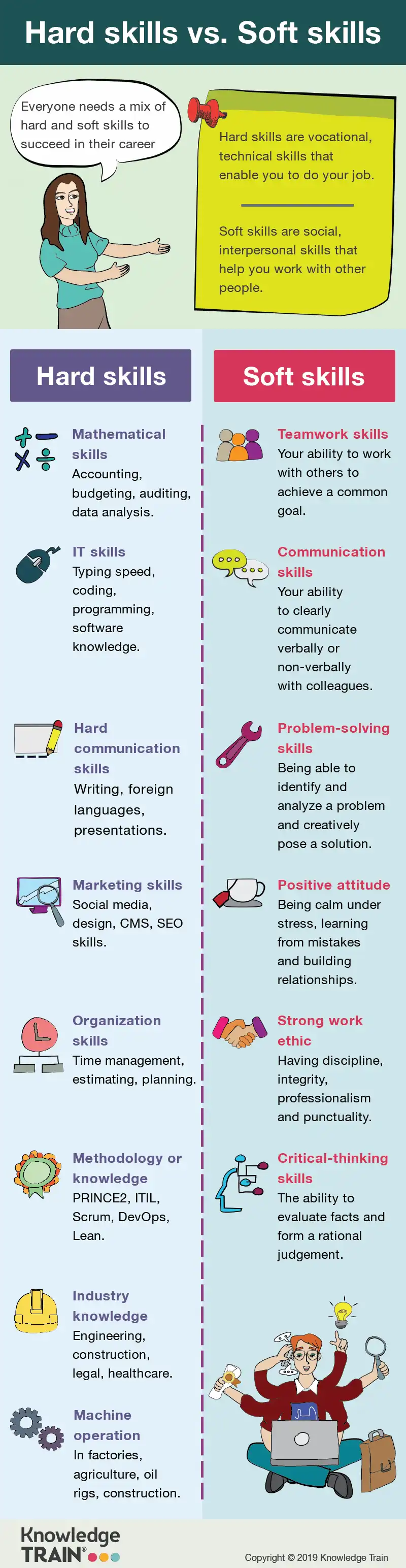
In contrast, project management hard skills are the technical skills and knowledge required to perform your job as a project manager. These skills are normally industry-specific and can be acquired through user storiesproject management courses, use cases) or on-the-job experience.Gap analysis and feasibility studies:
Here are some examples: Assessing current and desired future states to highlight improvements and evaluate solution viability
- Mathematic skills – accounting, budgeting, auditing, data analysis.Stakeholder engagement:
- IT skills – typing speed, coding, programming, software knowledge. Communicating with diverse stakeholders to ensure requirements are validated and aligned
- Hard communication skills – writing, foreign languages, presentations.Process mapping and
- Marketing skills – social media, design, CMS, SEO skills.business process modelling
- Organization skills – time management, estimating, planning.:
- Industry knowledge – engineering, construction, legal, healthcare. Visualising workflows for process improvement opportunities
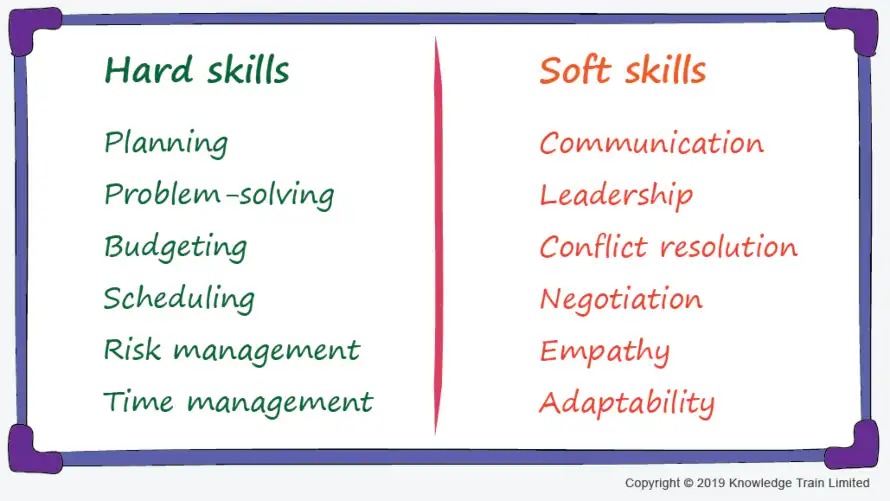
Both hard and soft skills are desired by employers when hiring project managers. Hard skills can be proved with a degree, diploma, apprenticeship, professional Solution assessment and validation:certification Reviewing proposals to ensure solutions address documented or other requirementsqualification and deliver value. However, project manager soft skills can be difficult to prove, so it’s essential to show-off such skills at interview and provide examples on your CV.Change management
Project management soft skills:
The work of project managers involves not only managing teams, and ensuring deadlines and budgets are met, but also working with stakeholders. When engaging with stakeholders, project manager soft skills will be sorely tested especially when dealing with senior people across functional boundaries. This can be extremely challenging when such senior people have a much higher level of authority than the project manager. Supporting the transition of solutions into the business and managing effects on people and processes
The Main business analysis processesAssociation for Project ManagementProcess (APM) in the UK recommends project managers have the soft skills listed below as core competencies.Description
CommunicationRequirements elicitation
Communication means relaying information or instructions to other people. It is a vital skill for project managers. Communication can be verbal or non-verbal but must be regular and accurate. The language used should be clear, objective and non-emotive. Listening is also a crucial part of communication.Gathering information from stakeholders using interviews, workshops, observation, and document analysis
Conflict managementRequirements documentation
Conflicts arise due to disagreement, conflicting values, and miscommunication. It causes teams to lack morale, productivity, and harmony. This can cause project failure, so conflict must be dissipated quickly. Conflict can be reduced by setting clear expectations at the start of the project.Capturing business and technical requirements in written formats, such as
Delegationuser stories
This is the act of giving team members responsibilities. It can be a way of motivating people to reach their full potential. , use cases, or requirement specificationsProject managersRequirements validation must know who has the correct skills, working style and knowledge for the work. Feedback and reward mechanisms should be implemented.Ensuring requirements are accurate, feasible, and aligned with business goals
InfluencingStakeholder engagement
Leaders must be good influencers. This skill involves affecting the behaviours and actions of the team and stakeholders. It’s better to influence rather than authoritative, so people become willing rather than obedient. This requires empathy and understanding. Influencers must also communicate their vision and generate positivity for the project.Building relationships with all parties affected by the change to ensure their needs are met
LeadershipProcess improvement
Project managers are leaders. They must inspire, direct, empower and influence their team. Transformational leadership is recommended. This is where leaders help the team succeed and become leaders themselves. They help the team transform and achieve more than was intended. They should mentor their team, celebrate success and constructive feedback should be a two-way thing.Analysing existing workflows and recommending enhancements for efficiency
NegotiationSolution assessment
This is when two parties try to reach an agreement. Negotiation usually occurs when agreeing project time, cost, quality, and scope with stakeholders, or signing contracts with suppliers. It also happens when resolving conflict. Good negotiators communicate well, control their emotions, set limits, listen to the other party, and know when to close the deal. They come prepared and know when to walk away.Evaluating potential solutions against requirements
TeamworkChange management
Teamwork is when a group work together towards a common goal. It works best when people with complementary skills, personalities and different strengths/weaknesses commit to an objective. Project managers must keep the team together via motivation, support, and communication of project goals.Supporting successful adoption of new processes or systems
What type of attitude do project managers need? Using quantitative and qualitative data to inform decision-making
It perhaps goes without saying that a positive attitude is best. Negative project managers create a lacklustre team with no passion for the project. He or she will be unable to influence, negotiate or inspire their team. They’ll panic when problems arise. And they’ll normally be at the centre of conflict.Business analysis tools and methodologies
Mariana Magalhães, Project Manager for Forty8Creates, believes a proactive attitude is essential:Key tools
Proactive leaders make things happen. They’re positive and learn from mistakes. They stay in control, even in stressful situations, and make rational decisions that help the project move forward. They give praise and deal with criticism constructively.Mind mapping and collaboration software
Reactive leaders are the opposite. They have a lack of control and wait for things to happen. They have no foresight and have a negative outlook. This type of attitude is useless on Data analysis tools (for example, Excel, Power BI)projectsMethodologies, where planning, control and decisiveness are vital.BABOK (Business Analysis Body of Knowledge):
How should project managers communicate? The leading global standard published by
, outlining best practices and techniques for business analysis
Nicci Beacham, Project Manager at Liberty Marketing, believes communication is key:Agile
Keeping communication open is vital. Building rapport with the team and stakeholders helps achieve this. Let people know they can come to you. If people feel unable to approach you with issues, they’ll keep information from you. This causes a breakdown in communication and damages the project.Problem-solving and solution assessment
Learning project manager soft skillsKnowledge of business and technical requirements
Some project managers seem born with the right skills for the job. They might naturally be more extroverted or adept at leadership. It’s true that being a more naturally outgoing or empathetic person makes you perfect for this role. But this doesn’t mean such skills can’t be learned.Proficiency in process improvement and data analysis
You can learn soft skills with:Certification and career progression
- Books or articlesBCS
- Training or coaching offers globally recognised certifications, such as
- Team-building exercisesBusiness Analysis Foundation
- On the job experience,
- TED Talks videos on YouTubeInternational Diploma in Business Analysis
Some of the soft skills required for , Practitioner certificates in project managementRequirements Engineering are briefly covered on courses like , APM PFQModelling Business Processes. This course is a great choice for anyone just starting a project-based career. It is recognized in all industries as proof of , and