
Key takeaways
Strong project managers read for frameworks, practical techniques, and the human side of delivery.Copied!
- Keep a core reference book on hand for standards and exam preparation, such as PMBOK and PRINCE2.Key takeaways
- Balance technical delivery guidance with books that focus on judgement, communication, and team dynamics.Kanban helps teams manage work visually, reduce waste, and improve delivery through steady flow.
- Use productivity methods to prioritise work and stay calm when plans change.Make work visible on a board so every character can spot progress, priorities, and problems quickly.
- Learn from software project classics that explain why adding resources can slow delivery.Use a pull system so new work starts only when there is capacity, preventing queues and overload.
- Explore narrative approaches like Critical Chain to apply constraints thinking without heavy theory.Set WIP limits per column to reduce multitasking and expose bottlenecks early.
Infographic
Learn the favourite books of the online project management communities.The 4 principles of Kanban
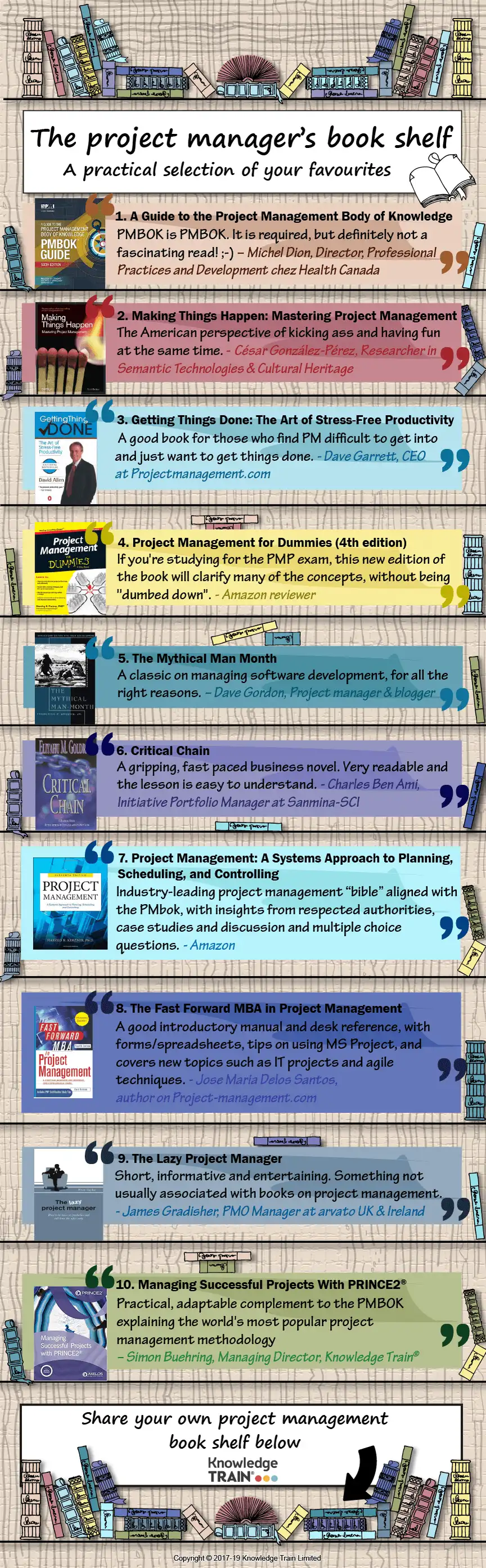
The thing that I found interesting while researching the best sellers on Amazon, reading reviews and talking to other project managers about their favourite project management booksConclusion – was the reason that project managers liked to read.Introduction
Although many of them come across as if they live and breathe Kanban is discussed on many project managementagile courses, some project managers stated that they enjoyed publications that were less technical and when project management wasn’t the primary topic. They enjoyed understanding people, general management approaches and sought to be entertained even when delving into a business subject., including a
The most mentioned book was the PRINCE2 Agile courseGuide to the Project Management Body of Knowledge (PMBoK) and , now in its 7th edition. Definitely a necessity but not the most entertaining choice!Agile Project Management course
Here we have selected the top-10 project management books from delving into discussions and scouring reviews, everything from heavy reference text books to soft-skills and fictional stories..
Book reviewsWhat is Kanban?
Take your pick and share what’s on your own project management book shelf!Developed by Toyota
Visualize your work on a board with cards to represent user stories (work) in your product backlog (inventory). Use colours to represent the theme of your – A fictional business novel that explores the Theory of Constraints principles and applies them to problems in project management, a follow-up to the author’s previous book ‘The Goal’. A nice text-book alternative!user stories
7. . For a simple Kanban board, label one column “TO-DO” and another “DONE”. Label columns in between “TO-DO” and “DONE” to represent either the type of work or whoever is responsible for undertaking it. Split these columns into two and label “Doing” and “Done”. Place the cards into columns depending on their workflow status. Doing this enables the whole team to view work in progress, work that has been completed and work to be started next. As work gets completed, move your cards from left to right.Project Management:Top tip: A Systems Approach to Planning, Scheduling and Controlling (Harold R. Kerzner) – The eleventh edition of this book states to be even more aligned to the PMBokKeep your column labels simple and intuitive.
8. 2. Limit work in progress (WIP)The Fast Forward MBA in Project Management (Eric Verzuh)Set a limit on how much work can be in progress at one time in each column. In other words, how many cards can be in each column at a given time. This ensures that cards are moving smoothly across the board as and when the team are ready for them. – Both an excellent desk reference and introductory guide for beginners and experienced alike.Do the top priority work first
9. Your “TO-DO” column should be filled with top priority work from your product backlog. When you have a space in your “TO-DO” column, you can fill it with another The Lazy Project Manager (Peter Taylor)user story – Fortunately the author is not implying that we do absolutely nothing, but to approach work using the Pareto Principle; that only 20 per cent of the things we do during our working day really matter. Quite an entertaining read that includes a chapter about eating dinosaurs and why the Jungle Book’s ‘Bare Necessities’ should be the productive lazy theme tune. Learn simple techniques to master the art of “productive laziness”. from your product backlog.
10. By setting work in progress limits (WIP limits), the entire team can quickly see if there is a blockage and collaborate to fix it. Setting WIP limits eliminates multi-tasking, which is the ultimate productivity killer.Managing Successful Projects With PRINCE2Top tip: ® Teams can assist other teams when bottlenecks are identified, regardless of expertise.73. Focus on flowthBy now, your work should flow freely through the Kanban system. It might even feel very easy! Make sure that you keep a lookout for any interruptions in flow and use these as opportunities for improvement. Workflow should run smoothly and not stop and start. Choose some flow metrics to track and analyse them. Which ones you choose are entirely up to you, but here are some helpful examples: Edition. Known as the Lead time PRINCE2 manual– how long does it take for a card to move from “TO-DO” to “DONE”? this book wasn’t chosen from the online communities, but I added it in because I think it’s a valuable asset for every project manager. After all, Cycle time PRINCE2– how long does it take for a card to move from “Doing” to “Done”? is the worlds’ most popular project management methodology and is therefore essential reading for all Number of items not started project managers– are you struggling with your workload?.Number of items that are WIP
Book references
Here’s the details of each of the 10 books.{"@context":"https://schema.org","@type":"ImageObject","contentUrl":"https://www.knowledgetrain.co.uk/training-courses/kanban-principles-890x501.webp","description":"Using Kanban To Manage Your Workflow","license":"https://www.knowledgetrain.co.uk/license","acquireLicensePage":"https://www.knowledgetrain.co.uk/license","creditText":"Knowledge Train","uploadDate":"2023-05-18T06:34:48.000Z","copyrightNotice":"© 2023 Knowledge Train Limited. All rights reserved.","creator":{"@type":"Organization","name":"Knowledge Train","url":"https://www.knowledgetrain.co.uk"}}
1. Project Management Institute (2021). A Guide to the Project Management Body of Knowledge: PMBOK{"@context":"https://schema.org","@type":"ImageObject","contentUrl":"https://www.knowledgetrain.co.uk/training-courses/res/images/agile/kanban/kanban-principles-infographic.webp","description":"kanban principles","license":"https://www.knowledgetrain.co.uk/license","acquireLicensePage":"https://www.knowledgetrain.co.uk/license","creditText":"Knowledge Train","uploadDate":"2023-05-18T06:34:48.000Z","copyrightNotice":"© 2023 Knowledge Train Limited. All rights reserved.","creator":{"@type":"Organization","name":"Knowledge Train","url":"https://www.knowledgetrain.co.uk"}}® GuideRelated articles. Seventh Edition. Pennsylvania: Project Management Institute, Inc.. ISBN: 978-162825664
2. Scott Berkun (2008). Making Things Happen: Mastering Project Management (Theory in Practice) . Sebastopol: O’Reilly Media Inc. 410. ISBN-13: 978-0596517717
3. David Allen (2002). Getting Things Done: The Art of Stress-Free Productivity . New York: Penguin Group. 288. ISBN-13: 978-0142000281
4. Stanley E. Portny (2013). Project Management For Dummies . 4 thMoSCoW prioritisation method ed. New Jersey: John Wiley & Sons, Inc. 408. ISBN-13: 978-1118497234Simon Buehring
5. Frederick P. Brooks Jr. (1995). 19 Feb 2026The Mythical Man-Month: Essays on Software Engineering, Anniversary Edition . 2Understand how MoSCoW prioritisation aids Agile projects in task management. Read more to apply this method effectively.nd ed. United States of America: Addison-Wesley Professional. 336. ISBN-13: 978-0201835953
6. Eliyahu M. Goldratt (1997). Critical Chain . Massachusetts: The North River Press. 246. ISBN-13: 978-0884271536
7. Harold R. Kerzner (2013). How Agile Project Management (AgilePMProject Management: A Systems Approach to Planning, Scheduling and Controlling®19 Feb 2026
8. Eric Verzuh (2008). The Fast Forward MBA in Project ManagementAgilePM qualifications can significantly advance your project management career. Discover how by reading further.. 3 rd ed. New Jersey: John Wiley & Sons, Inc. 480. ISBN-13: 978-0470247891
9. Peter Taylor (2010). The Lazy Project Manager: How to be twice as productive and still leave the office early . United Kingdom: Infinite Ideas. 152. ISBN-13: 978-1906821678Knowledge Train independently rated as a ‘Market Leader’ for AgilePM!
10. PeopleCert (2023). Managing Successful Projects With PRINCE2Simon Buehring®19 Feb 2026. Nicosia, Cyprus. PeopleCert. ISBN-13: 978-9925-34-450-5Find out why Knowledge Train is rated as a market leader for AgilePM. Read on for independent insights.