
Introduction trained in agile practices. Agile requires a different mindset from traditional
This guide to the project managementPRINCE2 principles. is one in a series of four study guides designed to prepare students for attending a Agile focuses on PRINCE2 Foundation courseflexibility, responsiveness to change, and autonomy. The other three – for teams, whereas traditional approaches focus more on strict project governance and resource management.PRINCE2 practicesAgile projects work in , iterative and incrementalPRINCE2 processes ways to deliver value early and frequently. Traditional projects use a ‘waterfall’ approach – work progresses only after meeting predefined targets., and If you are flexible, adaptable and enjoy working collaboratively, you might already be suitable for an agile career.PeopleLow barriers to entry – are available to download as ebooks.Enterprise-level roles
These articles have all been updated so they are based upon the Complex enterprise-level projects often require integration with other activities beyond the scope of the agile teams.7Fulfilling an enterprise-level agile project management role requires detailed knowledge of how agile can interface with other agile and non-agile approaches to project development.thThese roles are reserved for agile experts capable of creating new (and sometime never seen before) solutions to complex issues. edition of PRINCE2Team-level roles which was released in 2023. We recommend you read all four articles.Most agile project managers begin their career in a team-level role, responsible for sourcing the appropriate tools, resources, and staff, to boost team effectiveness and efficiency.
Read on to learn all about the They act as ‘servant-leaders,’ helping optimise the project team’s efficiency outside of time-boxed increments but otherwise keeping out the way, so developers have the autonomy to tackle problems they see fit.seven PRINCE2 principlesCareer progression and start preparing yourself for the PRINCE2 Foundation exam.Agile project management
In can make a great career progression path for existing roles. PRINCE2Project managers, its seven principles are the foundations upon which everything else in the methodology is based., procurement managers, contract officers, administrators, and other professionals can move into agile project management.
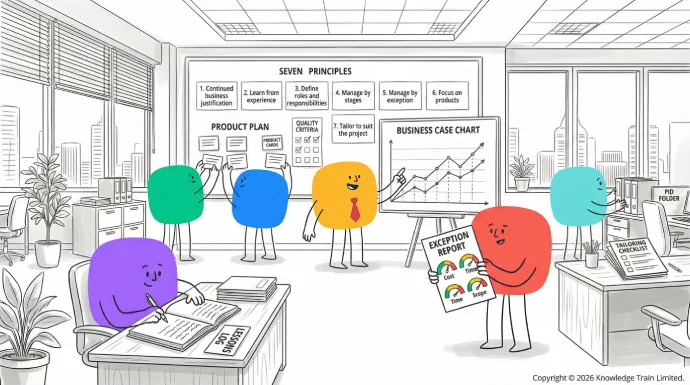
The 7 principles in PRINCE2 are:An agile project management career can provide opportunity for
- Ensure continued business justificationgrowth, learning and personal development
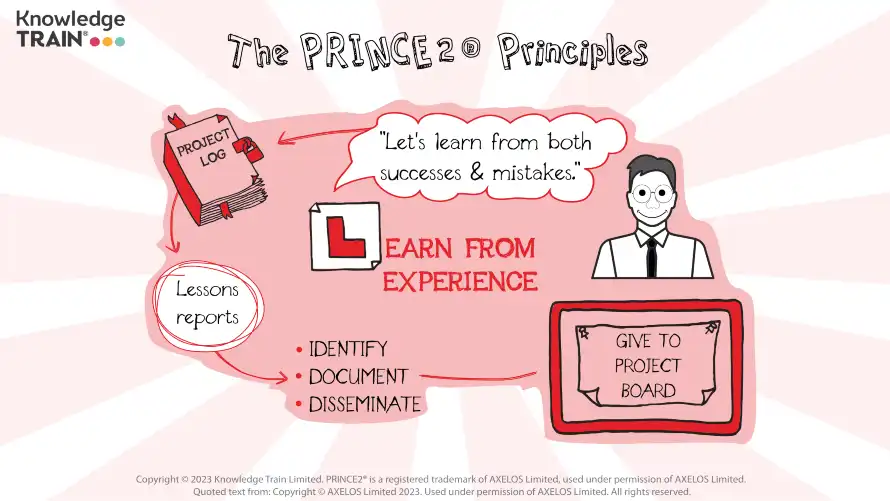
- Learn from experience.
- Define roles, responsibilities, and relationshipsHow can AgilePM help you start a career?
- Manage by exceptionIn response to the
- Manage by stagesgrowing demand for qualified agile project managers
- Focus on products, the Agile Business Consortium, together with APMG International, developed the AgilePM qualifications scheme.
- Tailor to suit the projectHolistic approach
UniversalYou can use
PRINCE2AgilePM is based upon these principles for a very simple reason. Being principles-based, it means the framework can be applied to any type, size, or scale of project. In this way, the principles can be universally applied, both to a small in-house company project based here in London, or equally to a massive international aid project spanning many borders commissioned by the United Nations. alone or in conjunction with other agile and non-agile approaches, including
Best practicesScrum
These principles have also been proven in practice over many years to be the most effective ways of managing projects i.e. they are based upon modern best practices in project management. This means they can be applied directly on projects and the project management team does not need to “re-invent the wheel” by creating their own project management method from scratch.,
EmpoweringPRINCE2
The principles are also empowering to the project management team because they can give them added confidence and an ability to shape and manage their projects., and
So, let’s now look at each of these principles in turn.PRINCE2 Agile
Ensure continued business justification.
The first principle of If you want to begin your career as an PRINCE2agile project manager emphasizes that the project must always remain desirable, viable and achievable, otherwise it must be closed. and or looking to enhance your CV with a well-known agile project management qualification, look no further than AgilePM.Desirable Enhance your skills with our expert-led coursesrefers to the balance of costs, benefits, and risks; viable refers to the ability to deliver the products; and achievableInstructor-led refers to whether the use of the project’s products is likely to result in the outcomes and benefits expected. The word ‘continued’ in this principle emphasizes these are questions to be asked not only when the project starts up but must be asked continuously throughout the project.AgilePM Practitioner (with Foundation) course
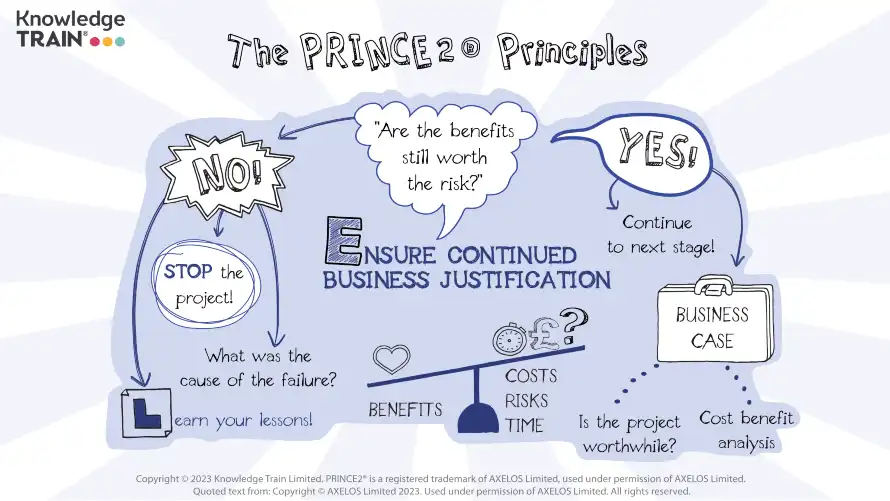
Business case
The £1,699 +vatbusiness case is updated throughout the project, as well as being used when starting up the project. If the factors underlying the business case change in such a way that the expected benefits are no longer likely to be realised, then the project should be closed prematurely.See all dates
Changes detrimental to the business case are often linked to the economy; for example, in 2008 the credit crunch led to many major building projects being brought to a halt.
Applies to compulsory projects
This principle also applies if the project is compulsory (e.g. required to achieve compliance with new legislation) – the organization will require justification of the chosen project, as there may be several options available that yield different costs, benefits and risks.
Benefits toleranceSelf-paced
The business case contains the reasons for running the project, with the expected benefits documented in measurable terms. In PRINCE2, the benefits expected from a project are subject to tolerances; if they drop below those tolerances, then the business case is no longer viable.AgilePM Practitioner (with Foundation) self-paced online
For example, if a project is mandated to make a profit, then the mandate should identify the threshold of profit that determines the viability of the business case. If the expected profit drops below that threshold, due to changes in circumstances, the project should be stopped.
Update stage-by-stage£1,299 +vat
In PRINCE2, project work should be broken down into stages, for ease of manageability. The business case is updated by the project manager at the end of a stage and the project board will be presented with this updated documentation when they assess the project at a stage boundary.
Checking ongoing viabilityInstructor-led
At a stage end the project board decides if the business case remains viable, before authorising the plan for the next stage. If the viability of the business case raises concerns during a stage, a project issue can be raised to bring the matter to the attention of the project board as soon as possible, and before the end of stage assessment.AgilePM Foundation course
Premature closure
In the event of a project being closed prematurely, the organization must ensure that lessons are learned about the cause of the failure. In addition, every attempt should be made to derive maximum benefit from any outputs and outcomes that had been achieved by the project.£1,299 +vat
Benefits are not always financial
For most commercial organizations, the business justification for See all datesprojectsLearn to manage agile projects effectively is often a financial one i.e. will there be a return on investment (in terms of money). But the business justification can be made in other ways too.A 2021 survey by
Consider a proposal to equip a residential apartment block with a water sprinkler system in case of fire. Such a project would have clear benefits (in terms of saving people’s lives in a fire) but it probably cannot expect a return in investment in purely financial terms. The decision to invest in such a project would therefore need to consider the wider benefits to society of keeping its citizens safe.APM
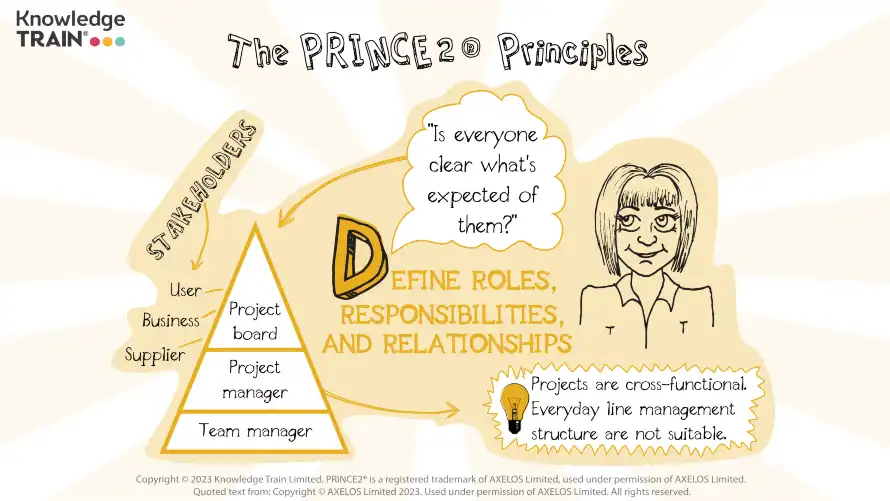
today, you’ll learn all this and more. The compete AgilePM syllabus covers those topics needed for you to begin managing agile projects effectively.If everyone understands what is required of them, the chances of delivering a successful project are greatly improved. Any confusion about what should be done, by whom, and when is likely to be detrimental to the project’s progress.
In PRINCE2, the project board is part of the project team, which also includes the £1,699 +vatproject manager , project support and team managers.See all dates
Stakeholders
Moreover, PRINCE2 identifies three stakeholder interests: business, user and supplier and the project board is designed to represent all three interests.
Business
The business interest (in the Self-pacedPRINCE2 manualAgilePM Practitioner (with Foundation) self-paced online this is referred to as the ‘business’ or ‘business layer’) sponsors the project, endorses its objectives, and aims to ensure that the business investment provides value for money.
User£1,299 +vat
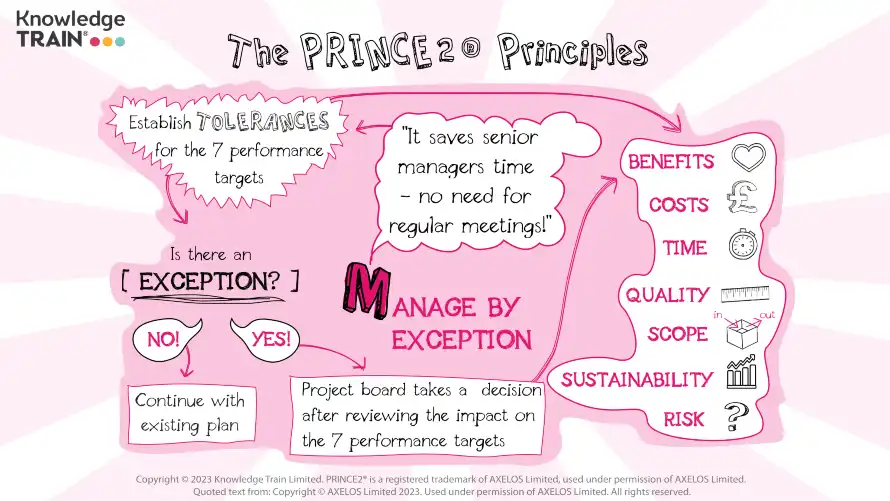
Enhance your skills with our expert-led coursesPRINCE2 if the ‘manage by exception’ principle is performed, there is no need for regular progress meetings between the project board and the project manager.
Manage by stages
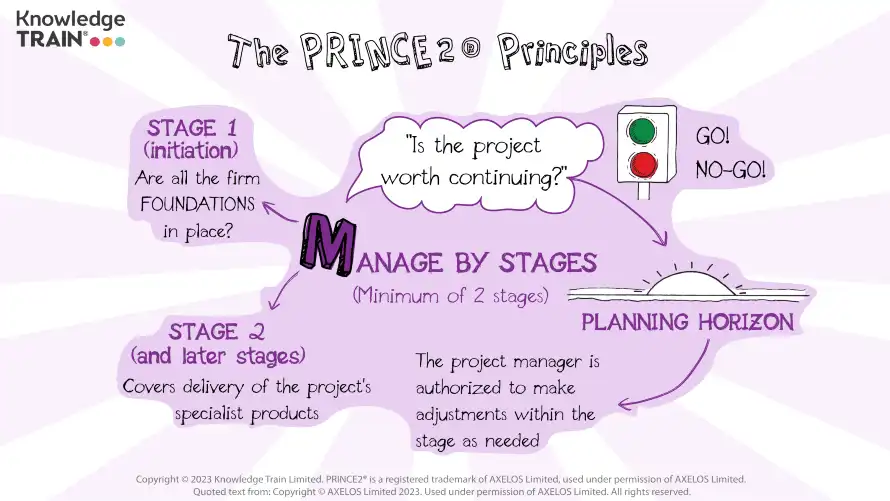
According to this principle each stage of a project must be properly planned, monitored, and controlled. A PRINCE2 project requires a minimum of two stages – the first one being called the ‘initiation’ stage (during which the project is planned), and then at least one more which covers the delivery of the project’s specialist products.Instructor-led
Initiation stageAgilePM Practitioner (with Foundation) course
The requirement for an initiation stage ensures that a project is not started before detailed forecasts of costs and timescales have been completed. If the project skips this stage, there is a risk that it will ultimately cost considerably more than originally anticipated.
Project initiation documentation (PID)£1,699 +vat
At the end of the initiation stage, the project board assesses the viability of the project by examining the project initiation documentation (PID). In accordance with this principle, a project that is given the go ahead will be assessed again by the project board at the end of each management stage during its lifecycle. After each assessment, the project board may decide that the project should continue or be prematurely closed it if it is no longer viable.
Planning horizonSee all dates
It is a general rule of planning that every plan should be made only to a manageable and foreseeable level of detail (called a planning horizon). PRINCE2 recommends three levels of plan – project plan , stage plans and optional team plans; each is appropriate for the level of management which uses it.
The project board uses an updated version of the project plan to help it monitor and control progress. The project manager, who is responsible for the day-to-day management of the project, uses the current stage plan, and team manager(s) use team plans to an appropriate level of detail.Self-paced
Stop/continueAgilePM Practitioner (with Foundation) self-paced online
Each management stage in PRINCE2£1,299 +vat acts as a ‘stop/continue’ decision point for the project board. It’s where it decides whether the project is still viable and if so, can commit to the next stage by approving the plan for the next stage.
If the decision is ‘continue’ then effectively this gives permission for the project manager to spend the money authorized by the project board for the next stage and is thus a less risky approach to taking investment decisions when compared with taking one big decision at the start of the project.
Stages are a control for the project boardAgilePM Foundation course
Stage boundaries therefore enable the project board to control the project on a stage-by-stage basis, whilst delegating day to day management of the project to the project manager.
To help the decision of the project board, the project manager updates the project plan at the end of every stage with the ‘actuals’ from the current stage and ‘forecasts’ for the remainder of the project. Before taking a decision therefore, the project board has up to date information about the project which helps it assess the ongoing viability.£1,299 +vat
Focus on products
PRINCE2 recognises the importance of delivering products that meet their agreed quality criteria, hence the ‘focus on products’ principle.See all dates
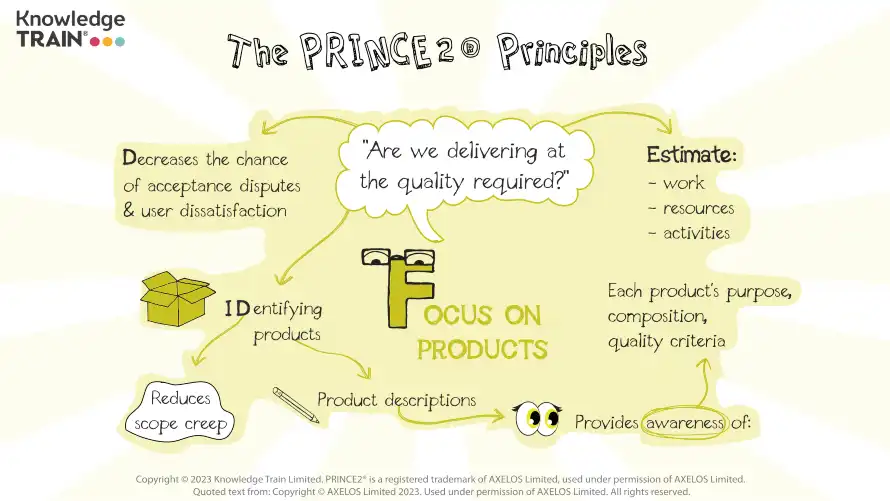
When products are successfully delivered, they lead to project benefits, and so it is extremely important that they are planned and delivered effectively. If the stakeholders’ expectations are to be fulfilled in accordance with the business justification, everyone involved with the project must agree on and fully understand the nature of its products. Otherwise, the aim of the project will be open to interpretation – and considerable confusion is likely to ensue, impeding the project’s progress.About our training
Product-based planningKnowledge Train
Whereas some is an accredited training organisation for Agile Project Management (AgilePM).project management methodsTrainers focus on activity planning, planning in PRINCE2 starts with identifying products. Product-based planning is a crucial aspect of the Our PRINCE2 approachtrainers to managing projects; it helps the project team reduce the risk of scope creep, as well as making issues such as acceptance disputes and user dissatisfaction less likely to occur and potentially less damaging. have years of applied experience in agile project management and the skills needed to help others learn from their experience.
Product descriptionsWe hire trainers who can engage and motivate our students and help them learn the intricacies of each subject.
As part of PRINCE2’s product-based planning technique, product descriptions are developed and agreed, and these effectively describe what is to be delivered by the project. They help to ensure that everyone involved in the project is aware of each product’s purpose, composition, and quality specifications. They also enable the project team to estimate how much work will be involved in bringing each product to fruition, what resources will be required, the activities required, and how the products will be tested and approved. The agreed products define the project’s scope, as well as providing a foundation for planning and control activities.Our rigorous selection process for trainers and ongoing improvements means you can be assured you’ll get the best learning experience available.
Tailor to suit the project
The final principle ‘tailor to suit the project’ highlights a key advantage of using PRINCE2 – its adaptability.
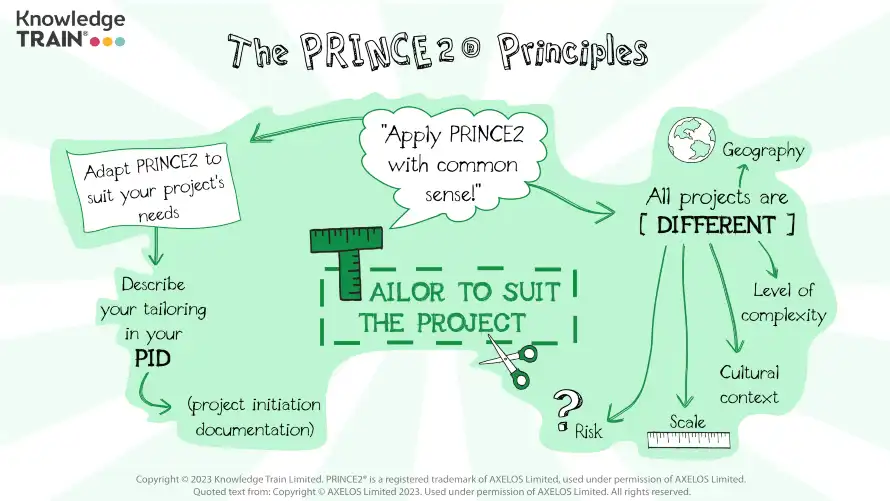
The verb to ‘tailor’ refers to the appropriate use of PRINCE2 so that it matches the needs of each project. PRINCE2 recognises that all projects are different in terms of their cultural context, geographical location, level of complexity, scale, and risk. This principle allows you to adapt the PRINCE2 methodology to suit the needs of your project – and still comply with the PRINCE2 approach to project management.
For example, one element of PRINCE2 that is routinely tailored is the schedule for project board meetings. Such meetings are not a requirement of the PRINCE2 methodology; regular highlight reports are considered sufficient. In many organizations, however, regular meetings are part of the corporate culture. They can be accommodated by PRINCE2, thanks to the tailoring principle.
If your organisation tailors PRINCE2, you should document the changes made to the method and describe these in the project initiation documentation (PID). In this way, the changes can be audited and provide evidence of compliance with PRINCE2 and business standards.
Tailoring whilst remaining compliantHow to write a user story
When you are tailoring PRINCE2Simon Buehring, you must bear in mind that no part of the method should be ignored or removed. Even on a small project, you will need to address risk, quality and change control. If the method is changed too much, you will be in danger of running a ‘PINO’ (that’s ‘PRINCE2 In Name Only’) project.19 Feb 2026
Organizations can address the PINO problem by referring to the PRINCE2 Maturity ModelMaster the art of writing user stories with our simple guide. Ideal for newcomers to Agile. Scroll down to start learning.. Organizations can use the model to establish their level of compliance with PRINCE2.
Tailoring goals
The goal of the tailoring principle is to adapt the PRINCE2 method to the needs of your project thereby avoiding the creation of a ‘template-driven’ project management method in which everything is done unquestioningly. Remember that PRINCE2 focuses on decisions being taken by those with delegated authority based upon timely information, rather than focussing on documents, templates , and meetings.
SummaryThe 4 Kanban principles: A visual guide
Hopefully you’ve learned something about the PRINCE2 principles after reading this ebook. As a trainer on a PRINCE2 course, I often hear students refer to their employer as being one which manages their projects according to PRINCE2. After delving a little deeper, it becomes apparent that these organizations are usually not managing their projects according to PRINCE2 at all.
There is only one simple test of whether a project is a PRINCE2 project and it’s nothing to do with how many documents are written by the project management team. Nor is it to do with whether all the guidance in the PRINCE2 manual is being followed. The test is simply whether the project is applying all Simon Buehringseven of the PRINCE2 principles19 Feb 2026.
PRINCE2 therefore is not a rigid and ancient text written down on tablets of stone which cannot be challenged and changed. On the contrary, it’s a very practical and workable set of best practices which can be applied to any project, no matter what type of project, scale or level of complexity and risk.Visualize the 4 Kanban principles and how they apply across various projects and workflows. Discover more by scrolling down.
It’s by applying these principles sensibly on your project that you will gain the greatest benefit of the world’s most popular project management methodology.