USD $555

li>PMI’s Key takeaways<
strong>Authorised Training Partners (ATPs)PRINCE2 Agile combines PRINCE2 governance with Agile delivery to suit fast-changing environments.
- >PRINCE2 keeps projects anchored to business justification, clear roles, and decision points across the lifecycle.
- >Agile focuses on rapid, incremental delivery with customer feedback, collaboration, and self-organising teams.<
- li>Practice exams and exam content outlinesPRINCE2 can support iterative delivery and is not inherently a waterfall approach.
- >PRINCE2 Agile explains how to tailor PRINCE2 for Agile work while keeping the same principles, practices, and processes.
- >Use fix or flex to protect time and cost, while flexing scope and quality criteria through prioritisation.<
PRINCE2
PRINCE2 is the world’s most widely used project management methodology. Simon BuehringPRINCE2 qualifications19 Feb 2026 are also a standard feature of project management job specifications in the UK and have grown in popularity since PRINCE2Enhance your PRINCE2 learning with our podcasts, narrated by an experienced project manager. Perfect for complementing your course studies. was launched in 1996.
Currently, over 100,000 PRINCE2 exams are sat somewhere in the world every year.
Agile
‘Agile’ is an umbrella term used to refer to numerous product delivery methods, frameworks and techniques used by development teams.
Agile approaches emerged from the software industry in the 1990’s, to try to overcome many of the problems which had beset traditional software projects. They were often delivered late, over budget, and with low quality.
Levels of planSimon Buehring
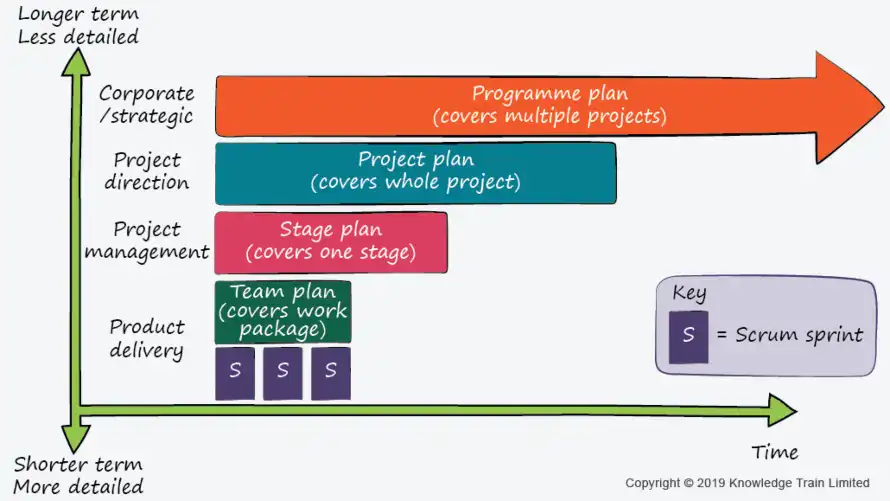
PRINCE2 has the concept of ‘19 Feb 2026levels of plan ’. This suggests that different plans are required by different levels of the project management team. There are 3 levels of plan in PRINCE2:Considering PRINCE2 Agile certification? Discover how it integrates PRINCE2 with Agile concepts to advance your project management skills.
- Long-term – this is a high-level project plan which is required by the key decision-makers (the project board).
- Medium-term – this is a stage plan required by the project manager for every stage of the project.
- Short-term – this is a team plan required by each team manager (leader) to cover the work done by their team. This is a detailed plan.
Sprints and timeboxing
Agile approaches such as Scrum , take this concept even further by suggesting a detailed plan for each ‘sprint’. A Scrum sprint is based upon the key Agile concept of a ‘time-box’ – a fixed period of time typically ranging from between 1-4 weeks.
Delivering working products
At the end of every Scrum sprint a Scrum team delivers working software to the customer. Delivering working software at the end of each sprint guarantees that the software is never delivered late.
The customer receives ever increasing increments of working software until, at the end of the final sprint, they receive the fully built and tested system.
Time-boxes and team plans
The Agile concept of time-boxes or iterations fits in neatly with PRINCE2’s concept of a team plan because there can be one or more time-boxes within a team plan.
PRINCE2 doesn’t prescribe how many time-boxes a team plan should contain because that’s a decision for the self-organizing Agile team members.
PRINCE2 Agile addresses similar concepts to these in the form of ‘be on time and hit deadlines’ which is one of the five PRINCE2 Agile targets . Similarly, regular releases is one of the five focus areas in PRINCE2 Agile .
Responding to change
Cost of change
One criticism of more predictive project management approaches is that it is difficult and costly to manage changes. Changes are managed through formal change control processes, and decisions taken by a change authority.
In Agile approaches, changes can be done quickly. This is because customer requirements (e.g. software features) are described by the customer in the form of tasks which are prioritised in a backlog.
Because planning is never done further in advance than the next iteration (1-4 weeks usually), tasks can be quickly re-assigned a different priority, new tasks added, or unnecessary tasks removed.Give us a call
Again, PRINCE2 Agile views change positively. One of the five targets in PRINCE2 Agile is the ‘ embrace change ’ target which sees change as something positive to be embraced, rather than something negative to be managed.+44 (0)207 148 5985
PRINCE2 doesn’t have to be waterfall
There is a perception (wrong in my view) that PRINCE2 struggles to adapt to changing business requirements.Or chat with us using the link at the bottom of the screen.
This view is based upon the assumption that PRINCE2 is a project ‘Contact us with questions about the courses on this page, or about which project management certification or training is best for you.waterfallFinance FAQs’ approach. A waterfall approach is where requirements are documented and approved before moving to a design phase, followed by a build phase and finally a testing phase.Contact
There is nothing in PRINCE2 which prescribes such a Cookieswaterfall approachPrivacy. In fact, the latest TermsPRINCE2 manual 7Customer Supportth edition[email protected] assumes that on many projects, requirements emerge and evolve as the project continues.Join Our Team
PRINCE2 manages such changes to project scope using its change control approach. However, lower-level changes, such as a feature requests can easily be managed at the team level using the prioritization techniques common in Agile approaches.
Using both PRINCE2 and Agile[email protected]
The best of both worlds Copyright © 2005-2026 Knowledge Train Limited.
Whereas PRINCE2 focuses on understanding what products are needed to support the business needs, Agile focuses on completing those products in an efficient manner, incrementally delivering more working software (products) as the work progresses. Registered in UK: 5566983.
Utilizing Agile approaches on PRINCE2 projects therefore can bring the best of both worlds – the structure and direction of PRINCE2, coupled with the flexibility and responsiveness of Agile. Registered VAT: GB872413526.
PRINCE2 is not concerned with how teams organize or the methods they use. It does however define a simple interface between the customer organisation which is paying for the project and the supplier organisation which provides the teams which do the specialist work. Knowledge Train
Business focus and timely delivery®
This therefore means that teams on a PRINCE2 project can use any development approach they choose – including any of the Agile approaches. Providing they comply with the interface defined by PRINCE2, teams can utilize the benefits of Agile (such as on-time delivery), whilst the customer maintains the benefits of PRINCE2’s focus on the is a registered trademark of Knowledge Train Limited. business justification 20 Old Bailey, London, EC4M 7AN, England, United Kingdom.. Knowledge Train are experts in project management, PRINCE2, agile and change management training and certification. Choose from a full range of instructor-led and self-paced
Quick PRINCE2 and Agile comparisonproject management courses
| PRINCE2, a | AgilePRINCE2 course |
|---|---|
| Useful for the customer to justify a project, or an | Useful for the supplier to deliver working softwareagile project management course |
| Focuses on higher management levels to boost your career. | Focuses on lower-level delivery teamsPRINCE2 |
| Answers questions such as “should we do the project?” and “are the benefits worth the costs and risk?”® | Answers questions such as “what do we deliver next week?” “how will we know it (a product) is finished?”, MSP |
| More predictive approach® | More adaptive approach, ITIL |
PRINCE2 vs PRINCE2 Agile
In 2015, in recognition that many people were struggling to find a way of applying PRINCE2 on Agile projects, AXELOS launched PRINCE2 Agile [2].
PRINCE2 Agile is essentially the same as PRINCE2 . They both rely upon the exact same principles, practices, and processes. The only real difference is that the PRINCE2 Agile guidance explains in detail how to tailor these elements for Agile projects. In the PRINCE2 manual , whilst there are lots of examples of how to tailor PRINCE2 to different project context, it doesn’t go into the same amount of detail as the PRINCE2 Agile manualRequest a quote.
Fix or flex?
In particular, PRINCE2 Agile explains what to ‘ fix or flex ’ for the 6 performance targets of PRINCE2 (time, cost, quality, scope, risks, benefits).
For PRINCE2 Agile, time and cost are fixed. These cannot change. However, to be able to deliver what the customer truly needs, scope and the products’ quality criteria can be flexed.
What to flex must be agreed with the customer. Typically, to achieve this PRINCE2 Agile uses prioritization techniques such as MoSCoWManage Consent, coupled with sprint backlogs.
The other 2 performance targets (benefits and risk) may be either fixed or flexed depending upon the customer’s needs.To provide the best experiences, we use technologies like cookies to store and/or access device information. Consenting to these technologies will allow us to process data such as browsing behavior or unique IDs on this site. Not consenting or withdrawing consent, may adversely affect certain features and functions.
Conclusion
Simply choosing to use a particular method or approach will never guarantee a project is always successful. In fact, any method or approach used without thinking will make a mess of any project.
The PRINCE2 focus on the business justification and whether a project is justified when the business environment changes remain its biggest assets. It helps to ensure that projects are based upon sound business sense.
The ability to respond quickly to changes with on-time delivery of products which deliver value to the customer is the biggest contribution of Agile approaches.
So, is it a matter of choosing either FunctionalPRINCE2 or Agile ? I don’t think so. If you are looking for a robust project management methodology to use on Agile projects, then PRINCE2 Agile fits the bill perfectly.
PRINCE2 Agile gives practitioners both the control and governance to guide the project, whilst at the same time it provides the agility and ability to deliver rapidly in a changing business environment.
If you want to learn more about PRINCE2 Agile, or want to become certified, consider taking a How To Write a Business Case | Business Case Template PRINCE2 Agile courseFunctional.