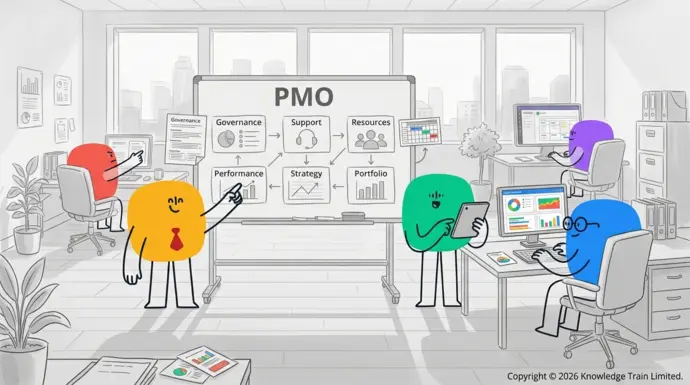
What is a PMO?


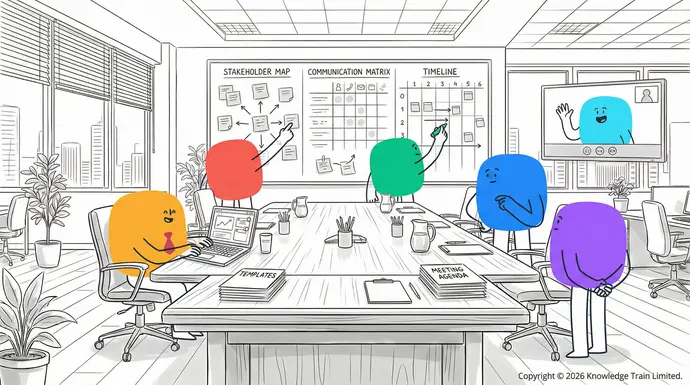
Project communication plans
image
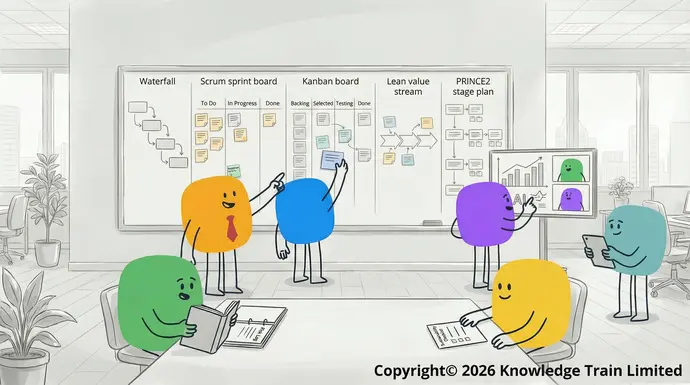
Project management frameworks
image
Germany
Malta
Netherlandsimage
RomaniaSlovakia
Slovenia
Project portfolio management - what, why & howProject management triangle
{"@context":"http://schema.org","@type":"BreadcrumbList","itemListElement":[{"@type":"ListItem","position":1,"name":"Home","item":"https://www.knowledgetrain.co.uk/"},{"@type":"ListItem","position":2,"name":"Project Management","item":"https://www.knowledgetrain.co.uk/project-management"},{"@type":"ListItem","position":3,"name":"Project portfolio management - what, why & how","item":"https://www.knowledgetrain.co.uk/project-management/project-portfolio-management-what-why-and-how"}]}image
Project portfolio management – what, why & how with Stephen Jenner The project management triangle is a key factor in the success of a project. Learn how to balance scope, time and cost for project goals and deliver exceptional results.
Sevcan Yasa
29 Sep 2026
A guide to project manager salaries: free ebook
Understanding PMO roles and responsibilities
image
® Agile Business Analysis: Definition, Roles & Best PracticesPRINCE2 Agile certification
PRINCE2 Agile certificationFoundationTranscript
PractitionerIntroduction image
Project Management Qualification (PMQ)VideoAccess the
presentation
PRINCE2Stephen Jenner is author and Chief Examiner for APMG’s ‘Managing Benefits’ and ‘Managing Portfolios’. He is also co-author of ‘Management of Portfolios’. Stephen has authored multiple books on project portfolio management and benefits realisation. His Portfolio Management approach gained international recognition from the OECD and European Commission and won the Civil Service Financial Management Award. PRINCE2 Agile focus areas
PRINCE2 Agile focus areas®Stephen is a regular keynote speaker at international conferences. He advises organisations worldwide on portfolio and benefits management. He is a Fellow of the Chartered Institute of Management Accountants with an MBA and Master’s degree from Cambridge University.
AI Project Governance Framework (AIPGF)MSP provides a framework for managing programmes that deliver transformational change and strategic benefits. The certification helps you coordinate multiple projects to achieve business outcomes. You’ll learn how to manage programme governance, stakeholder engagement, and benefit realisation. Foundation and practitioner levels are available. Merging Agile methods with PRINCE2 requires focusing on five key areas. Explore these to enhance your project's agility and success.FoundationMSP courses
Practitioner
What is the Association for Project Management (APM)?House of PMO Essentials for Analysts00:00:00 Sevcan Valiyeva 
House of PMO Essentials for Managers: Hello, everyone, and welcome to another session of our webinar. Today, we have Steve with us. Steve, thank you so much for joining. So, for a few minutes while people enter, we do have two very simple questions for you. Just while people wait, just to know if you can answer those, that would be fantastic. Again, as usual, feel free to introduce yourself and where you come from in the chat. image
®00:01:13 Stephen Jenner  The Association for Project Management (APM) is the UK’s chartered body advancing project management standards, membership and professional development.Foundation: I mean, in a way, it’s a trick question because we should all be developing. That’s the continuous learning.
Foundation & Practitioner00:01:26 Sevcan Valiyeva 
ARTIFICIAL INTELLIGENCE (AI)00:01:52 Stephen Jenner  Project management tools in 2025
Project management tools in 2025BCS AI: Cool.
Foundation00:01:55 Sevcan Valiyeva  image
Practitioner: Share all results. It’s a few minutes, seconds. Well, you know, if you want to look at the results and then we can head over to Steve. Find out about the most efficient project management tools for 2025. This comprehensive guide compares the best software solutions and enables you to select the right one to manage your workflow and complete the project on time.Can you fail PRINCE2? | Knowledge TrainWorkshops00:02:12 Stephen Jenner 
AI in Project Management: I suppose one thing, one point I’d make about the Project Programme Portfolio question is that too often there is this usually unspoken, thank God, no one feels brave enough to express it, but there is this unspoken assumption that somehow projects are for beginners. And once you get good at project delivery, then you’re going to swap to programme delivery. And then if you get really good at programmes, you could actually be go towards the portfolio or the portfolio is more complex than project approach, absolute rubbish. Different disciplines, people can come at portfolio management from a project management background, a programme management background, and even from a sort of financial strategic background.
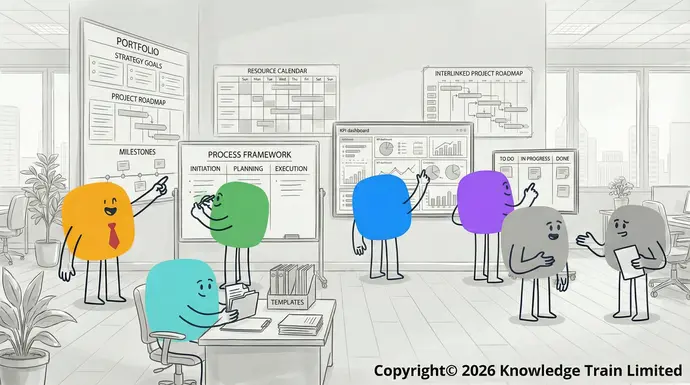
AI Learning Library (AILL)™ : So, we’re going to use the bell for the advancing of the slides. It’s one of those weeks where the technology is, Anyway, what is portfolio management? Well, to kind of sum it up on the quote from the PMI on the left-hand side, it’s about two things. It’s about choosing which projects and programmes should we invest in. So, it’s the investment management question or practice. It’s therefore about finance, but it’s also about psychology. Because of the way we make decisions, it’s a mixture of science and art. Management judgment needs to be applied and beyond that, the choosing is about then executing those projects and programmes to realise benefits and optimise value.
AGILE00:06:47 Stephen Jenner  AgilePM: Now, two points on that. Secondly, to the last point. The fundamental purpose is about optimising value. So, it’s about executing projects to realise value. That’s fundamental and you can see at the center of the diagram on the right-hand side, the model for managing portfolios, and it’s the subtitle of the book. It’s about optimising strategic, I say optimise strategic contribution, that’s what the objective is. And when it says execute, it doesn’t mean suddenly all the project and programme managers are reporting to me because I’m the portfolio guy. What it means is the project manager is still responsible for delivery; the sponsor or the project executive are still accountable for successful delivery. But who are they accountable to? They are accountable to the portfolio. And it’s the portfolio’s job to ensure that we address any barriers to delivery. 00:07:56 Stephen Jenner  ®
: We make it easier for projects and programmes to deliver because as we will see, one of the problems, one of the issues, one of the root causes behind project and programme failure or say less than optimum performance, one of the root causes is doesn’t lie within the control of the project, it lies outside. And so, it’s the portfolio’s job to identify those barriers and address them effectively. So, we see that in this model on the right-hand side, when we wrote MOP originally, it was portfolio definition and portfolio delivery. Craig and I who wrote MOP and Craig assisted with managing portfolios; we call it portfolio design. Designing the portfolio, which is fundamentally a part about structuring the portfolio, but then deciding this issue about prioritising. How do we prioritise our projects and pros? Which ones are the most important? Which collection of projects represents the best use of limited resources? So, it’s about doing the right things and on the other side, it’s about portfolio delivery. And I was doing the projects right and so, we have these 12 practices to ensure we do the right things, and the right things refers to optimum strategic contribution, and the doing things right, they actually deliver, on time to a budget, and we have actually deliver the impact that was originally intended. So, we achieve the objectives or the outcomes that were designed. – Agile Project Management
00:09:39 Stephen Jenner  FoAI challenges in Agile project management with Dan Stelian Roman
AI challenges in Agile project management with Dan Stelian Roman : But beyond that, and this is something that we kind of missed in MOP, but we’ve picked it up in managing portfolios, is not just about doing the right things and doing them right, it’s also about doing them at the right time. And I’ll come to that in a little while; it’s really fundamentally important. Yes, you need to prioritise your portfolio, but you also need to decide in which order should they be done and it’s of fundamental importance. I think it’s a major, one of the major gaps in MOP in hindsight that we didn’t address that. But as I say, it’s addressed in managing portfolios. So, oh, I just touched on one other thing. In this model, you’ll see the very centre is the purpose is to optimise strategic contribution. We have portfolio design, so we scope and structure the portfolio, decide what the objectives are. We prioritise our current and then we optimise, so we seek to ensure that we’ve got appropriate coverage of different objectives. And then we produce a plan with delivery, management oversight, benefits management, financial management, risk management, resource management and stakeholder management. But you’ll see those six in the dark pink and the dark blue, those we refer to as the key success characteristics. undation
00:11:06 Stephen Jenner  Practitionerimage
Sevcan Yasa : Because I invited questions and Lance actually asked me to say something about, you know, yes, you can implement portfolio management. And if you’re implementing, you’re focusing very much on the processes or the practices, you know, of prioritisation and monitoring and all that kind of good stuff. When it comes to sustaining progress, which I think is what Lance really was talking about, how do we sustain progress or build, making sure we continue to, the thing continues to work efficiently and effectively, then I think we need to start focusing on those six key success characteristics that portfolio management needs to be benefits led. Because it’s about delivering value, value being benefits take away the cost. So, everything we do in the portfolio should be about being benefits. Are we realising the impact? Are we making the difference that we said we would? Are we optimising that? It should be evidence-based. So, whatever we do in portfolio management, there should be some evidence-based for what we’re doing. And I’m going to refer to that but at the same time, we don’t want these huge algorithms. I was talking to on one webinar, I wasn’t talking, I was attending one webinar and someone said, when it comes to structuring the portfolio, every project should be in the portfolio. So, I typed in the question in the chat and Steve’s asked the question and Steve says, so what do you do if you’ve got 10,000 projects? And the response from the esteemed panel was, these experts was, well, you have a big PMO then, don’t you? And in managing portfolios, I call this the strategic planner syndrome. It’s just wrong, wrong, wrong. You should go, the sort of key themes underpinning managing portfolios in many ways are about focus, about focusing the portfolio on the most important initiatives. And it’s about flow, ensuring the projects flow through the delivery process. PRINCE2
: So, what we don’t want is huge algorithms trying to work out, which is the most important thing. It’s about fast and frugal decision making, being able to speed up decision making. Bob Cooper’s research in Canada, Professor Bob Cooper suggests no more than six criteria on average, around about six criteria maximum. It’s also about being active, it’s not about sitting in the office. It’s saying to the guys I was speaking to this morning, cutting the umbilical cord, getting people away from the computer screen, get out talking to project and programme managers and business people. It’s about being disciplined, and I come on to that, it’s really important. And it’s about being transparent, a transparent view so everyone can see where we are and what we’re delivering and what impact it’s having. AgileJoin Dan Stelian Roman in a webinar exploring the challenges of implementing AI in Agile projects. Watch to enhance your understanding of navigating these challenges. 00:13:54 Stephen Jenner  Foundation