
Self-paced training course to gain LSS Yellow Belt.
7. RiskPMI
Risk tolerances establish boundaries for total project risk and individual risk outcomes.®
Example: Threat costs must remain under 10% of the budget collectively while ensuring each individual threat doesn’t surpass 5%.PMI-ACP
Project managers who define precise tolerances for these seven elements can:Self-paced course to prepare you for the exam (exam not included).
- Establish clear boundaries for decision-makingKanban
- Identify potential issues earlyEstimating for Agile Foundation
- Ensure appropriate escalation of exceptionsAgile Learning Library (ALL)™
- Maintain a balance between flexibility and control.BUSINESS ANALYSIS
Successful project outcomes result from effective performance management which enables decision-makers to respond appropriately and quickly to necessary changes.BCS Business Analysis
Exception management technique in PRINCE2Business Analysis Foundation
Six-step exception management processLearn the fundamentals of business analysis.
PRINCE2Modelling Business Processes manages exceptions through a structured approach that involves Gain practitioner certificate in modelling business processes.six distinct stepsBusiness Analysis Practices .Gain practitioner certificate in business analysis practices.
- ForecastRequirements Engineering : The team manager expects to exceed the allotted tolerance levels for a work package.Gain practitioner certificate in requirements engineering.
- Raise issueBusiness Analysis International Diploma : The project manager receives an All 4 courses bundled into this Diploma certification package.issue registrationAgileBA notice within the issue register.®
- Escalate – Agile Business Analysis: When an issue impacts stage tolerances the project manager proceeds to draft an Foundation training exception reportLearn the fundamentals of Agile Business Analysis..Practitioner
- Review options4-day course including Foundation.: The project board assesses both the PMIexception report® and possible solutions.PMI-PBA
- Create exception planSelf-paced course to prepare you for the exam (exam not included).: The project manager creates a detailed plan to manage the exception when it becomes necessary.Business Analysis Learning Library (BALL)™
- ImplementCHANGE MANAGEMENT: Once approved, the APMG Change Managementexception planFoundation functions as the new Learn the fundamentals of enterprise change management.stage planPractitioner .Includes Foundation & Practitioner combined option.
Roles and responsibilities:PROGRAMME MANAGEMENT
- Team manager: Forecasts exceptions and raises issuesMSP
- Project manager: Assesses issues, creates exception reports and plans®
- Project board: The project board evaluates exception reports to determine necessary corrective measures.Foundation
Exception plansLearn the fundamentals of programme management.
Exception plans function as guides for managing substantial deviations outside accepted tolerance limits. Their primary purposes are to:Practitioner
- The project manager develops a detailed plan outlining specific actions needed to correct the project’s path within acceptable tolerancesIncludes Foundation & Practitioner combined option.
- Provide a revised baseline for project performance.INFORMATION TECHNOLOGY (IT)
Creation process:ITIL
- Analyse the exception’s impact on the project®
- Develop alternative courses of actionFoundation
- Select the most appropriate solutionLearn the fundamentals of ITIL service management.
- Detail the implementation approach.Strategist DPI
The 3-day ITIL Strategist: Direct, Plan & Improve (DPI) course.exception plan takes over from the original stage plan to set the new standard for project execution and performance tracking after approval. The methodology enables projects to remain flexible to change while preserving defined goals and management controls.Specialist: DSV
PRINCE2 projects that utilise this structured process can manage exceptions efficiently by reducing their effects and preserving project progress.3-day ITIL Specialist: Drive Stakeholder Value (DSV) course.
Forecasting in exception management
Importance of forecastingAPM COURSES
Forecasting serves as a Select your preferred training course below:key element in exception management because it facilitates early detection of potential issues. It allows project teams to:AGILE PROJECT MANAGEMENT COURSES
- Anticipate deviations from tolerancesSelect your preferred training course below:
- Implement preventive measures early
- Develop strategies that reduce the potential negative consequences exceptions can create on project results.PRINCE2 AGILE COURSES
Effective forecasting depends on multiple types of data sources.Select your preferred training course below:
- Historical project performance
- Current project metricsBETTER BUSINESS CASES COURSES
- External factors affecting the projectSelect your preferred training course below:
- Risk assessments and probability analyses.
Tools and techniques for forecastingP3O COURSES
Modern PRINCE2 forecasting approaches use Select your preferred training course below:sophisticated technology solutions and methods that emphasise data interpretation.WORKSHOPS
- Digital management systemsSelect your preferred workshop below::
- Integrated AGILE QUALIFICATIONSproject management softwareSelect your preferred qualification.
- Real-time data collection and analysis tools.
- Predictive analyticsAGILE PROJECT MANAGEMENT COURSES:Select your preferred training course below:
- Machine learning algorithms for trend identification
- Scenario modelling for risk assessment.PRINCE2 AGILE COURSES
- Data trustsSelect your preferred training course below::
- Shared data repositories for benchmarkingSCRUM COURSES
- Industry-specific performance metrics.Select your preferred training course below:
Project management tools support managers in performing ‘what-if’ analyses to improve their decision-making processes. Teams can produce precise forecasts by merging historical data with current project details and predictive models. The method enables prompt detection of exceptions while managing project tolerances effectively.
Effective practices for exception managementAGILE BUSINESS ANALYSIS COURSES
Robust exception management implementation depends on following multiple Select your preferred training course below:essential practices .BUSINESS ANALYSIS QUALIFICATIONS
Clear communication channelsSelect your preferred qualification.
Transparent communication pathways form the foundation of effective exception management.
- Define clear escalation proceduresBCS BUSINESS ANALYSIS COURSES
- Ensure all team members understand reporting linesSelect your preferred training course below:
- Utilise project management softwareAGILE BUSINESS ANALYSIS COURSES for real-time updatesSelect your preferred training course below:
- Conduct regular team briefings on tolerance status.
Regular monitoring and reportingCHANGE MANAGEMENT QUALIFICATIONS
Consistent oversight of project performance is crucial:Select your preferred qualification.
- Implement automated tracking systems for key metrics
- Conduct weekly reviews of tolerance levelsAPMG CHANGE MANAGEMENT COURSES
- Generate standardised reports for easy comparisonSelect your preferred training course below:
- Use visual dashboards to highlight potential exceptions.
Continuous learning and improvementPROGRAMME MANAGEMENT QUALIFICATIONS
Enhancing exception management processes over time:Select your preferred qualification.
- Record detailed lessons in a logMSP COURSES throughout the duration of the projectSelect your preferred training course below:
- Conduct post-exception reviews to identify improvement areas
- Distribute organisational insights to prevent similar problems from happening againPMI COURSES
- Ensure that exception management procedures are consistently updated with new insights and learnings.Select your preferred training course below:
Project teams will achieve better exception identification and management through the integration of these practices while also learning from these exceptional events. Through this method organisations develop proactive management practices and ongoing improvement which results in better project results and stronger organisational skills in managing exceptions.
ConclusionPMI COURSES
Effective project governance in Select your preferred training course below:PRINCE2 fundamentally relies on exception management. Project teams that apply the ‘manage by exception’ principle and establish explicit tolerances through structured processes can:PRINCE2 COURSES
- Identify and address issues promptlySelect your preferred training course below:
- Optimise resource allocation
- Maintain APM COURSESproject controlSelect your preferred training course below: while allowing flexibility.
The seven performance aspects establish a complete system for overseeing the health of projects. When integrated with strong forecasting methods together with effective management practices exception management produces better project results.AGILE PROJECT MANAGEMENT COURSES
Exception management expertise allows Select your preferred training course below:project managers to deal with obstacles in an effective manner. Through exception management projects stay aligned with their goals while adapting to changes and consistently delivering value. Project success over extended periods in complex settings requires mastery of this essential skill.PRINCE2 AGILE COURSES
FAQs
What is the main goal of exception management in PRINCE2?BCS BUSINESS ANALYST COURSES
The main objective of the approach is to keep the project under control through quick detection and resolution of tolerance deviations.Select your preferred training course below:
How does ‘manage by exception’ compare to other project management approaches?
This approach delegates authority within defined boundaries which minimises micromanagement while boosting efficiency against conventional hierarchical management methods.CHANGE MANAGEMENT COURSES
What are the seven aspects of performance in PRINCE2 exception management?Select your self-paced training course topic.
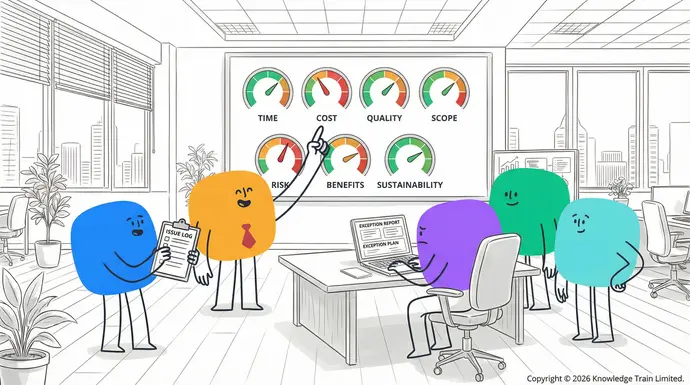
The seven aspects are: PRINCE2 exception management encompasses seven performance aspects which include time, cost, quality, scope, risk, benefits, and sustainability.
How often should teams review tolerances during a project?APMG CHANGE MANAGEMENT COURSES
Teams need to evaluate tolerances during stage transitions and through ongoing project progress reviews.Select your preferred training course below:
What is the project board’s role in exception management?
The project board establishes project-level tolerances, examines exception reports and decides on corrective actions whenever tolerances surpass allowable limits.PROGRAMME MANAGEMENT COURSES
How does exception management help use senior management time efficiently?Select your self-paced training course topic.
Senior management can optimise their time allocation by intervening only when major issues occur since they delegate authority within established tolerances.
What is an exception plan, and when do teams create one?MSP COURSES
An exception plan serves as a comprehensive approach for resolving tolerance breaches. Teams generate exception plans when predictions indicate that a stage will surpass its established tolerances.Select your preferred training course below:
How does forecasting contribute to effective exception management?
Through forecasting teams can detect potential tolerance breaches ahead of time to take early preventive actions and protect project results.IT QUALIFICATIONS
InfographicSelect your preferred qualification.
