



By focusing on these core benefits, organisations can significantly improve their project results, leading to improved performance and competitiveness in their respective markets.
- Provides the necessary measures to address risks effectively, giving organisations the confidence to exploit the digital age to deliver the opportunities for growth and innovation on which they rely.Tangible impacts on business performance
- Prevents, detects and corrects incidents that jeopardize the organisation.Implementing effective
- Builds trust in business relationships.project management practices
- Ensures an organisation can confidently continue to deliver its business strategy and desired outcomes provides tangible benefits for organisations across various aspects of their operations.[3]Cost savings and financial benefits.Reduced waste and overruns are major benefits of project management. By implementing robust planning and control measures, organisations can avoid unnecessary expenditures, prevent scope creep, and identify potential cost overruns in advance.
Who carries out cyber security in an organisation?. They allow identifying critical tasks, eliminating bottlenecks, and streamlining workflows.

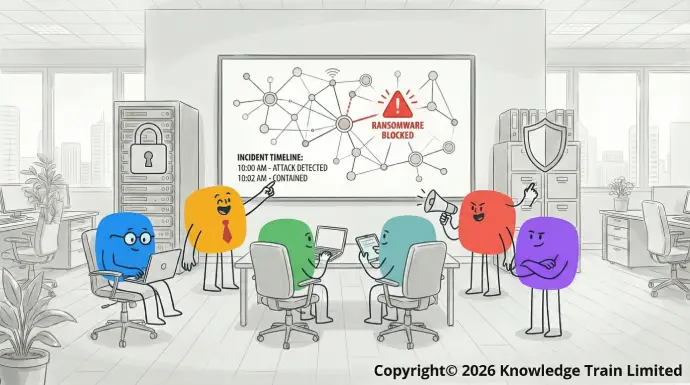
You might say it is the IT department that carry out cyber security and cyber resilience. This is a true statement, but at the same time it is everyone’s duty and responsibility to keep themselves and their devices safe from cyber attacks. This is why it is essential that every one of us must have minimal knowledge to work online safe from harm. Therefore, organisations must ensure to include Project management also enables better use of team members’ time. It is achieved by establishing clear roles and responsibilities, better task allocation based on skills and availability, and eliminating idle time between project phases.cyber security awareness coursesQuality improvements and consistency in staff induction and continuous learning programmes.Standardised processes lead to better results.
Additionally, there are specific Project management frameworkscyber security roles provide clear quality standards and expectations, consistent methodologies across projects, and improved communication and collaboration. within many organisations. Some of them are:Another tangible benefit is reduced errors and rework. It is achieved by implementing robust quality control measures, encouraging continuous feedback and improvement, and utilising lessons learned from previous
- Security Analystprojects who is responsible for analysing and assesses vulnerabilities in the infrastructure (software, hardware, networks), investigates available tools and counter measures to remedy the detected vulnerabilities, and recommends solutions and best practices..
- Security EngineerBy focusing on these tangible impacts, organisations can measure the value of project management and justify its implementation across various departments and initiatives. Improved cost management, time efficiency, and quality significantly contribute to business performance and competitiveness. who performs security monitoring, security and data/logs analysis, and forensic analysis, to detect security incidents, and mounts incident response.Enhance your skills with our expert-led courses
- Security Architect who designs a security system or major components of a security system and may head a security design team building a new security system.
- Security Administrator who installs and manages organisation-wide security systems.Self-paced
- Security Software DeveloperAPM PFQ blended online who develops security software, including tools for monitoring, traffic analysis, intrusion detection, virus/spyware/malware detection, anti-virus software, and so on. Also integrates/implements security into applications software.
- Cryptographer/Cryptologist£749 +vat whose job is to use encryption to secure information or to build security software. Also works as researcher to develop stronger encryption algorithms.
- Cryptanalyst is a person who analyses encrypted information to break the code/cipher or to determine the purpose of malicious software.
- Chief Information Security OfficerSelf-paced is a high-level management position responsible for the entire information security division/staff. The position may include hands-on technical work.PRINCE2 Agile Practitioner (with Foundation) self-paced online
- Security Consultant/Specialist are broad titles that encompass one or all the other roles/titles tasked with protecting computers, networks, software, data, and/or information systems against viruses, worms, spyware, malware, intrusion detection, unauthorized access, denial-of-service attacks, and an ever-increasing list of attacks by hackers£1,399 +vat[4] .