Key takeaways
Lewin’s model helps organisations manage change by focusing on both process and psychology.
- Unfreezing works best when characters communicate clearly, involve stakeholders early, and challenge the status quo to reduce resistance.
- Changing succeeds when training, coaching, and practical support help characters adopt new ways of working.
- Feedback loops during implementation surface issues early and keep the transition on track.
- Refreezing makes change stick through reinforcement, aligned policies, and cultural integration.
- Lewin’s simplicity is a strength, but fast-moving environments may need more iterative or combined approaches such as Kotter or ADKAR.
Introduction in many different organisations.
In today’s uncertain world, The fifth disciplinechange managementIn his seminal book, “The fifth discipline,” Senge outlines five key disciplines necessary for building a learning organisation. These include personal mastery, mental models, shared vision, team learning, and systems thinking. His work highlights how these disciplines can transform organisational culture, enhancing efficiency and strategic thinking. plays a crucial role in ensuring that organisations adapt effectively to shifting markets and technological advancements. Successful change management allows businesses to transform, innovate, and remain relevant.Core principles of Senge’s model
One of the most respected frameworks in this field is Understanding the five disciplinesKurtPersonal mastery Personal mastery centres on recognising the gap between current reality and personal vision. This gap creates ‘creative tension’ which drives individual growth and learning. It requires both clarifying what matters and seeing current reality clearly. In the context of system thinking, personal mastery encourages individuals to see their role within a larger system.LewinThis self-awareness helps them contribute more effectively to organisational goals.’Mental modelss change modelMental models are deeply ingrained assumptions that influence how we understand the world. Senge incorporated Chris Argyris’s ‘ladder of inference’ alongside the ‘left-hand column’ technique to examine these assumptions. These tools help organisations identify and challenge limiting beliefs., which offers a structured approach to implementing change. Developed in 1947, Lewin’s model breaks down the complex process of change into three distinct stages: By examining and challenging mental models, individuals and teams can eliminate biases and embrace new perspectives. This process is crucial for fostering open-mindedness and adaptability.unfreezingShared vision
- CommunicationEnhance your skills with our expert-led courses: Open and transparent communication helps employees understand the reasons for change. It reduces uncertainty and anxiety, fostering a supportive environment where individuals are more willing to let go of old habits.
- Leadership engagement : Leaders play a crucial role in modelling desired behaviours and attitudes. Their involvement is essential in building trust and commitment to the change process.
- Stakeholder involvementInstructor-led: Engaging key stakeholders early in the process ensures that their concerns are addressed, and their insights are incorporated into the change strategy. This involvement can lead to more innovative solutions and greater buy-in.Change Management Practitioner (with Foundation) course
Psychologically, unfreezing helps individuals and groups prepare for change by breaking down existing mindsets and fostering a readiness to embrace new ideas. By addressing the emotional aspects of change, organisations can create a foundation for successful transformation.
Changing£1,699 +vat
The changingSee all dates stage represents the transition from old behaviours to new practices. It is the phase where the actual change occurs, requiring careful planning and execution. This stage focuses on:
- Implementation : Introducing new processes, technologies, or structures requires clear guidance and support. Training programmes and resources should be made available to facilitate learning and adaptation.
- Support systemsSelf-paced: Providing support through mentoring or coaching can help employees navigate the challenges of change. It ensures that they have the necessary skills and confidence to adopt new ways of working.Change Management Practitioner (with Foundation) self-paced online
- Feedback mechanisms : Regular feedback allows for continuous improvement and adjustment. It helps identify areas of resistance or difficulty, enabling timely interventions to keep the change process on track.£1,299 +vat
During the changing stage, the emphasis is on enabling individuals to adopt new behaviours and integrate them into their daily routines. By focusing on both structural and human elements, organisations can ensure that change is effective and sustainable.
Refreezing
The refreezingSelf-paced stage is the final step, where new changes are solidified and integrated into the organisational culture. It ensures that the changes become permanent and prevents regression to old practices. Key aspects of refreezing include:Change Management Foundation self-paced online
- Reinforcement : Recognising and rewarding employees who successfully adapt to change reinforces desired behaviours. It encourages others to follow suit and helps embed new norms.£799 +vat
- Policy and procedure alignmentApplications of Senge’s system thinking model: Updating policies and procedures to reflect new practices ensures consistency and clarity. It provides a framework for maintaining changes over time.Organisational strategy and change management
- Cultural integrationStrategic planning: Embedding changes into the organisational culture requires ongoing effort and commitment. It involves aligning values, beliefs, and behaviours with the new direction.System thinking plays a crucial role in strategic planning by offering a comprehensive view of organisational dynamics. It encourages leaders to consider the long-term effects of their decisions. By recognising patterns and feedback loops, organisations can develop robust strategies that anticipate potential challenges. This approach ensures that plans are adaptable and aligned with the organisation’s vision.
Refreezing is crucial for sustaining change, as it creates stability and reduces the likelihood of reverting to previous habits. By reinforcing new behaviours and aligning them with organisational goals, change becomes an integral part of the organisation’s identity.Change management
In conclusion, Lewin’s change model offers a structured approach to managing organisational change, addressing both the psychological and practical aspects of transformation. Its enduring relevance lies in its ability to guide organisations through the complexities of change, ensuring successful and lasting outcomes.In change management, system thinking provides a framework for understanding the complexities of organisational transitions. It helps identify underlying causes of resistance and facilitates smoother implementation of change initiatives. By focusing on relationships and interdependencies, leaders can craft strategies that address concerns and engage stakeholders effectively. This holistic view reduces disruptions and enhances the success of change efforts.
Advantages and disadvantages of Lewin’s change modelSeveral companies have successfully integrated Senge’s system thinking model into their operations. For instance, Royal Dutch Shell applied systems thinking through scenario planning in the 1970s and 1980s, which helped them prepare for major oil market changes. Similarly, Unilever adopted system thinking to improve sustainability practices, resulting in significant reductions in waste and resource consumption.
Kurt Sector-specific applicationsLewin’sIn the healthcare sector, system thinking has been applied to streamline patient care pathways, improving outcomes and reducing costs. Educational institutions have also embraced this model to foster collaborative learning environments, enhancing both teaching methods and student engagement. These sector-specific applications demonstrate the versatility of Senge’s model across different fields. force field analysis and three-stage model of change are renowned for their simplicity and clarity, making them accessible tools for organisations navigating change.Lessons learned
One of its primary strengths is its straightforward three-stage process – Key takeawaysunfreezingThe key takeaway from these examples is the importance of aligning the organisation’s vision with system thinking principles. Successful implementations often involve a strong commitment from leadership and a willingness to challenge existing mental models. Organisations that foster a culture of learning and open communication tend to reap the most benefits., By focusing on the interconnectedness of processes, companies can achieve improved efficiency and innovation. Moreover, the psychological benefits, such as reduced stress and increased job satisfaction, contribute to a more positive organisational culture. These lessons highlight the potential of Senge’s model to transform diverse workplace settings.changingImplementing Senge’s system thinking, and Learning how to implement Senge’s system thinking model, as well as learning other refreezingchange management skills. This structure provides a clear roadmap for implementing change, helping organisations manage transitions systematically. can be made easier for change managers who attend a
Additionally, the model emphasises the psychological aspects of change, such as reducing stress and enhancing acceptance, which fosters a supportive environment for transformation.change management course
However, despite these advantages, Lewin’s model is not without criticism. A notable limitation is its planned approach to change, which some argue oversimplifies emergent and continuous organisational change processes.. Such courses often lead to a
In today’s fast changing world, change often requires flexibility and adaptability, which a linear model may not sufficiently address. Critics also point out that the model assumes a relatively static environment, whereas many organisations face continuous or overlapping changes that demand more iterative processes.change management qualification
Furthermore, while Lewin’s model is effective in highlighting the human element of change, it may not fully account for technological advancements and rapid market shifts that influence contemporary , but they equip change managers with the skills and tools to deliver change initiatives successfully.change managementIf you are seeking to become a change manager, read .How to become a change manager
Therefore, while Lewin’s change model provides a foundational framework, organisations may need to adapt it or integrate it with other .change management modelsConclusion to address the multifaceted nature of change in today’s world.Senge’s system thinking model offers a holistic framework that enhances efficiency, innovation, and collaboration. By integrating personal mastery, mental models, shared vision, team learning, and systems thinking, organisations can address complex challenges effectively.
Real-world applications of Lewin’s change modelorganisational change
Lewin’s change model has been successfully applied across various sectors, demonstrating its versatility and effectiveness. These applications provide valuable insights into how organisations can manage transformation effectively..
Example 1: Application in a corporate settingHow can system thinking improve organisational performance?
In a leading technology firm, Lewin’s model guided a transition to By enhancing efficiency, collaboration, and innovation. The approach helps organisations identify root causes of problems, understand feedback loops, and develop more sustainable solutions through holistic analysis.agile project managementWhat are the challenges in implementing Senge’s model?Can Senge’s model be applied in small businesses?unfreezingYes, it is adaptable to different organisational sizes. Small businesses can particularly benefit from systems thinking by understanding interconnections between different business functions and making more informed strategic decisions. stage, management identified the need for agility to stay competitive. Workshops and discussions were held to prepare employees for the shift. In the What are some real-world examples of system thinking?changingRoyal Dutch Shell applied systems thinking for scenario planning in oil market changes. Other examples include Unilever’s sustainability initiatives and healthcare organisations improving patient care through systems approaches. These cases demonstrate how systems thinking can lead to better strategic planning and operational improvements. phase, How does system thinking affect decision-making processes?agile methodologiesIt promotes informed and sustainable decisions. Systems thinking helps leaders consider long-term consequences, understand feedback loops, and recognise how different parts of the organisation influence each other before making strategic choices. were introduced through training programmes, supported by mentors to ease the transition. The What role does “The fifth discipline” play in system thinking?refreezingIt outlines the core principles of Senge’s model. Published in 1990, the book introduces the five disciplines and explains how systems thinking integrates them to create lasting organisational learning and change. stage involved integrating these practices into the company culture, reinforced by regular feedback sessions.Infographic
- OutcomePeter Senge change management model has been captured in this infographic.: The move resulted in improved project delivery times and enhanced team collaboration.Subscribe to our exclusive offers and promotions
- Lesson : Clear communication and support systems are crucial for overcoming resistance.Subscribe now
Example 2: Implementation in healthcare
A hospital implemented Lewin’s model to transition from paper-based to electronic medical records. The {"@context":"https://schema.org","@type":"ImageObject","contentUrl":"https://www.knowledgetrain.co.uk/training-courses/change-management-model-peter-senge-with-infographic-890x501.webp","description":"Peter Senge systems thinking model.","license":"https://www.knowledgetrain.co.uk/license","acquireLicensePage":"https://www.knowledgetrain.co.uk/license","creditText":"Knowledge Train","uploadDate":"2023-05-16T13:55:59.000Z","copyrightNotice":"© 2023 Knowledge Train Limited. All rights reserved.","creator":{"@type":"Organization","name":"Knowledge Train","url":"https://www.knowledgetrain.co.uk"}}unfreezing{"@context":"https://schema.org","@type":"ImageObject","contentUrl":"https://www.knowledgetrain.co.uk/training-courses/peter-senge.webp","description":"Unveiling the impact of Senge’s system thinking model on change management","license":"https://www.knowledgetrain.co.uk/license","acquireLicensePage":"https://www.knowledgetrain.co.uk/license","creditText":"Knowledge Train","uploadDate":"2023-05-16T13:55:59.000Z","copyrightNotice":"© 2023 Knowledge Train Limited. All rights reserved.","creator":{"@type":"Organization","name":"Knowledge Train","url":"https://www.knowledgetrain.co.uk"}} phase involved addressing staff concerns through information sessions. During the Related articles
- : This change increased efficiency and accuracy in patient record management.
- Lesson: Continuous support and training are vital for successful technological adoption.
Example 3: Educational institutions
A university applied Lewin’s model to innovate its teaching methodologies. Unfreezing involved recognising the limitations of traditional teaching. The changing phase saw the introduction of digital tools and interactive techniques. Refreezing embedded these new practices through policy changes and faculty workshops.
- OutcomeKotter’s organisational change model: Student engagement and learning outcomes improved significantly.
- LessonSimon Buehring: Institutional support and policy alignment are key to sustaining educational change.8 Sep 2026
These examples highlight the model’s adaptability and the importance of addressing both human and structural elements in change initiatives.
Comparing Lewin’s model with other change management theoriesExplore Kotter's 8-step model to navigate organisational change effectively. Understand each phase and enhance your transformation strategy. Keep reading to refine your change management skills.
Lewin’s model is just one of many change models that change managers must understand to ensure the best chances of leading successful change. This is why attending a change management course can be invaluable. Not only do such courses often lead to gaining a change management qualification , but they equip change managers with the change management skills to deliver successful change initiatives.
If you are interested in becoming a change manager, read Change management modelsHow to become a change manager .Simon Buehring
Kurt 10 Sep 2026Lewin’s change model is often compared with frameworks such as Discover popular change management models and their applications. Click through for colorful infographics and detailed descriptions.Kotter’s 8-step process and ADKAR . Each model offers unique perspectives and methodologies for managing change within organisations.
- Lewin’s model is straightforward, focusing on three stages: unfreezing, changing, and refreezing. Its strength lies in its simplicity and emphasis on the psychological aspects of change, which can reduce stress and increase acceptance.
- Kotter’s 8-step process provides a more detailed approach, outlining specific steps like establishing a sense of urgency and creating short-term wins. This model is particularly useful for large-scale transformations requiring clear guidance and extensive communication.Kübler-Ross change curve for successful transitions
- ADKAR focuses on individual change and is goal-oriented, emphasising Simon BuehringAwareness8 Sep 2026, DesireDiscover how the change curve can assist in managing transitions effectively. Gain insights and strategies to navigate change smoothly. Scroll down to explore more., Knowledge , Ability , and Reinforcement . It is beneficial for understanding and managing personal impacts during organisational changes.
Lewin’s model is preferred when a concise and psychologically grounded approach is needed. It is particularly effective in scenarios where resistance to change is prominent, and fostering a supportive environment is crucial. However, in complex or large-scale organisational transformations, Kotter’s detailed steps or ADKAR’s individual focus might offer additional advantages.Change management qualifications explained
Ultimately, the choice of model depends on the organisational context and the specific challenges faced. Integrating elements from different frameworks can often provide a more comprehensive strategy, catering to both structural and human elements of change.
Influence tactics and work outcomes in change managementChange management skills
The success of change managementSimon Buehring efforts is significantly influenced by the tactics employed to guide and motivate individuals within an organisation. Effective 10 Sep 2026influence tactics are essential for ensuring that changes are not only implemented but also sustained over time. These tactics include clear communication, employee involvement, and positive reinforcement, all of which contribute to a supportive environment for change.Discover the essential skills required for effective change management and how they apply to unique organizational contexts. Read further for detailed insights.
Research on work outcomes in relation to change efforts highlights the importance of these tactics. The analysis reveals that successful change initiatives often involve:
- Effective communication : Keeping communication channels open and transparent helps align employees with the change objectives. It reduces uncertainty and stress, fostering an environment where employees feel informed and valued.
, a foundational framework for implementing organisational change . The model’s three stages – unfreezing, changing, and refreezing – provide a structured approach that emphasises the psychological aspects of change, such as stress reduction and enhanced acceptance.
While Lewin’s model offers simplicity and clarity, it is essential to acknowledge its limitations, especially in dynamic environments requiring more iterative approaches. Comparing it with other frameworks like Kotter’s 8-Step Process and ADKARLewin’s change model for successful change management reveals the need to tailor strategies to specific organisational contexts.
Ultimately, understanding and implementing Lewin’s model can facilitate successful change management by addressing both human and structural elements, ensuring that transformations are sustainable and beneficial for organisations.Simon Buehring
FAQs8 Sep 2026
What are the key stages of Lewin’s change model?
Lewin’s change model consists of three key stages: Learn how Lewin's change model can guide your organisation through change. Uncover practical strategies and insights to facilitate smooth transitions. Scroll down for more information.unfreezing , changing , and refreezing . Unfreezing prepares the organisation for change by challenging the current state. Changing involves implementing new processes or behaviours. Refreezing solidifies these changes, integrating them into the organisational culture.
How does unfreezing facilitate change in organisations?
UnfreezingThriving in Change – Webinar with Luz Flores Lee facilitates change by creating awareness of the need for transformation. It involves dismantling existing mindsets and behaviours, reducing resistance, and preparing employees psychologically for the upcoming changes. This stage is crucial for establishing a foundation for successful change.
What are common challenges in the refreezing stage, and how can they be addressed?Sevcan Yasa
Common challenges in the 7 Oct 2026refreezing stage include reverting to old habits and lack of reinforcement. To address these, organisations can implement continuous support systems, provide ongoing training, and celebrate successes to reinforce new behaviours, ensuring they become part of the organisational norm.Watch this insightful webinar with Luz Flores Lee to master Agile strategies for navigating change in your career. Scroll down to enhance your skills and advance your professional journey.
How does Lewin’s change model compare to Kotter’s 8-step process?
While Lewin’s model offers a simple three-stage framework, Kotter’s 8-Step Process provides a more detailed approach. Kotter’s model outlines specific steps such as creating urgency and building a guiding coalition. Lewin’s model is ideal for straightforward changes, whereas Kotter’s is suited for complex transformations requiring extensive communication.
Can Lewin’s model be applied in small businesses? If so, how?
Yes, Lewin’s model can be effectively applied in small businesses . Its simplicity makes it accessible for limited resources. Small businesses can use it to prepare employees for change, implement new practices incrementally, and ensure that these changes are sustained through regular feedback and reinforcement. This approach helps maintain agility while fostering a culture of continuous improvement.Guiding your team through change using the Satir change model
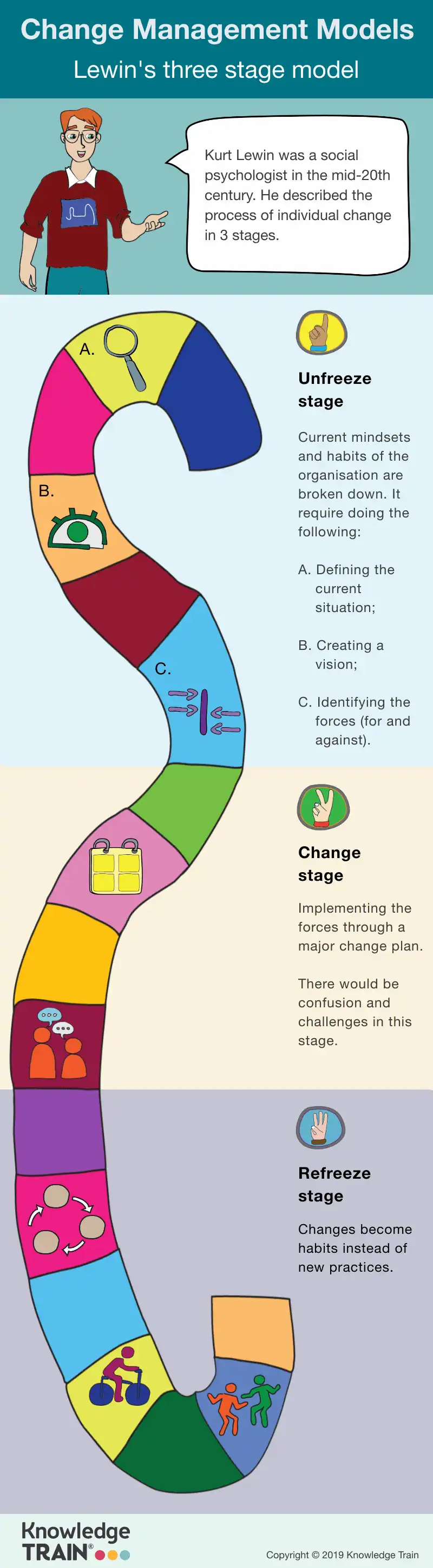
Infographic
Kurt Lewin’s change management model has been summarised on this colourful infographic.Simon Buehring