
Key takeawaysPRINCE2 manual
Different change models suit different scales of change and different human impacts. or any other printed or electronic materials during the examination.
- Use Lewin’s three stages to frame straightforward organisational change from start to stabilisation. The exam contains 4 types of question style: ‘standard’, ‘list’, ‘negative’, and ‘missing word’. The questions are always in multiple-choice format, so you simply need to pick one answer out of the four options given. There are no trick questions on the exam paper and each question only has one correct answer.
- Apply Kotter’s eight steps when coordinating large, complex transformation programmes.{"@context":"https://schema.org","@type":"ImageObject","contentUrl":"https://www.knowledgetrain.co.uk/training-courses/res/images/agile/how-to-write-user-story.png","description":"User story example","license":"https://www.knowledgetrain.co.uk/license","acquireLicensePage":"https://www.knowledgetrain.co.uk/license","creditText":"Knowledge Train","uploadDate":"2023-05-18T07:11:17.000Z","copyrightNotice":"© 2023 Knowledge Train Limited. All rights reserved.","creator":{"@type":"Organization","name":"Knowledge Train","url":"https://www.knowledgetrain.co.uk"}}‘Standard’ style questions
- Use Senge’s systems view to understand how change spreads and affects individual staff over time. This is the style of question which you will have answered many times before. For example:
- Borrow Satir and Kubler Ross to anticipate emotional responses and reduce disruption during change.Related articlesQ. In which of the following processes does the project board choose a suitable risk response?
- Use ADKAR to diagnose and build individual readiness through Awareness, Desire, Knowledge, Ability, and Reinforcement. Controlling a stage
- Apply McKinsey 7-S to align key organisational elements and track progress and issues clearly. Managing a stage boundary
Introduction Project assurance
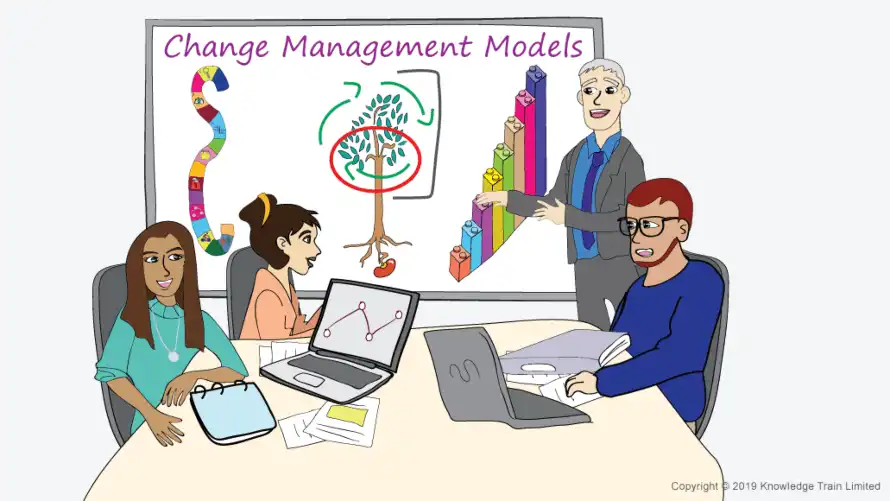
Some How Agile Project Management (AgilePMBusiness managerchange management®Senior supplier models can be used to analyse change on an enterprise level. Others are best suited to understanding how change affects individual members of staff.) qualifications can help your careerFor this type of question, it is important that you take notice of the word
Below, we have information on some of the most popular NOTchange modelsSimon Buehring. The word . Click to see colourful infographics of each model.19 Feb 2026NOT
Lewin change model is always bolded to bring your attention to the fact that the question is a negative one.
Developed by Kurt Lewin in the 19040’s, this model remains a cornerstone of AgilePM qualifications can significantly advance your project management career. Discover how by reading further.‘Missing word’ style questionsorganisational change For example: – using a simple 3-step method to successfully implement change in organisations both large and small. Identify the missing word in the following sentence.
Read more and see a colourful infographic about the A purpose of the [ ? ] practice is to control any unacceptable deviations from the project’s objectives.Lewin change management model Change here. Plans
Kotter change model or a
Kotter’s 8-step model is suitable for large change initiatives in complex organisations. Kotter expanded on the work of Kurt Lewin to develop a more complex, more intricate model for the processmanagement of change. Since there are a lot of management products, practices and processes, that’s a lot of purposes to remember! That can be too many things. You need some trusted methods to help you remember so try paraphrasing.Go to Appendix A in the
Read more about the Apply the McKinsey 7-S model three-pass approach here. to maximize your chances of passing.
Kubler Ross change curve Do
Another odd accompaniment to the change managers’ arsenal, the Kubler Ross curve, was designed to model the human reaction to loss and grief. Once again, change managers saw this as a good way to understand the impact of business change on human lives and appropriated the model for their own use. NOT
Read more and see a colourful infographic about the spend too long on complex questions – skip them and answer them last.Kubler Ross change curve Don’t over-analyze questions. here. Think carefully before changing answers. Your initial response is often correct.