Change management modelsThe technical storage or access is strictly necessary for the legitimate purpose of enabling the use of a specific service explicitly requested by the subscriber or user, or for the sole purpose of carrying out the transmission of a communication over an electronic communications network.

Key takeawaysStatistics
Different change models suit different scales of change and different human impacts.
- Use Lewin’s three stages to frame straightforward organisational change from start to stabilisation.
- Apply Kotter’s eight steps when coordinating large, complex transformation programmes.
- Use Senge’s systems view to understand how change spreads and affects individual staff over time.
- Borrow Satir and Kubler Ross to anticipate emotional responses and reduce disruption during change.
- Use ADKAR to diagnose and build individual readiness through Awareness, Desire, Knowledge, Ability, and Reinforcement.
- Apply McKinsey 7-S to align key organisational elements and track progress and issues clearly.
The technical storage or access that is used exclusively for statistical purposes.
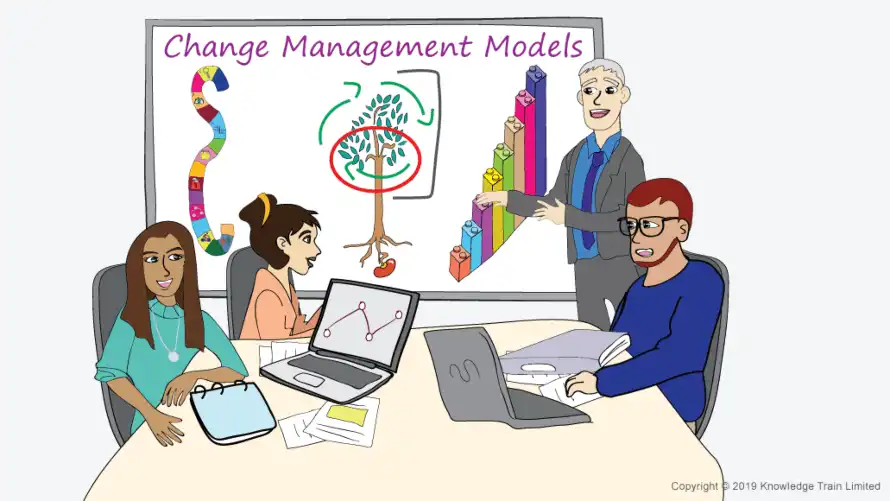
Kubler Ross change curve
Another odd accompaniment to the change managers’ arsenal, the Kubler Ross curve, was designed to model the human reaction to loss and grief. Once again, change managers saw this as a good way to understand the impact of business change on human lives and appropriated the model for their own use.Manage options
Read more and see a colourful infographic about the Manage servicesKubler Ross change curveManage {vendor_count} vendors here.Read more about these purposes