
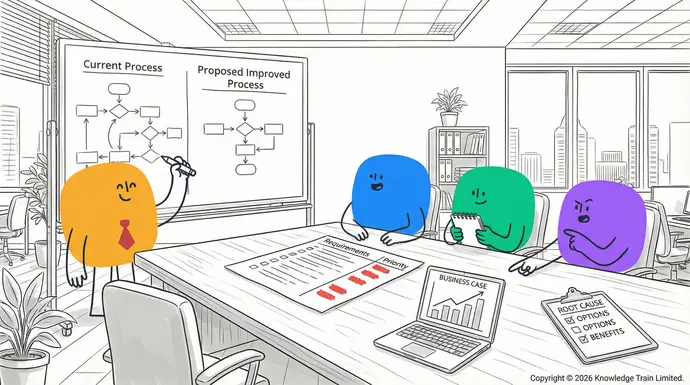
Introduction™
What is a business analyst?Foundation
Business analysts normally work on Learn the fundamentals of Better Business cases.projectsPractitioner .Includes Foundation & Practitioner combined option.
Their role involves:P3O
- Understanding the current organisational situation;®
- Identifying future needs;Foundation
- Defining solutions which will meet those needs.Learn the fundamentals of the P3O project management office.
Many business analysts develop their careers by attending a Practitioner business analyst courseIncludes Foundation & Practitioner combined option., either to learn some initial business analyst skills, or to further develop existing business analysis skills. These courses typically teach a wide variety of different business analysis tools and techniques.Workshops
What do business analysts do?AgilePM
A ®business analyst – Agile Project Management is an advisor. He or she advises business decision makers about potential changes or improvements to business IT systems and processes which align with the needs of the business.Foundation
A large part of what a business analyst does involves identifying and evaluating options for improvements to business systems, and helping business users define and elaborate their business needs so that they can be turned into a new business process, product or system which helps the organisation meets its business goals.Learn the key principles of Agile Project Management.
Responsibilities of a business analystPractitioner
These are the main responsibilities of a Includes Foundation & Practitioner combined option.business analystPRINCE2:®
- Investigate business systems Agile – this involves looking at the current organisational structures, business IT systems and current business processes;Foundation
- Evaluate actionsLearn the fundamentals of the PRINCE2 Agile method. – this is done to identify potential improvements to current business systems and processes. This involves assessing staff development needs so that they align with any proposed process redesign or IT systems;Practitioner
- Elaborating business requirementsIncludes Foundation & Practitioner combined option. – this is done by working closely with users of the proposed or modified business systems or processes;Scrum
- Documenting business requirementsScrum Essentials – for the IT systems support;Self-paced training course to learn the essentials of Scrum.
- Writing business cases for projectsScrum Master – this involves weighing up the benefits against the costs, risks and timescales for a project.Choose Scrum Alliance or Scrum.org Scrum Master training courses.
Senior business analyst roleScrum Product Owner
More senior business analysts can be involved in other areas as well, including:Choose Scrum Alliance or Scrum.org Product Owner training courses.
- Strategic implementationAgileBA – working closely with senior management to help define the most appropriate business IS systems and processes which help meet the organisation’s strategic business needs;®
- Business case production – Agile Business Analysis – defining a robust Foundation business caseLearn the fundamentals of Agile Business Analysis. to justify the investment. This is often done with experts from finance;Practitioner
- Benefits realisation4-day course including Foundation.
- Practitioner Product owner.
Business analyst skillsFoundation
Some of the skills you will need as a business analyst include the following:Learn the fundamentals of ITIL service management.
| Personal qualitiesStrategist DPI | Business knowledge3-day ITIL Strategist: Direct, Plan & Improve (DPI) course. | Professional techniquesSpecialist: DSV |
|---|---|---|
| Communication; Relationship building; Influencing; Team working; Political awareness; Analytical skills; Critical thinking; Attention to detail; Problem solving; Leadership; Self-belief; Professional development.3-day ITIL Specialist: Drive Stakeholder Value (DSV) course. | Business finance; Business case development; Domain knowledge; Subject matter expertise; Principles of Specialist: CDS IT3-day ITIL Specialist: Create, Deliver and Support (CDS) course.; Organisation structure; Supplier management; Business architecture.IT Learning Library (ITLL)™ | Project management; Strategy analysis; Stakeholder analysis; Stakeholder management; Investigation techniques; Requirements engineering; Business modelling; Data modelling; Gap analysis; Facilitation skills; Portfolio managementBUSINESS LEARNING LIBRARY (BLL)™; Benefits management; Business case development; Agile thinking.Agile Learning Library (ALL)™ |
Business analyst certificationBusiness Analysis Learning Library (BALL)™
Having a Compliance Learning Library (CLL)™business analyst certificationIT Learning Library (ITLL)™ will help you stand out from the crowd. It helps to equip you with the knowledge and techniques in business analysis.Business solutions
In the UK, BCS is the main accreditation body that provides _blankbusiness analysis certificationFree tools. APMG International also provides the Aboutagile business analyst certification_blank. A Blogbusiness analyst course can be expensive, but you can expect a return on your investment.EXPLORE SUBJECTS
Business analyst salarySelect your preferred subject.
According to glassdoor.co.uk, the average salary of a business analyst is over £38k per year. This depends upon your qualifications and experience.
Can you be a business analyst?PROJECT MANAGEMENT QUALIFICATIONS & WORKSHOPS
If you have the skills, the knowledge and experience, you could be a business analyst. If you tick all the boxes in the list, it is worth thinking about it.Select your preferred qualification or workshop.
If you are considering a change in your career path, check our guide to business analysis careersPRINCE2 COURSES.Select your preferred training course below: