Exploring the impact of the McKinsey 7S model on organisational performanceCheap courses often cut corners on materials, venue comfort, classroom time, and trainer experience.

Key takeaways
Use the 7S model to improve performance by aligning what the organisation does with how it operates and behaves.Is the provider ethical?
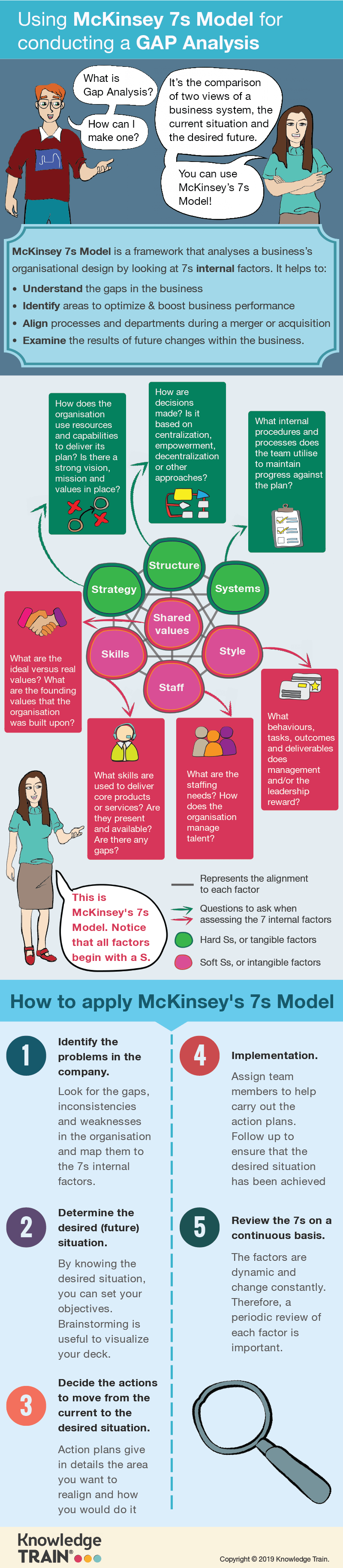
- The 7S model links three hard elements and four soft elements, so changes in one area affect the others.
- Start by assessing the current state of strategy, structure, systems, shared values, style, staff, and skills using stakeholder input.Terms and conditions
- Identify the most damaging gaps, such as strategy that the structure cannot deliver or skills that do not match role needs.
- Create an action plan with measurable objectives, owners, and timelines, and review progress regularly to sustain alignment.Tactics to help you
- Use complementary tools for external factors, as the model focuses mainly on internal organisational elements.Introduction
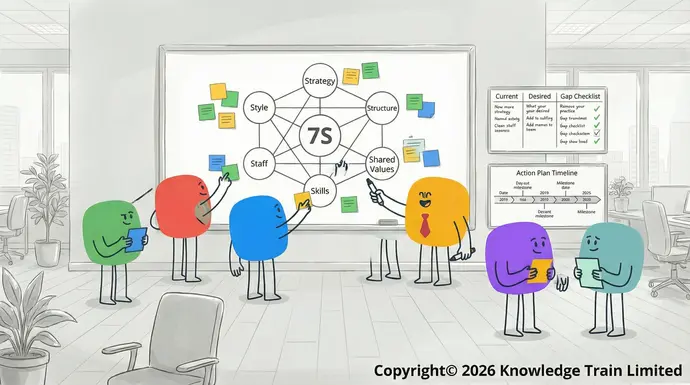
- : This refers to the organisational hierarchy and how different departments and teams are organised. The structure determines reporting lines, decision-making authority, and communication channels. An optimal structure facilitates efficient operations and supports the implementation of the strategy.See all dates
- SystemsMaterials: These encompass all procedures, processes, and technologies that support daily operations. Systems include everything from PRINCE2IT is a comprehensive methodology, and it is vital that students have access to clear and reliable training materials, in order to grasp the ins and outs of each process, the interrelation of the infrastructure to performance management processes. Well-designed systems enhance productivity and ensure consistent quality across the organisation.management products
Soft elements, and the role each principle and theme plays in the overall framework.
The four Death by PowerPointsoft elementsCheap training courses have a preference for PowerPoint, often printed six to a page. There are some PRINCE2 training providers who offer their students more than 360 PowerPoint slides in 3 days. Talk about death by PowerPoint! are less tangible but equally crucial for organisational success:Ask about the materials
- Shared valuesWhen selecting a : These are the core principles and beliefs that guide the organisation’s behaviour. Shared values form the foundation of corporate culture and influence decision-making at all levels. They should align with the organisation’s mission and strategy.PRINCE2 course
- Skills for yourself or your team, take a few minutes to enquire about, or peruse the training materials available: Are they printed, for example, in black and white or colour (a significant concern, given the quantity of PRINCE2 charts and diagrams)? Are training materials available online? What kind of pre-course materials are offered?: This element represents the collective capabilities and expertise of the organisation’s workforce. It includes both technical and soft skills. Continuously developing and aligning skills with strategic objectives is essential for maintaining competitive advantage.Need to be continuously improved
- StyleLess reputable training providers will not devote time to improving their course materials because they see this as a cost. If they can get away with using the same materials time after time, even though they aren’t effective, then they will do so.: This refers to the leadership approach and overall organisational culture. The management style influences employee motivation, communication patterns, and decision-making processes. An effective style fosters innovation, collaboration, and high performance.Better training providers know how important the whole learning experience is, and take the time to improve their materials over time.
. Each component should be evaluated individually to understand its present condition. Engage with key stakeholders to gather insights and perspectives. Use surveys and interviews to collect data, ensuring a comprehensive understanding of each element. The goal is to establish a clear baseline that will guide future improvements and alignments.Big is not better
Identifying gaps and misalignmentsSome companies like to tell you they are the largest provider. You know what large companies are often like – think of your mobile, or gas or electric provider. Good customer service? Probably not. It’s the same with training providers.
Once the current state is assessed, focus on identifying any gaps and misalignments among the seven elements. These discrepancies can hinder organisational effectiveness and should be addressed promptly. Compare the current state with the desired future state to pinpoint areas needing attention. Look for inconsistencies between The sales staff trying to sell you a course cares nothing about you, or your career goals. They are only interested in their sales commission. That’s why they will try to sell you a course which might be totally unsuitable for you. That includes making all kinds of untrue claims simply because they want to close the sale.strategyDon’t be treated as a sales target and It’s generally the case that the larger the company, the less the individual customer is valued. You just become a number, a sales target, something to be shifted between departments as part of a system.structureA smaller provider is much more likely to treat you as an individual, not as a potential sales target. The best providers will try to understand your training needs before offering you advice about which course (if any) would suit you., or mismatches in Is the provider ethical?skillsYou might think that all training organisations are ethical in the sense that they advertise a course, you pay for it, and then you attend and hopefully get accreditation at the end. Sounds simple doesn’t it? and However, there are some unethical training organizations who have no intention of ever running a course in a particular location. They advertise it however, will take your money but often don’t deliver.staffThe typical way this works is that the unethical provider will advertise the same course running in 5 or 6 cities in the same country all on the same date. They will then advertise the same course in the same cities the next month. They hope to get one or two people from each city and will then cancel all the courses except one and tell people from the other cities the location has changed and they must travel to the other city to attend the course, take their deployment. Prioritise issues that have the most significant impact on performance. This step is crucial for setting the foundation for an actionable plan that addresses these discrepancies.online learning
Developing an action plan instead, or lose their money.
With a clear understanding of gaps and misalignments, the next step involves crafting an actionable plan. This plan should address each of the seven elements with specific, measurable objectives. Assign responsibilities and timelines to ensure accountability. Develop strategies to realign misaligned elements, such as restructuring teams or enhancing Enhance your skills with our expert-led coursesskills through targeted training. Regularly review progress and adjust the plan as necessary to maintain alignment. Effective communication is key; keep all stakeholders informed and engaged throughout the process. This strategic approach encourages sustainable change and enhances organisational performance.
Applications of the 7S framework
Strategic planningInstructor-led
The McKinsey 7S Model serves as a powerful tool for PRINCE2 Practitioner (with Foundation) coursestrategic planning . It provides a comprehensive framework for assessing an organisation’s current state and aligning all elements towards future goals. By examining each of the seven components, leaders can identify areas that require adjustment to support new strategies. This holistic approach ensures that all aspects of the organisation are considered when developing and implementing strategic initiatives.£1,899 +vat
Organisational change management
In See all dateschange management, the 7S Framework proves invaluable. It offers a structured approach to navigating complex organisational transformations. By analysing the interdependencies between the seven elements, change leaders can anticipate potential challenges and develop more effective change strategies. The model helps identify which elements need to be modified to support the desired change and ensures that all aspects of the organisation are aligned during the transition process.
Benefits and limitations
Key advantages
The Self-pacedMcKinsey 7S ModelPRINCE2 Practitioner (with Foundation) self-paced online provides a comprehensive framework for organisational analysis and improvement. It ensures alignment between strategy£1,399 +vat, structure , and other key elements, promoting holistic change. By considering both hard and soft elements, it creates a balanced approach that improves overall organisational performance.
Potential drawbacksInstructor-led
Despite its benefits, the model has limitations. It may be time-consuming to apply thoroughly, requiring significant resources and stakeholder engagement. Additionally, the model focuses on internal elements whilst external factors such as market conditions and competition are not directly addressed. This may require complementary frameworks for comprehensive analysis.PRINCE2 Foundation course
Case study: McKinsey 7S in action
An international £1,299 +vatmanufacturing company successfully utilised the See all datesMcKinsey 7S ModelTerms and conditions to enhance operational efficiency. Facing challenges in aligning their global operations, the company applied the model to assess and realign their Can you get your money back? The law is quite clear in the UK – you should be able to get a full refund if the company is not able to provide you with the goods or services which you have paid for. Read carefully the terms and conditions on the supplier’s website. You might be in for a nasty shock.strategyUnethical providers will keep your money and will make it extremely difficult for you to get a refund. Be clear what you are getting yourself into. If you do fall foul of abusive practices, contact your local trading standards office to make a complaint. and Tactics to help youstructurePRINCE2 training providers operate in a keen market place. This puts the potential PRINCE2 student in the position of selecting from a wide range of providers.. They identified that their It is easy, for example, for training providers to fiddle their statistics (anyone can have a 100% pass rate, if you take into account only a few selected examinations), and to make the kinds of claims we considered at the beginning of this article. In this case, how can the new PRINCE2 student cut through the sales guff to choose the truly optimum course?systemsWe’ve put together 12 questions to ask before buying a course in an article. By asking these questions you can save yourself a lot of money and disappointment later by choosing a reputable training provider. were outdated and required modernisation to support their strategic goals. By addressing these misalignments, they improved coordination and communication across different regions. The intervention also focused on developing Don’t just consider costskillsFinally, do not be deceived by cost. A among staff through targeted training PRINCE 2 courseprogrammes. As a result, the company experienced increased productivity and a more cohesive organisational culture, demonstrating the model’s effectiveness in fostering sustainable change.
Conclusion
The several hundred pounds cheaper than the rest is likely to be lacking something crucial – good quality training materials, experienced trainers, training time, or training space, all essential components for an effective and fulfilling PRINCE2 training experience.McKinsey 7S ModelDon’t forget the old adage: “if it seems too good to be true, it probably is”. offers a robust framework for analysing and improving organisational effectiveness. By assessing elements like Subscribe to our exclusive offers and promotionsstrategy , Subscribe nowstructure , systems, and