Exploring the impact of the McKinsey 7S model on organisational performance

Key takeawaysAgile improves delivery by combining iterative planning, tight feedback loops and disciplined ways of working.
Use the 7S model to improve performance by aligning what the organisation does with how it operates and behaves.Agile delivers value in short iterations, using regular reviews and retrospectives to adapt quickly to change.
- The 7S model links three hard elements and four soft elements, so changes in one area affect the others.Scrum, Kanban, Lean and XP offer different structures, so choose based on workflow needs and team maturity.
- Start by assessing the current state of strategy, structure, systems, shared values, style, staff, and skills using stakeholder input.Clear roles, prioritised backlogs and well-written user stories reduce confusion and keep work aligned to outcomes.
- Identify the most damaging gaps, such as strategy that the structure cannot deliver or skills that do not match role needs.Metrics such as velocity, cycle time and burn-down charts improve predictability when paired with a clear definition of done.
- Create an action plan with measurable objectives, owners, and timelines, and review progress regularly to sustain alignment.Lightweight governance, change management and technical debt controls help Agile scale without losing quality.
- Use complementary tools for external factors, as the model focuses mainly on internal organisational elements.
Introduction to the McKinsey 7S modelFAQs
Origins and developmentWhat is Agile project management?
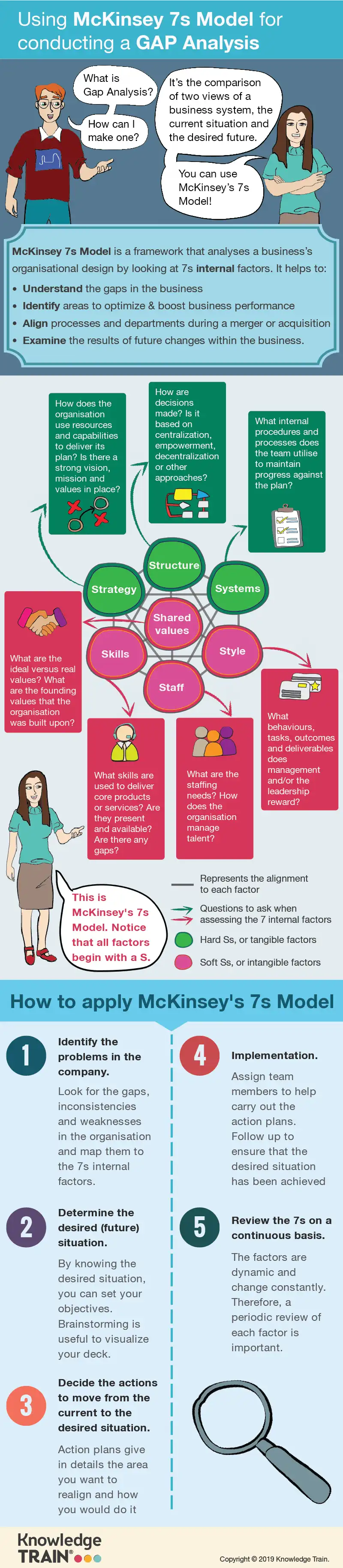
The Agile project managementMcKinsey 7S model is an iterative approach to planning, executing, and emerged in 1978, developed by consultants Tom Peters, Robert Waterman Jr., Richard Pascale and Anthony Athos at McKinsey & Company. This innovative framework addressed a critical gap in organisational theory. Prior to its creation, companies primarily focused on structural aspects for effectiveness. The 7S Model expanded this perspective, recognising that multiple interconnected factors contribute to organisational success.delivering projects
Overview of the 7S framework by breaking work into small, manageable increments known as iterations or sprints. Rather than following a strict linear plan,
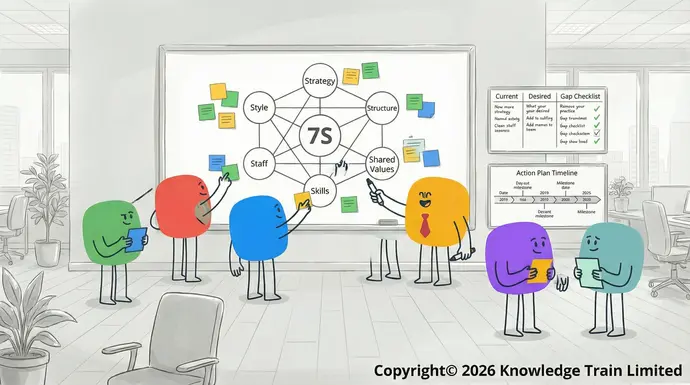
With a clear understanding of gaps and misalignments, the next step involves crafting an actionable plan. This plan should address each of the seven elements with specific, measurable objectives. Assign responsibilities and timelines to ensure accountability. Develop strategies to realign misaligned elements, such as restructuring teams or enhancing Process improvement, efficiencyskillsXP through targeted training. Regularly review progress and adjust the plan as necessary to maintain alignment. Effective communication is key; keep all stakeholders informed and engaged throughout the process. This strategic approach encourages sustainable change and enhances organisational performance.Technical best practices
Applications of the 7S frameworkPair programming, TDD
Strategic planningSmall, tech-focused teams
The McKinsey 7S Model serves as a powerful tool for Software projects needing qualitystrategic planningAgile vs traditional (waterfall) project management. It provides a comprehensive framework for assessing an organisation’s current state and aligning all elements towards future goals. By examining each of the seven components, leaders can identify areas that require adjustment to support new strategies. This holistic approach ensures that all aspects of the organisation are considered when developing and implementing strategic initiatives.The
Organisational change managementwaterfall model
In is a sequential, plan-driven approach where phases follow one another with minimal overlap. change managementAgile project management, the 7S Framework proves invaluable. It offers a structured approach to navigating complex organisational transformations. By analysing the interdependencies between the seven elements, change leaders can anticipate potential challenges and develop more effective change strategies. The model helps identify which elements need to be modified to support the desired change and ensures that all aspects of the organisation are aligned during the transition process. contrasts this with its focus on flexible planning, iterative progress, and stakeholder feedback throughout:
Benefits and limitationsAspect
Key advantagesAgile
The WaterfallMcKinsey 7S ModelApproach provides a comprehensive framework for organisational analysis and improvement. It ensures alignment between Iterative and incrementalstrategySequential and linear, FlexibilitystructureHighly adaptive to change, and other key elements, promoting holistic change. By considering both hard and soft elements, it creates a balanced approach that improves overall organisational performance.Change-resistant
Potential drawbacksCustomer Involvement
Despite its benefits, the model has limitations. It may be time-consuming to apply thoroughly, requiring significant resources and stakeholder engagement. Additionally, the model focuses on internal elements whilst external factors such as market conditions and competition are not directly addressed. This may require complementary frameworks for comprehensive analysis.Continuous collaboration
Case study: McKinsey 7S in actionPrimarily at start/end
An international Risk managementmanufacturing companyEarly and ongoing detection successfully utilised the Late-stage identificationMcKinsey 7S ModelDelivery to enhance operational efficiency. Facing challenges in aligning their global operations, the company applied the model to assess and realign their Work delivered frequentlystrategySingle final delivery and Suitable forstructureComplex, evolving . They identified that their projectssystemsClear, fixed requirements were outdated and required modernisation to support their strategic goals. By addressing these misalignments, they improved coordination and communication across different regions. The intervention also focused on developing Key roles and concepts in Agile projectsskillsProduct Owner: among staff through targeted training Represents stakeholders, manages product backlog, prioritises featuresprogrammesScrum Master. As a result, the company experienced increased productivity and a more cohesive organisational culture, demonstrating the model’s effectiveness in fostering sustainable change.:
Conclusion Facilitates
The ScrumMcKinsey 7S Model process, removes impediments offers a robust framework for analysing and improving organisational effectiveness. By assessing elements like User storiesstrategy:, Short, simple descriptions of a feature told from the perspective of the userstructureBacklog:, Ordered list of project tasks and featuressystemsSprint/Iteration:, and Short, time-boxed development cyclesshared valuesStakeholders:, organisations can achieve greater alignment and efficiency. Although implementing the model requires effort, its benefits in fostering sustainable change are substantial. We encourage organisations to apply this framework to identify misalignments and develop targeted action plans. By doing so, they can enhance performance and create a cohesive organisational culture. Embracing the McKinsey 7S Model can lead to long-term success and resilience in a competitive environment. Individuals or groups with interests in project outcomes
Agile, staff frameworks are designed for product delivery, not , and project managementskills..Less suitable when requirements are fixed and well-defined
How do organisations benefit from the model?Organisational resistance to cultural change
Organisations benefit by achieving alignment between these elements, which enhances overall efficiency and effectiveness. It aids in identifying gaps and formulating targeted action plans.Potential for scope creep without disciplined backlog management
Are there any limitations?Real-world applications and use cases
The model requires significant resources to implement properly and primarily focuses on internal factors, which may necessitate additional frameworks for external analysis.Agile project management originated in software development but is now used in industries including marketing, education, manufacturing, and construction. Its
Infographiccontinuous improvement