
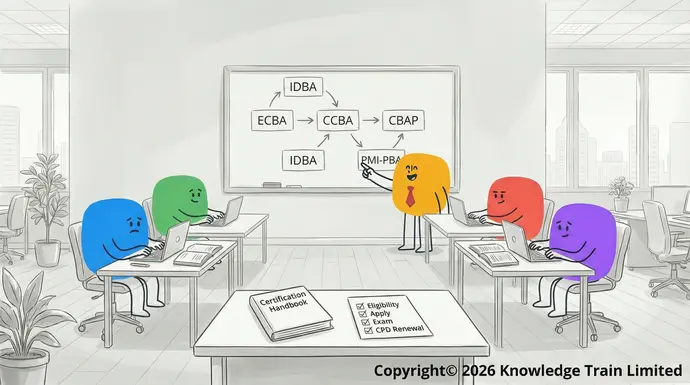
What is business analyst certification?Lean project management
Business analyst certification is the process by which professionals validate their understanding, skills, and experience in Hybrid and adaptive methodologiesbusiness analysis through a recognised credential awarded by authoritative organisations.Choosing the right methodology
Achieving business analyst certification, such as the Certified Business Analysis Professional (CBAP)Conclusion from the International Institute of Business Analysis (IIBA)FAQs, International Diploma in Business Analysis (IDBA) from the InfographicBCSIntroduction, or the Running a modern business requires that certain tasks are coordinated in a way that increases chances of getting results. PMI Professional in Business Analysis (PMI-PBA)Project management from the methodology is a set of rules and processes that are implemented by teams in order to plan, develop, and deliver project outcomes. In this way, business people can make the most of the project to achieve business goals.Project Management InstituteChoosing the right one is important for several reasons: the methodology should be applicable to your teams’ strong suits and their project needs it should also be helpful in communication and collaboration it needs to improve the process of resource allocation and (PMI)risk management, demonstrates a thorough mastery of techniques and principles such as those from the and, finally, it is likely to increase the chances of project success.Business Analysis Body of Knowledge (BABOK)This comprehensive guide will look at the most relevant .project management methodologies
These certifications help employers identify qualified candidates and support analysts in career progression, salary increases, and professional recognition., including:
How to become a certified business analystTraditional approaches like
- Assess your requirements:waterfall Review your career goals, current experience, and the types of business analysis roles you are interested in before choosing a certification.Agile methodologies
- Choose the right certification: such as Compare key options from the BCS, IIBA, and PMI based on their eligibility requirements, recognition, and suitability to your experience level and industry.Scrum
- Check eligibility criteria: and Kanban Evaluate prerequisites such as education, work experience, and professional development units (PDUs) for your chosen Lean project management principlescertificationHybrid and adaptive frameworks..We will review the strengths and weaknesses of each project management method, enabling you to select the most appropriate one for your next endeavor. Gain a better understanding of these methods, and it will be easier for you to lead your team to victory.
- Prepare for the exam:<span style="display: inline-block; width: 0px; overflow: hidden; line-height: 0;" data-mce-type="bookmark" class="mce_SELRES_start"> Use exam study materials like BABOK, take preparation courses from accredited training providers, and practise with sample questions.
| Late identification of issues or misalignments | £200Potentially longer development cycles. | Beginners, recent graduatesIterative (Agile) approach | ||||
| Practitioner Certificate in Business Analysis PracticeDescription and key principles (PCBAP)Agile | Intermediate methodologies, on the other hand, emphasise flexibility, collaboration, and the rapid delivery of working products. Core tenets of Agile approaches include iterative development cycles (known as sprints), continuous feedback and adaptation, close collaboration with stakeholders, and a focus on delivering value early and frequently. | BCSAdvantages and disadvantages | Some experience recommendedAdvantages: | 40 multiple choice (1 hr)Adaptability to changing requirements | £250Early and frequent delivery of usable products | Recent graduatesIncreased stakeholder satisfaction |
| Practitioner Certificate in Requirements EngineeringQuicker identification and resolution of issues. (PCRE)Disadvantages: | IntermediateRisk of scope creep | BCSChallenges in estimating overall project timelines | Some experience recommendedRequires highly skilled and self-motivated team members. | 40 multiple choice (1 hr)It’s worth noting that choosing between linear and iterative strategies depends on several factors, such as project complexity, stakeholder involvement, and the team’s capabilities. Additionally, some | £250projects | Recent graduates may benefit from a hybrid approach that combines elements of both strategies to leverage their respective strengths. |
| Practitioner Certificate in Modelling Business ProcessesEnhance your skills with our expert-led courses (PCMBP) | Intermediate | BCS | Some experience recommendedInstructor-led | 40 multiple choice (1 hr)Introduction to Project Management course | £250 | Recent graduates£499 +vat |
| International Diploma in Business Analysis (IDBA)See all dates | Intermediate | BCS | Some experience recommended | 50 minute oral examInstructor-led | £1,250Project Management Essentials | Recent graduates |
| Entry Certificate in Business Analysis (ECBA)£999 +vat | Entry | IIBASee all dates | No experience requiredTraditional project management methodologies | 50 multiple choice (1 hr)In this article, we will dive deep into several traditional | £150 (members)project management | Beginners, recent graduates methodologies. These have been in use for years, and if you are new to the field or are simply curious to learn more, read on! |
| Certification of Capability in Business Analysis (CCBA)Waterfall | IntermediateProcess and stages | IIBAWaterfall | 3750 hrs BA work exp. (7 yrs) methodology follows a linear and sequential approach consisting of the following stages: | 130 multiple choice (3 hrs)Requirements gathering | £250 (members)Design | Analysts with 2-3 yrs exp.Implementation |
| Certified Business Analysis Professional (CBAP)Testing | AdvancedDeployment | IIBAMaintenance. | 7500 hrs BA exp. (10 yrs)Each stage must be completed before proceeding to the next, with an emphasis on documentation and clear milestones. | 120 multiple choice (3.5 hrs)Best use cases | £260 (members)Construction projects, manufacturing processes, large-scale infrastructure projects and projects with well-defined and stable requirements are particularly suitable for Waterfall. | Senior/principal analystsPros and cons |
| PMI Professional in Business AnalysisPros: (PMI-PBA)Clear structure and timeline | AdvancedEasy to understand and manage | PMIDetailed documentation at each stage. | Bachelor’s + 3 yrs BA exp., or 5 yrs w/oCons: | 200 multiple choice (4 hrs)Limited flexibility for changes | £300 (members)Late identification of issues | Project managers/BA leadersPotentially lengthy development cycles. |
Certification details and processesCritical Path Method (CPM)
Foundation Certificate in Business Analysis (FCBA)Key concepts and implementation
- Eligibility requirements:CPM No prior experience. is a scheduling technique for project activities. It involves identifying all necessary tasks, task dependencies, calculating the longest path of planned activities, and determining the minimum project duration.
- Exam process:Suitable projects and industries 40 multiple choice questions, held online.CPM is commonly used in construction projects, product development, research initiatives, and event planning.
- Preparation resources:PRINCE2 (PRojects IN Controlled Environments) Online preparation courses, sample questions.Framework overview
- Benefits:PRINCE2 Entry-level validation, ideal for newcomers to is a process-based method that emphasises organisation and control. Its key features include division into manageable stages, defined roles and responsibilities, product-based planning approach and a strong focus on business justification.business analysisWhen to use PRINCE2.PRINCE2 is well-suited for large-scale government projects, IT implementations, business transformations and
Practitioner Certificate in Business Analysis Practice (PCBAP)projects
- Eligibility requirements: with a need for strict governance. Some prior business analysis experience it recommended.Project Management Body of Knowledge (PMBOK)
- Exam process:Core principles and processes 40 multiple choice questions, held online.PMBOK
- Preparation resources: is a comprehensive guide that offers best practices across five process groups: Online preparation courses, sample questions.Initiating
- Benefits:Planning Ideal for those seeking a pathway to the BCS-IDBA certification.Executing
Practitioner Certificate in Requirements Engineering (PCRE)Monitoring and Controlling
- Eligibility requirements:Closing. Some prior business analysis experience it recommended.It also encompasses ten knowledge areas, including scope, time, cost, and
- Exam process:quality management 40 multiple choice questions, held online..
- Preparation resources:Applications in various industries Online preparation courses, sample questions.PMBOK principles can be applied in information technology, healthcare, finance and banking, engineering and construction, and education industries, among others.
- Benefits:These traditional methodologies provide reliable frameworks for managing projects. They work best in situations where requirements are well-defined, and stability is preferred over flexibility. However, they can face challenges in rapidly changing environments or when continuous stakeholder feedback is essential. Ideal for those seeking a pathway to the BCS-IDBA certification.Ultimately, the choice of methodology depends on the specific needs of your
Practitioner Certificate in Modelling Business Processes (PCMBP)project
- Events Must have passed the Foundation certificate and 3 Practitioner exams.Artifact
- Exam process:Product Owner 50 minutes oral exam.Sprint Planning
- Preparation resources:Product Backlog Online preparation courses for the Foundation certificate and 3 Practitioner courses.Scrum Master
- Benefits:Daily Scrum Ideal for experienced business analyst professionals.Sprint Backlog
Entry Certificate in Business Analysis (ECBA)Development Team
- Eligibility requirements:Sprint Review No prior experience; 21 hours of professional training in the last 4 years.Review Increment
- Exam process:Sprint Retrospective 50 multiple choice questions, held online.Sprint planning and execution
- Preparation resources:Scrum operates in time-boxed iterations known as BABOK, online preparation courses, sample questions.Sprints
- Benefits:, typically ranging from 1 to 4 weeks. During each Sprint, the team commits to delivering a set of features. Entry-level validation, ideal for newcomers to business analysis.Benefits and challenges
Certification of Capability in Business Analysis (CCBA)Benefits:
- Eligibility requirements:Improved product quality 3,750 hours Increased stakeholder satisfactionbusiness analysisBetter team collaboration. experience within the past 7 years, 21 PDUs, and two references.Challenges:
- Exam process:Requires cultural shift Computer-based, 130 multiple-choice questions, scenario-based.Potential for scope creep
- Resources:Difficulty in estimating long-term projects. Accredited training providers, BABOK study guides, online courses.Kanban
- Benefits:Visualising workflow with Kanban boards For professionals with 2-3 years’ experience, demonstrates advanced capability.Kanban
Certified Business Analysis Professional (CBAP) uses visual boards to represent work items as they move through different stages of completion.
- Eligibility requirements:Principles of Kanban 7,500 hours of business analysis work in the last 10 years, 35 hours professional development, two references.Key principles include:
- Exam process:Visualise the workflow 120 scenario-based multiple-choice questions, computer-based, 3.5 hours.Limit Work In Progress (WIP)
- Preparation:Manage flow Intensive BABOK study, preparation courses, exam study materials.Make process policies explicit
- Benefits:Implement feedback loops. For experienced analysts, international recognition, often leads to salary increase and senior roles.Industries benefiting from Kanban
PMI Professional in Business Analysis (PMI-PBA)Kanban is versatile and can be applied in various sectors, including software development, marketing and design, human resources, and manufacturing.
- Eligibility requirements:Extreme Programming (XP) Secondary degree (A-levels, etc.) and 5 years business analysis experience, or bachelor’s degree and 3 years’ experience; 35 contact hours training required.Key practices and values
- Exam process:XP 200 multiple choice questions, 4-hour duration; online or centre-based. emphasises technical excellence and customer satisfaction. Core practices include pair programming, test-driven development, continuous integration, and small, frequent releases.
- Preparation resources:Best scenarios for XP implementation PMI-PBA handbook, training courses, online simulators, BABOK.XP is particularly effective for projects with changing requirements, small to medium-sized development teams, and environments that value close collaboration with customers.
- Benefits:Crystal Widely recognised, ideal for Family of methodologiesproject managersCrystal and analysts working in multi-disciplinary environments. is a family of
Business analyst certification comparisonAgile methodologies
| Certification, each named after a precious gemstone. Popular var | BCS/IIBA/PMI | Entry Experience | Global Recognition | Maintenance |
|---|---|---|---|---|
| FCBA | BCS | No experience; training required | High | Noneiants include: |
| PCBAPCrystal Clear | BCSCrystal Yellow | No experience; training requiredCrystal Orange | HighCrystal Red. | NoneEach variant is designed for different team sizes and project criticality. |
| PCRECore principles and adaptability | BCSCrystal methodologies share common principles, such as frequent delivery, reflective improvement, osmotic communication, personal safety and focus. | No experience; training requiredThe framework is highly adaptable, allowing teams to customise their approach based on project needs. | HighFeature Driven Development (FDD) | NoneFive processes of FDD |
| PCMBPFDD consists of five main processes: | BCSDevelop an overall model | No experience; training requiredBuild a features list | HighPlan by feature | NoneDesign by feature |
| IDBABuild by feature | BCSAdvantages for client-focused projects | No experience; training requiredFDD offers several benefits for client-centric projects: | HighRegular, tangible progress | NoneEarly detection of errors |
| ECBAAccurate status reporting | IIBAScalability for larger projects. | No experience; training requiredAgile methodologies offer numerous advantages, including increased flexibility, faster delivery of value, and improved stakeholder satisfaction. However, they also present challenges, such as the need for cultural change and potential difficulties in long-term planning. | HighWhen considering an Agile approach, evaluate your team’s skills, project requirements, and organisational culture. Some projects may benefit from combining elements of different Agile methodologies or even blending Agile with traditional approaches. | Annual renewalRemember that successful implementation of any Agile methodology requires commitment from the entire team and support from management. Continuous learning and adaptation are key to maximising the benefits of |
| CCBA | ||||
- Certified business analysts often command higher salaries and are eligible for more lucrative contracts.Lean project management
- Professional recognition:Origins and principles of lean Certified individuals are recognised by peers and employers as experts in business analysis best practice.Lean
- Opportunities for networking and continuous learning: is a philosophy that originated in the manufacturing industry, particularly in the production system of Toyota. The primary principle of Lean is to maximise customer value while minimising waste. Lean thinking has been adapted to other industries, including Membership in professional bodies like BCS, IIBA and project managementPMI. opens access to communities, resources, and up-to-date insights.Key
Business analyst certification costprinciples of Lean
Certification costs vary by level, provider, and membership status (BCS, IIBA or PMI), typically ranging from £192 for entry-level to over £1,200 for advanced certifications. Many preparation courses and exams offer include:online certification optionsIdentify value, including remote proctored exams, e-learning modules, and digital study materials. Costs should also take into account renewal fees and continuing professional development requirements.Map the value stream
Certification exam tipsCreate flow
- Study the BABOK guide and related exam study materials thoroughly.Establish pull
- Take practice exams from accredited training providers.Seek perfection.
- Join online study groups or forums to discuss scenario-based questions.Eliminating waste in project management
- Ensure you meet all eligibility requirements before applying.Lean project management is all about identifying and eliminating waste in processes. There are 8 types of waste that Lean project management focuses on:
- Develop a study plan covering all exam topics well in advance of your exam date.Defects
FAQsOverproduction
What is a business analyst certification?Waiting
Business analyst certification is a recognised professional qualification that verifies an individual’s expertise and competence in business analysis practices, typically awarded by bodies such as BCS, IIBA or PMI.Non-utilised talent
combines Yes, business analyst certification can significantly enhance your career prospects, provide professional recognition, and typically lead to higher salary opportunities and career advancement.