Agile project management: Frameworks, benefits and how it works.

Key takeawaysWe will now give you 2 business case examples. The first example is one which you might find useful for taking decisions in your personal life. The 2nd business case example is more business focused project.
Agile improves delivery by combining iterative planning, tight feedback loops and disciplined ways of working.Business case example 1: Moving home
- Agile delivers value in short iterations, using regular reviews and retrospectives to adapt quickly to change.Suppose you and your spouse are considering moving to a new home. You will need to weigh up the pros and cons of moving. This is done using a business case. You might not call it that, but that’s what it is. Let’s look at an example.
- Scrum, Kanban, Lean and XP offer different structures, so choose based on workflow needs and team maturity.Reason
- Clear roles, prioritised backlogs and well-written user stories reduce confusion and keep work aligned to outcomes.As you can see from the example, the first thing to be clear about in a business case is the reason for doing the project or activity. In this example, the couple has answered the question
- Metrics such as velocity, cycle time and burn-down charts improve predictability when paired with a clear definition of done.Why?
- Lightweight governance, change management and technical debt controls help Agile scale without losing quality. In fact, there are two problems here – the local school and John’s long commute.
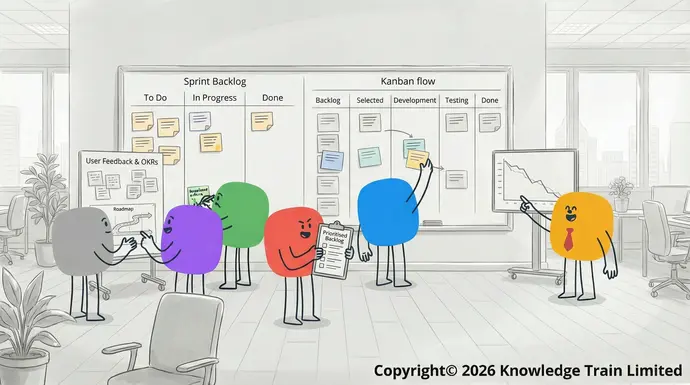
What is Agile project management?
Agile project management£2,400 +vat is an iterative approach to planning, executing, and delivering projectsSee all dates by breaking work into small, manageable increments known as iterations or sprints. Rather than following a strict linear plan, Agile focuses on adaptability, team collaboration, and continuous delivery of value to stakeholders. Agile principlesSelf-paced emphasise close communication, incremental progress, and regular feedback cycles to enhance quality and meet customer needs.Better Business Cases Practitioner (with Foundation) self-paced online
The Agile Manifesto: Values and principles
The £1,199 +vatAgile Manifesto underpins Agile project management, defining four core values and twelve guiding principles. These foster a culture of collaboration, adaptability, and response to change.
£2,400 +vat
- Main focus: Elimination of waste, maximising value, continuous improvementSee all dates
- Core elements: Value stream mapping, optimised flow, customer focus
- Advantages: Improved efficiency, reduced delays, enhanced qualitySelf-paced
| strategies? | ||||
| KanbanIs the | Visual workflow & limitsproject plan | Kanban board, WIP limits aligned with the business case? (e.g. are the costs and timescales in the project plan correctly reflected in the business case?) | Flexible rolesAre the benefits clearly identified and justified? | Ongoing support/operationsIs it clear how the benefits will be realized? |
| LeanIs it clearly defined what will judged a successful outcome? | Eliminate wasteIs the preferred business option clearly stated, along with the reasons why? | Value stream mappingIf the project requires external procurement, is the preferred sourcing option stated, and why? | AnyIs it clearly stated how any necessary funding will be obtained? | Process improvement, efficiencyDoes the business case include non-financial, as well as financial criteria? |
| XPDoes the business case include operations and maintenance costs and risks? | Technical best practicesDoes the business case include project costs and risks? | Pair programming, TDDDoes the business case conform to organisational accounting standards (e.g. break-even analysis and cash-flow conventions)? | Small, tech-focused teamsAre the major risks faced by the project explicitly stated, together with any proposed responses? | Software projects needing qualityHow do you write a good business case? |
Agile vs traditional (waterfall) project managementA good business case must contain certain key information including:
The The reasons for doing the project;waterfall modelThe business options which have been considered, including the base business options of do nothing, so something, or do something else; is a sequential, plan-driven approach where phases follow one another with minimal overlap. Project and operational costs;Agile project managementProject and operational timescales; contrasts this with its focus on flexible planning, iterative progress, and stakeholder feedback throughout:Benefits, expressed in measurable terms;
| AspectInvestment appraisal (or cost benefit analysis); | AgileMajor risks and their mitigation plans; | WaterfallHow long is a business case? |
|---|---|---|
| ApproachA good business should be long enough that it contains all the information needed for the decision-makers to take an informed decision about whether to invest in the project. That means, remove any waffle, and only include information which helps decision-making. | Iterative and incrementalWhat’s included in a business case? | Sequential and linearThe following are the most important items to put into a business case: |
| Flexibility | Highly adaptive to change | Change-resistantExecutive summary – summarizes the key points; |
| Timescales – for the project and for realizing benefits – (answers the question ‘How long will it take?’); | ||
| Risk managementInvestment appraisal – weigh up costs, times, risks against benefits – (answers the question ‘Is it worth it?’); | Early and ongoing detectionMajor risks – (answers the question ‘What if?’). | Late-stage identificationWhat is a business case template? |
| DeliveryA business case template serves as a starting point when writing a business case. It is reusable and can be used across all your projects. Depending upon its needs, your organisation may have different business case templates, each one used for different scales of projects. | Work delivered frequentlyYou can download an example | Single final deliverybusiness case template here |
| Suitable for. | Complex, evolving What is the purpose of a business case?projectsThe purpose of a business case is simple – it’s used to justify an investment in an activity. Typically, in an organisation this activity is a project. It helps give confidence to management that their investment is worthwhile and will realize benefits for the organisation. | Clear, fixed requirementsWho owns a business case? |
Key roles and concepts in Agile projectsA business case is owned by the person who is funding the project. The name of this role is different across organisations, but commonly this role is known as a project sponsor, or project exec
19 Feb 2026Scrum.org, and Project Management Institute (PMI)Learn how to plan a project with this comprehensive guide. We'll cover everything you need to know to create an effective project plan, from getting started to execution, so your projects are on track and successful. provide resources, definitions, and certifications for Agile professionals.
FAQs
What is the difference between Agile and waterfall project management?
The main difference is that Agile is iterative and flexible, allowing change at any stage, while waterfall follows a strict, linear process where each phase must be completed before the next begins. Agile encourages frequent feedback and continuous delivery of value, whereas waterfall often delivers only at the end.What is PRINCE2 Agile?
What are the main stages of an Agile project?
Typical stages of an Agile project include vision and roadmap creation, backlog development, sprint planning, execution (iteration), review, and retrospectives. Continuous improvement occurs at every stage.Simon Buehring
What are the key frameworks of Agile project management?29 Apr 2026
Key Agile frameworks are ScrumPRINCE2 Agile is a project management methodology that combines the governance of PRINCE2 with the flexibility and responsiveness of Agile approaches. It enables organisations to deliver projects more effectively by integrating structured project control with iterative delivery techniques., Kanban, Lean, and Extreme Programming (XP). Each offers a unique structure for managing roles, processes, and workflow.
What are the benefits and challenges of Agile project management?
Advantages include adaptability, stakeholder engagement, and high product quality. Challenges may include initial resistance, need for team discipline, and less suitability for projects with fixed, unchanging requirements.
Where is Agile project management commonly used?
While most common in software development, Agile is used in industries such as marketing, manufacturing, construction, and education wherever flexible, iterative approaches add value.