The hidden cost of salary secrecy in hiring

Key takeaways
Salary secrecy in job adverts is a structural norm for many organisations and rarely supports employers’ stated goals.
- Withholding salary information wastes time for candidates and hiring teams, causing late drop outs and repeated hiring cycles.
- Pay opacity can damage employer credibility, reduce candidate attraction, and surface in employer reviews.
- High-demand, low-pay roles create a misalignment that candidates notice before or during interview stage.
- UK guidance and EU direction of travel point towards clearer pay communication, even though there is no blanket UK legal requirement to publish ranges yet.
- Good practice includes publishing a salary range in every advert and confirming alignment early in screening.
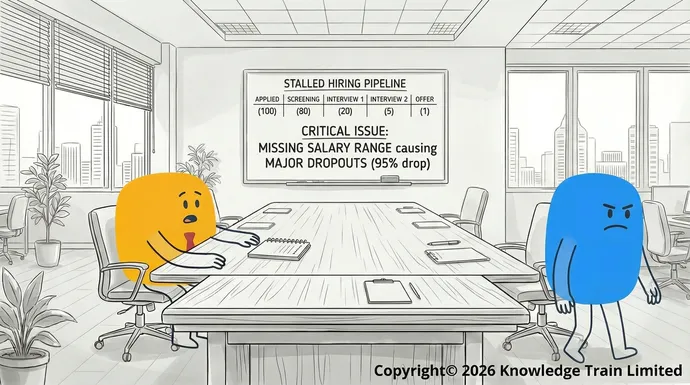
Why employers keep the number hidden
Ask most hiring managers why the salary is not listed on a job advert and you will hear a familiar set of justifications. The budget is ‘flexible’. The right figure ‘depends on experience’. They want to stay ‘competitive’ without tipping off rivals. Or, more candidly, they want to preserve a negotiation advantage by keeping candidates in the dark so they open lower than the employer might otherwise have to offer.
These reasons sound pragmatic, but they rarely hold up under scrutiny. According to UK job posting salary transparency stats, omitting pay information from job adverts is not an occasional oversight. It is a structural norm in how many organisations hire.
The harder question is whether that norm serves employers. Holding the number back to gain negotiation leverage only works if candidates stay in the process long enough to negotiate. Many do not. When a posting says ‘competitive salary’ and nothing else, strong candidates with options often move on. The flexibility argument is equally weak: a defensible pay structure should already include a range. When none can be shared, that absence suggests the budget is undefined, inconsistent, or applied according to negotiation strength rather than the value of the role.
What salary secrecy actually costs
Hiding a salary range may feel like a negotiating tactic. In practice, it is an expensive one. When pay is withheld until late in the process, candidates can spend time preparing for interviews they would never have accepted had the numbers been visible upfront. Hiring managers may similarly spend time screening, briefing, and meeting people who turn out to be unsuitable on compensation alone. That wastes time on both sides.
The pipeline cost compounds quickly. A strong candidate who drops out after a final stage offer mismatch leaves a vacancy open for longer, forces the team to restart sourcing, and may accept a role elsewhere while the process resets. Repeat hiring cycles can be significantly more expensive once you factor in recruitment, training, and lost productivity costs.
Reputational damage is harder to quantify but just as real. Candidates talk. A dismissive response to a salary question, or a late reveal that feels evasive, may surface in employer reviews. Once that perception takes hold, it affects the quality of future applicants before a single job is posted. Research into Pay transparency and hiring impacts suggests that organisations with opaque pay practices face disadvantages in candidate attraction.
According to Indeed’s Hiring Lab, salary opacity remains widespread across UK job postings, so these costs are not isolated incidents. They are a systemic drag on hiring performance across many organisations.
The credibility problem with high-demand, low-pay roles
Many experienced candidates view job adverts demanding five or more years of experience and management responsibility, combined with the expectation to ‘wear many hats’ across functions, as a red flag when the attached salary does not come close to market rate. When role scope and compensation appear misaligned, it can suggest that the organisation has not reconciled what it needs with what it is willing to pay.
This mismatch does not just frustrate candidates. It damages employer credibility. When someone with the right experience reads between the lines and walks away before applying, the organisation never knows what it lost. When a candidate progresses to interview stage and only then discovers the salary is well below what the scope of the role would justify, trust drops quickly and may later appear in employer reviews.
Eurofound lessons on pay transparency highlight that pay transparency measures are designed to help ensure pay reflects skills, responsibilities, and experience. Where salary information is absent from job postings, some organisations may post demanding roles at pay levels that do not reflect the seniority required, and that misalignment can be harder for candidates to detect until late in the process. Transparency brings that misalignment into the open.
For hiring managers, the practical implication is straightforward: if the salary budget does not match the role’s scope, revise either the budget or the brief. Posting an overloaded role at an underpaid rate and hoping candidates will not notice rarely works in a competitive talent market.
What UK law says now, and where things are heading
There is currently no blanket legal requirement for UK employers to advertise salary ranges in job postings. Organisations are largely free to keep pay figures off their listings, and many still do. What does exist is a growing body of guidance and statutory obligation pointing in the other direction.
The UK government’s UK guidance on pay transparency says pay decisions should be fair, consistent, and clearly communicated to employees and candidates. Gender pay gap reporting requirements already require larger employers to publish data on pay differences between men and women, and persistent gaps are linked in part to secrecy around vague bands or undisclosed ranges.
Beyond the UK, the EU Pay Transparency Directive sets a clear direction of travel. Although it does not apply to UK employers, it requires EU member states to mandate salary disclosure in job adverts by 2026. Some UK organisations already treat this as best practice rather than waiting for any domestic legal change.
The direction is clear: while UK hiring law does not yet require universal salary disclosure in adverts, both regulation and expectations are moving towards greater transparency. Organisations that treat disclosure as optional today may fall behind tomorrow’s standard.
Spotting a broken pay structure before it costs more candidates
Genuine flexibility in pay looks different from a structure that nobody understands. The warning signs tend to cluster. When a line manager cannot tell a recruiter what pay band a role sits in, that is a strong indicator of a pay governance problem rather than a sign of deliberate flexibility. When offers to different candidates vary significantly with no clear rationale tied to skills, experience, or market rate, this can signal that the pay structure has become inconsistent over time. When budget sign-off requires escalation simply to share a salary range with a shortlisted candidate, this can work against the hire by slowing the process and reducing transparency.
Recruiters inside the organisation feel this too. If sharing pay bands internally provokes anxiety or resistance, that may indicate underlying issues worth examining, such as inequities or poor communication about how pay decisions are made. Organisations with clear pay structures are better able to justify and communicate pay differences between employees. Those without them tend to deflect questions.
This does not mean flexible pay is inherently problematic. It means flexibility without transparency, or without line managers who understand how it works, tends to erode trust and candidates notice.
What good practice looks like in a salary conversation
The simplest fix available to any hiring team is also the most overlooked: publish the salary range in the job advert. Salary transparency in job adverts removes ambiguity before a single application arrives, filters for genuine fit, and signals that the organisation respects candidates’ time. ‘Competitive salary’ or ‘depends on experience’ with no supporting figure tells a candidate nothing useful and invites suspicion.
Once a candidate applies, first stage screening is the right moment to confirm alignment openly. A simple statement such as ‘The role is budgeted at X to Y; does that work for you?’ takes little time and prevents hours of wasted interviews. If a candidate’s expectation sits above the range, a professional response explains the budget constraint honestly rather than mocking the figure or refusing to engage. Dismissing expectations, or reacting with visible surprise, destroys trust quickly and will often be shared online.
The UK government’s own guidance on pay transparency makes clear that fair, open communication about pay and rewards is the standard organisations should work towards. Recruiters who stonewall or belittle candidates fall well short of that standard.
Building a more credible process requires consistent habits: a stated range in every advert, a salary check early in screening, and an honest conversation whenever expectations differ. Getting this right protects employer brand, reduces wasted effort, and helps strong candidates stay in the process long enough to accept.
Where to go from here
If the sections above feel familiar, there is a good chance these issues are already affecting the hiring pipeline, even if the full cost has not been measured. Salary secrecy rarely feels urgent until a pattern of withdrawn candidates, stalled offers, or declining application quality becomes hard to ignore.
Most of what needs to change is straightforward. It requires honest internal conversations about pay structures, a willingness to brief recruiters properly, and the discipline to have salary conversations early rather than late. None of that requires a complete overhaul of the hiring process, but it does require interviewers and hiring managers to be confident and well prepared.
If the hiring team is losing strong candidates because salary conversations go wrong, structured training can help. Interview skills courses can show how better prepared recruiters build the credibility that attracts the candidates the organisation wants to hire.