WBS – Work Breakdown StructureProject management


). It is structured around five core phases:
In this article, we will describe the main components of WBS, starting with basic definitions and the main properties of a model, and will list the benefits and advantages that it brings, as well as provide a clear step-by-step guide on how to build WBS correctly. We will also consider the most common examples and specific tools, how to use WBS in other project types and according to methodologies, and problems, which sometimes arise when working with a breakdown, and their solutions. In the end, you will get complete knowledge about the principles and use of a breakdown.Initiating, Planning, Executing, Monitoring and Controlling,
WBS fundamentals and
To start work with a Closingwork breakdown structure. and use all of its potential, it is important to know its main characteristics and components. It will help you to build a stable base for starting a WBS in project management.Project management
Key characteristics of WBS is a structured approach that guides a team or organisation in planning and controlling activities to achieve defined objectives and deliverables within agreed constraints of scope, schedule, cost and quality. A
- 100% ruleproject: The 100% rule is a crucial principle of WBS that states the WBS must include 100% of the work defined by the project scope. This means that no work should be omitted or duplicated within the WBS structure. is a temporary endeavour with a specific goal, differing from routine operations. Project management ensures successful delivery through systematic processes and best practices.
- Hierarchical structureProject life cycle phases: WBS is a hierarchical structure, with each level of the WBS broken down into smaller and more detailed components. This hierarchical nature helps to create a clear picture of the project scope and deliverables.The
- Deliverable-oriented or phase-based:project life cycle WBS can be organised based on deliverables or project phases. The deliverable-oriented approach breaks the project down into manageable chunks that result in a specific deliverable, while the phase-based approach organises the project into sequential phases of completion. The choice between the two approaches depends on the project’s nature and organisational preferences. generally comprises five standard process groups:
Essential components of WBSInitiating
- Levels and decomposition: Defining the project at a broad level, setting : The WBS consists of multiple levels, with the top level representing the entire project. Each subsequent level breaks down the project into smaller, more manageable components. This decomposition process continues until you reach a level of detail that can be effectively managed.business case
- Work packages, and identifying stakeholders.: Work packages are the lowest level in the WBS hierarchy. These are tangible deliverables that can be assigned, scheduled, and tracked. Work packages should be small enough to be manageable but large enough to be efficient.Planning
- Control accounts: Establishing the scope, objectives, detailed schedule, risk management plan, budget, deliverables, and resource allocation.: Control accounts are management control points where scope, budget, actual cost, and schedule are integrated and compared to earned value for performance measurement. They serve as a crucial checkpoint for Executingproject managers: Coordinating people and resources, as well as meeting established milestones and deliverables. to monitor project progress and make informed decisions.Monitoring and controlling
By understanding these fundamentals, you will be well-equipped to create and utilise a WBS effectively.: Tracking, reviewing, and regulating progress and performance, managing changes, and ensuring project stays on schedule and within scope.
Benefits of a WBSClosing
Implementing a work breakdown structure (WBS) as part of your : Finalising all activities, handing over deliverables to the user/customer, releasing resources, and capturing project management strategylessons learned offers a wide range of benefits that can help you achieve success..
- Better planning and organisationProject management methodologies & frameworks: WBS help Multiple methodologies and models structure how project managersprojects to plan and organise projects more effectively by breaking them down into smaller, more manageable components. This makes it easier to develop more accurate schedules and identify potential bottlenecks in advance. are managed:
- Improved communication and clarityAgile methodology: The visual representation of the different components of a project that is provided by a WBS makes it easier for everyone involved in the project to understand its scope and objectives. This can help to reduce misunderstandings and ensure that all parties are on the same page when it comes to project deliverables and expectations.:
- More efficient use of resources and budgetingAgile: The level of detail that is provided by a WBS can also help project managers to allocate resources more efficiently and stick to their budgets. By having a clear understanding of the tasks that need to be completed, project managers can more accurately estimate the resources they will require and avoid over-allocation or underutilisation. is an iterative, flexible approach emphasising collaboration, adaptability and rapid delivery; commonly used in software development and rapidly changing environments. Popular Agile frameworks such as
- Better project tracking and controlScrum: The hierarchical structure of a WBS also makes it easier to track project progress at different levels of detail. Project managers can compare actual progress against the planned WBS and identify any deviations from the plan early on. This allows them to take corrective action sooner and increases the chances of the project being completed successfully within its constraints. are used by teams to deliver the products specified by the customer.
- Conveying information clearly among stakeholders and team members.Maintain the right level of detail: Avoid going too deep or too shallow with your WBS. A highly detailed WBS can lead to micromanagement and increased complexity, while a high-level WBS can result in lack of control and oversight. Finding the right balance ensures your WBS is detailed enough to be useful but not so detailed that it becomes unwieldy.Risk management
- Ensure mutual exclusivity of tasksIdentifying, analysing, and mitigating risks.: Make sure that no work is counted in more than one place in the WBS. Each element in the WBS should be a unique piece of work, and the tasks should not overlap or be duplicated. This helps avoid confusion and double-counting of effort and makes it easier to allocate resources and track progress accurately.Scheduling
- Follow the 8/80 rule for work packagesPlanning timelines and managing deadlines using tools like Gantt charts and CPM.: The 8/80 rule states that work packages in a WBS should require no less than 8 hours and no more than 80 hours of work. This rule is a guideline for maintaining an appropriate level of detail and for estimation. Adjust this rule as necessary, for your specific reporting needs and project requirements.Budgeting
Using these steps and some best practices for WBS development you should be able to create an effective WBS that will serve as a solid backbone for your project management efforts.Estimating, allocating, and controlling project finances.
WBS formats and toolsScope management
When it comes to WBS, it’s not just about structure and levels, but also about the right tools and formats. This section dives into the common formats for WBS, the software that can help you create and manage it, and how you can integrate it with other Defining and controlling what is included and excluded in the project.project management toolsResource allocation for maximum efficiency.Assigning people, equipment and budget where needed.
Common WBS formatsProblem solving
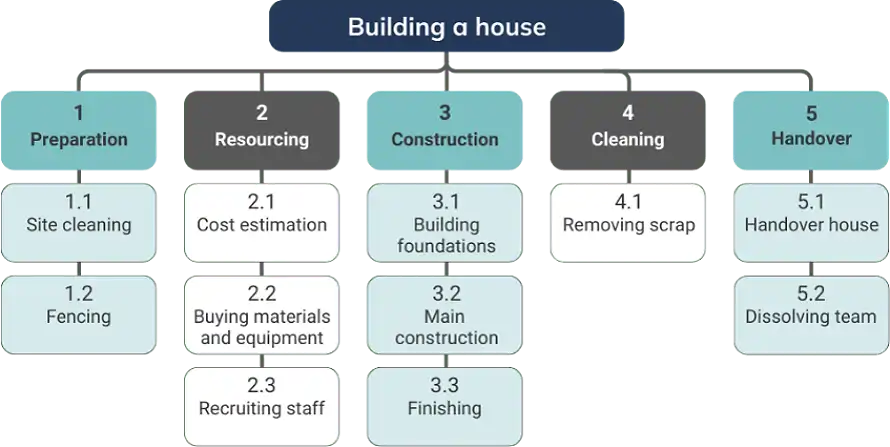
- Tree diagramOvercoming obstacles and finding effective solutions.: A visual representation of the hierarchical structure of a WBS. Starting with the project at the top, it branches down into finer levels of detail. This format is great for getting a birds-eye view of the project and understanding the relationships between different elements.Negotiation
- Outline or list viewReaching agreement among parties to resolve issues.: As the name suggests, this format displays the WBS as a numbered or bulleted list. Each level of indentation signifies a new level in the hierarchy. This is a simple format to create and can be easily converted into other formats if needed.Critical thinking
- Tabular formatEvaluating situations and implications for decision making.: This format organises WBS elements into columns and rows. It’s especially useful if you want to include additional information such as task owners, durations, or costs alongside the WBS structure.Project management tools & techniques
Software tools for creating and managing WBSProject management software
- Dedicated WBS software: (e.g., Microsoft Project, Asana, Trello) aids collaboration, scheduling, task assignment, budgeting, and document management.: There are software tools specifically designed for creating and managing WBS, like WBS Schedule Pro. These tools often come with advanced visualisation and analysis features.Gantt chart
- Project management platforms: Visual timeline for planning and tracking progress.: Comprehensive project management platforms like Microsoft Project or Wrike also include WBS functionality. These integrate WBS creation and management with the rest of your project management toolkit.Work Breakdown Structure (WBS)
Integrating WBS with other project management tools: Divides project into manageable sections.
- Gantt chartsCritical Path Method (CPM): Elements from a WBS can be easily mapped to tasks in a Gantt chart. This allows for a visual representation of task dependencies, durations, and timelines.: Identifies sequence of crucial tasks that determine project duration.
- Project schedulesProject portfolio management: The WBS forms the backbone of detailed : Prioritising, balancing, and overseeing multiple project schedulesprojects. Each work package can be further broken down into specific activities with assigned durations and resources. aligning with organisational strategy.
Choosing the right format and tools for your WBS can greatly enhance your project’s performance and the efficiency of your project team.Comparing project, programme, product management
Common WBS challenges and solutionsProject management
While WBS offers numerous advantages, there are potential challenges that can arise during its implementation. Identifying these challenges and implementing effective solutions will help you get the most from your WBS.: Focuses on delivering a unique, timebound outcome.
Scope creepProgramme management occurs when project boundaries expand uncontrollably, leading to an increased workload and potential delays. Solution: To prevent scope creep, ensure that the project scope is clearly defined during the initial WBS development. Establish a robust change control process to manage and approve any changes to the project scope. Regularly review and update the WBS to reflect approved changes, ensuring it aligns with the project’s objectives.: Oversees a group of related projects aligned to strategic objectives.
Finding the right balance between Product managementdetail and manageability: Manages the lifecycle, strategy and development of a product. is essential. Excessive detail may lead to micromanagement, while too little detail can result in oversight. To strike this balance, use the 80/20 rule when creating work packages and apply the principle of progressive elaboration, adding more detail as the project progresses. Regularly evaluate the WBS’s effectiveness and adjust as necessary to optimise its utility.Operations management
Team buy-in: Manages ongoing processes for continuous delivery of products or services. is crucial for the successful implementation of WBS. If team members do not understand or support the WBS, it can hinder its effectiveness.Best practices
Solution:PMBOK Involve the project team in the WBS creation process and ensure clear communication of its benefits to all stakeholders. Provide training and support for team members to become comfortable with using and maintaining the WBS. Celebrate successes and improvements that result from WBS implementation to reinforce its value to the team. (
By being aware of these common challenges and implementing the suggested solutions, you can optimise the effectiveness of your WBS and improve your overall project management results.Project Management Body of Knowledge
Case study level
Consider a PRINCE2 certificationsmultinational technology company and that launched a complex software development project to create a new customer relationship management (CRM) system.PRINCE2 Agile certifications
The project team used a comprehensive WBS to break down the CRM development project into major components such as database design, user interface development, integration modules, and testing phases. This hierarchical decomposition allowed for precise resource allocation and scheduling. The WBS played a significant role in the project’s success by providing a clear roadmap for all stakeholders. It facilitated effective communication between development teams and enabled accurate tracking of progress against the WBS. As a result, the CRM development project was completed on time and within budget..
Key lessons learned from this case study include the importance of stakeholder involvement in creating and maintaining the WBS. The project team realised that regular WBS reviews were essential to ensure alignment with evolving project needs. The team found that maintaining flexibility in the lower levels of the WBS allowed for FoundationAgile and responses to changing requirements. Best practices identified include engaging cross-functional teams in WBS development, regularly updating the WBS to reflect current project realities, and using the WBS as a central communication tool throughout the project lifecycle.Practitioner
This case study highlights the positive impact of a well-implemented WBS on the success of complex projects. level
ConclusionAgilePM certifications
The WBS is an essential project management tool, and we have discussed the important characteristics, advantages, steps of creation, and application to various methodologies throughout this article. It is a useful and effective method to organise, communicate, and control your project, and can be implemented in Traditional, Agile, and Hybrid environments. from APMG
We have discussed some common issues people may have when using WBS and addressed them with case studies and examples from actual Certifications are valued globally and support career advancement.projectsProject management career path. The examples have shown how using WBS allows you to improve your projects and control them to a better extent. As you continue your work with different projects, create your WBS and experience the benefits of clarity, organisation, efficiency, and accuracy.Career progression
FAQsStart by gaining experience in team-based roles, develop relevant skills, and pursue
What is the difference between a WBS and a project schedule?project management certifications
A WBS focuses on breaking down the project scope into manageable deliverables or components, while a such as project schedulePRINCE2 builds on the WBS structure by adding timelines and dependencies to the project elements.,
How detailed should a WBS be?AgilePM
A WBS should be detailed enough to allow for accurate estimation and assignment of resources, often adhering to the 8/80 rule for work packages, which suggests that work packages should be small enough to be managed but large enough to be meaningful. or CAPM. Practical experience and networking are valuable for career advancement.
Can WBS be used for small projects?What are effective project management tools?
Yes, a WBS can be adapted and scaled to suit the size of any project, including small projects. It provides a structured approach that can bring clarity and organisation to projects of all sizes.Popular tools include
How often should a WBS be updated during a project?project management software
A WBS should be reviewed and updated regularly, especially at major milestones or when there are significant changes in the project scope or objectives. This ensures that the WBS remains aligned with the project’s needs. (Microsoft Project, Asana), Gantt charts,
What is the relationship between WBS and risk management?WBS
The WBS can enhance , and CPM – all of which assist in planning, scheduling, allocating resources, and communication.risk managementSubscribe to our exclusive offers and promotions by providing a clear framework for identifying and assessing risks at different levels of the project. Risks can be mapped to specific work packages or deliverables, making it easier to manage and mitigate them.