Stakeholder Engagement: A Key to Project Success with David Longstaff

Key takeaways
Strong stakeholder engagement reduces delivery risk and improves the chances of meeting time, cost, and scope.
- Identify stakeholders widely, including groups indirectly impacted, and revisit the list throughout the project life cycle.
- Map stakeholders by interest and influence, and tailor actions such as monitor, inform, satisfy, or engage intensively.
- Consult early and often, using the right team members and sponsor to reach influential stakeholders.
- Build trust through empathy, transparency, and consistent communication, and watch for shifts in attitude.
- Treat stakeholders as both threats and opportunities, and plan compromises by clarifying what success means to them.
Introduction
This session explains why stakeholder engagement sits at the heart of project success. It shows how to identify stakeholders, understand interests, and maintain support. Watch this webinar to learn practical steps you can apply now.Watch video reviews from students who attended a PRINCE2 training course with Knowledge Train. Click through to hear about their experiences.
This webinar, ‘stakeholder engagement: a key to project success’, shares a straightforward approach. You will map stakeholders and plan actions that build trust and reduce risk. Expect clear guidance, useful examples, and tools you can reuse.
Video
Access the presentation here , listen to the audio , or read the full transcriptWhich project management qualification? below.
, P3O: Diane, yeah, great comment. Thank you. It’s true, we tend to see this as a two by two, whereas actually it is mirrored. Thank you, Diane. And Paula, first time doing this, realising I’m concerned that some might fall into influential active blockers. Wondering if you can move people into new sections with management. Paula, it’s a wonderful point that you’re making there, and the answer is, yes, to an extent or rather, I would probably suggest we can help them to an extent move into a different box. I don’t know what you feel, but I think managing stakeholders sounds like it’s been like being able to move pawns on a chessboard, and it’s not that easy. If I will comment on that in just a little moment, but yes, there are things that you can do to help, and actually, that’s the purpose of this session today. Thank you, Paula, a great point, and I as well. ®
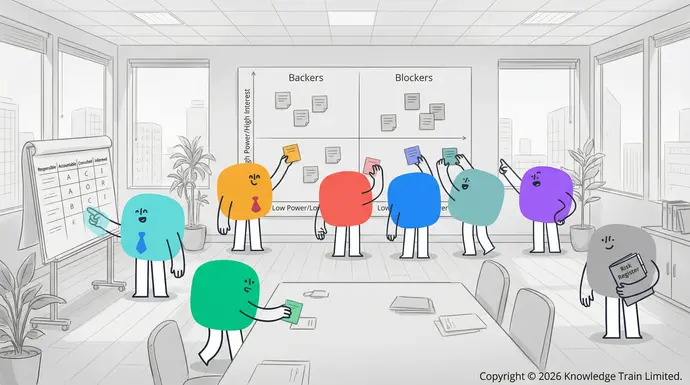
00:25:46 David Longstaff , PRINCE2: So that’s the first part of this, and now we move into APM’s 10 principles of stakeholder engagement. Now, in most cases, all I’m going to do is bring up just a single sort of slide, which is a kind of just a summary of what you’ll find if you go to their website, and we’ll just expand a little bit on it. But the first one, communicate, I just want to just take that a little bit further by going back to our chart, and this links in nicely to Paula’s point. So, you could overlay these eight boxes with some additional terminology. In other words, how do you deal with a particular group that may be in one of these boxes? Now, up at the top left and top right, where we’ve got people who are highly interested and have a high degree of influence, you’ll want regular engagement with these, intensive engagement. In the top middle boxes, so where they have less interest, you might simply need to keep these satisfied. In the bottom boxes there, you’ll want to keep them informed if they are highly interested but of low influence. And if they’re not terribly interested, so quite passive and don’t have a huge, and they are insignificant as opposed to influential, you might simply need to monitor these. So those are the terms that are used, you’ll see very slightly different terms between high power, high interest for, as opposed to those against, regular engagement versus intensive engagement. So, can I just ask you here, how would you translate some of these boxes into actual, practical actions? What would you do on a day-to-day basis? What would you do for each of these boxes or any of them, if you wish to comment? ®
: I’m going to pop down our website as well, just because the slide is not up. If you have any questions, please jot them down. To provide the best experiences, we use technologies like cookies to store and/or access device information. Consenting to these technologies will allow us to process data such as browsing behavior or unique IDs on this site. Not consenting or withdrawing consent, may adversely affect certain features and functions.
00:59:39 David Longstaff : Thank you, Thor. Thanks for all your comments, I appreciate that.
01:00:02 Sevcan Yasa : Thank you, everyone. Merry Christmas, if anyone doesn’t have any questions, I think it’s safe to say that we can end this webinar. Finish the poll.
01:00:52 Sevcan Yasa Functional: Okay, once again, this webinar is recorded, and you will receive the recording most probably next week. So, thank you all for joining. David, thank you so much for joining and Merry Christmas and a Happy New Year, everyone.
01:01:17 David Longstaff : Thank you, Sevcan.
01:01:18 Sevcan Yasa : Thank you, bye. Functional
01:01:19 David Longstaff : Bye. Always active