Risk management on projectsLEARNING LIBRARIES

Key takeawaysKnowledge Train is a P3O Accredited Training Organization.
Strong risk management improves delivery certainty by surfacing threats early and agreeing responses.
- Define risks as uncertain events that can help or harm scope, schedule, cost, or quality.Knowledge Train is an AgilePM Accredited Training Organization.
- Classify risks (internal, external, technical, financial, operational, strategic) to avoid blind spots.
- Use a repeatable cycle: identify, assess likelihood and impact, plan responses, then monitor and adapt.Knowledge Train is a PRINCE2 Agile Accredited Training Organization.
- Maintain a live risk register, supported by tools such as a risk matrix, SWOT, and project software alerts.
- Prevent common failures by controlling scope changes, monitoring budgets, managing dependencies, and planning resources.Knowledge Train is an Agile BA Accredited Training Organization.
- Keep stakeholders engaged with clear communication so risks are understood, owned, and acted on.
Introduction
Project managementAXELOS Peoplecert accredited training organisation for ITIL (IT Infrastructure Library). is a challenging process that is prone to many possible failures. Risk managementAXELOS Peoplecert accredited training organisation for ITIL (IT Infrastructure Library). is a key aspect of project management that can help increase the likelihood of project success. This involves the process of identifying, assessing, and mitigating risks that can threaten the project.
In this article, we will explore some of the risks that can arise on projects and how to deal with them effectively. We will discuss the following topics:Knowledge Train is an AIPGF Accredited Training Organization.
- The definition and importance of understanding project risks
- The different types of common project risksKnowledge Train is an AIPGF Accredited Training Organization.
- The process of risk management on projects
- The tools and techniques used in risk managementBCS accredited training partner for Business Analysis.
- The strategies for effective risk mitigation
- The best practices for successful risk management on projects.WHAT YOU WILL GET
By the end of this article, you will be able to:Accredited training course materials
- Identify potential risks on your projectsExpert, experienced trainers to support you
- Apply effective risk management strategiesCourse manual where applicable.
- Improve the chances of your project’s success.
You can also learn about project risk management on a SELF-PACED ONLINE TRAINING COURSESproject management courseSelf-paced online training courses (e-learning) include: such as Certification exam(s) where applicablePRINCE2 courseAccredited training course materials or an Support from expert, experienced trainersAPM courseLatest educational technology..
Let’s begin and explore the world of BUSINESS SOLUTIONSproject risk management
- CONTACT US: Operational risks affect the day-to-day functioning of the project. They can encompass issues like human errors, process inefficiencies, supply chain disruptions, or equipment failures.
- Strategic risks : Strategic risks influence the project’s alignment with the organisation’s overall business goals. They may involve risks related to changing market demands, competitive pressures, or organisational changes.
Impact of risks on project success
Risks can have a variety of impacts on a project’s success:
- Positive effects : These could include opportunities for innovation or efficiency improvementsName
- Negative effects : These could lead to delays, cost overruns, or quality issues.
Effective Emailrisk management is important for minimising negative impacts and maximising the potential for opportunities and overall project success.
By identifying and assessing risks, Phoneproject managers can develop contingency plans and take proactive steps to mitigate potential problems. This helps increase the chances of achieving project goals and delivering value to stakeholders.
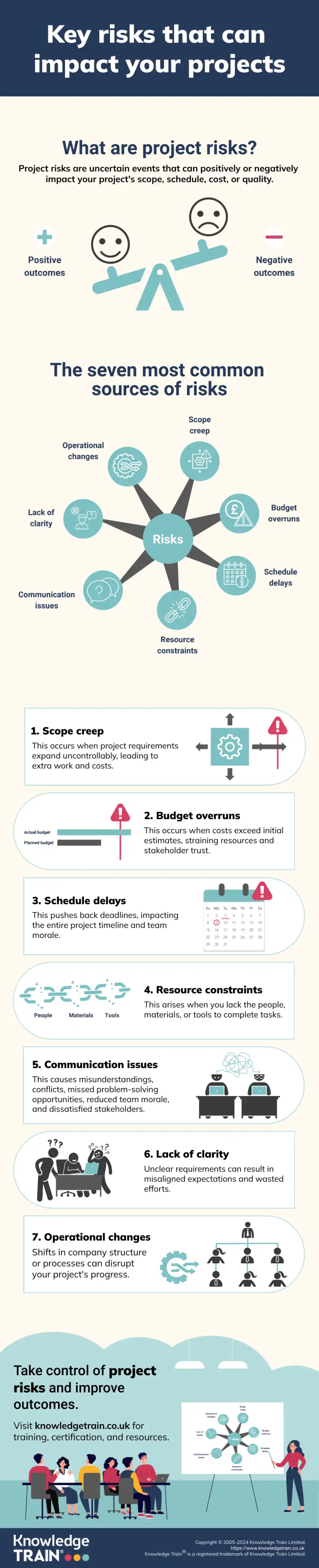
Common project management risks
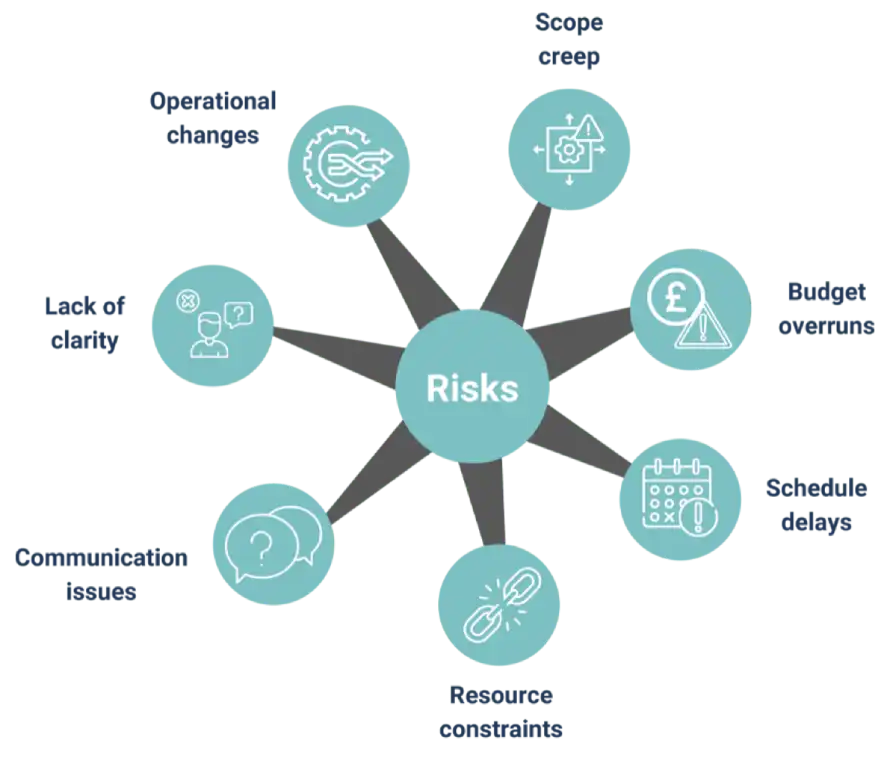
Scope creep
Common causes
Scope creep is the uncontrolled expansion of a project’s scope without corresponding adjustments to time, budget, and resources. Common causes of scope creep include ambiguous initial requirements, lack of change control processes, Stakeholder pressure for additional features, and insufficient stakeholder engagement.AWARDS
ImpactWe don’t go seeking awards, but here are two of the awards we have received for our training.
Scope creep can have several impacts on a project:
- It can increase the project’s duration, require more resources and increase costs
- It can lead to delays and missed deadlines Request a quote
- It can cause the project to lose focus and drift away from its original objectives
- It can lead to team burnout and demotivation.
To prevent scope creep, it is crucial to have a clear understanding of the project’s objectives and requirements, and to establish change control processes to manage and approve any changes to the project scope.
Budget overruns
Common causes+44 (0)207 148 5985
Budget overruns occur when the actual cost of a project exceeds the initially allocated budget. Common causes of budget overruns include inaccurate cost estimation, scope changes, unforeseen expenses, and poor resource management.[email protected]
Impact
Prevent budget problems by performing a detailed cost analysis and ensuring financial reporting is transparent throughout the project.
Schedule delays
Common causes
Schedule delays can occur due to a variety of reasons:
- Unrealistic time estimates
- Resource unavailabilityUnited Kingdom
- Dependency conflicts
- External factors (e.g. weather, supplier delays).
Impact
Schedule delays can lead to missed deadlines and milestones, increased costs due to prolonged project duration, reduced stakeholder satisfaction and potential loss of competitive advantage.
To address time-related risks, implement effective project scheduling techniques and regularly monitor project progress.
Resource constraints
Types of resource risksSearch
Resource risks can take various forms, such as:
- Skill shortages
- Equipment or material unavailability
- Insufficient funding
- Limited time availability.United Kingdom
Impact on project performanceAustria
Resource constraints can result in reduced productivity, compromised quality of deliverables, increased stress on team members and potential project delays.Belgium
Conduct thorough resource planning and maintain open communication with stakeholders to proactively address resource-related issues.Bulgaria
Communication issuesCroatia
Importance of effective communicationCyprus
Effective communicationCzech Republic is vital for project success. It facilitates alignment of project objectives, timely issue resolution, stakeholder engagement and buy-in and efficient team collaboration.Denmark
Consequences of poor communicationEstonia
Poor communication can lead to misunderstandings and conflicts, missed opportunities for problem-solving, reduced team morale and productivity and stakeholder dissatisfaction.Finland
Establish clear communication channels and protocols to promote open and transparent dialogue throughout the project.France
Lack of clarityGermany
Sources of unclear requirementsGreece
Unclear requirementsIreland can stem from ambiguous project objectives, insufficient stakeholder input, lack of detailed documentation and changing business needs.Italy
Effects on project outcomesLatvia
Lack of clarity can lead to misaligned expectations, rework and wasted resources, delayed decision-making and compromised project quality.Lithuania
Invest time in gathering and documenting clear requirements and maintain ongoing stakeholder engagement to ensure alignment.Luxemburg
Operational changesMalta
Types of operational risksNetherlands
Operational changesPoland can include:Portugal
- Organisational restructuringRomania
- Process modificationsSlovakia
- Technology upgradesSlovenia
- Regulatory changes.Spain
Impact on project executionSweden
Operational changes can affect Other countriesprojectsHome by disrupting established workflows, requiring additional training or resources, altering project priorities and necessitating scope or timeline adjustments.Project Management
Stay informed about potential organisational changes and maintain flexibility in Waterfall methodproject planning to accommodate operational shifts.{"@context":"http://schema.org","@type":"BreadcrumbList","itemListElement":[{"@type":"ListItem","position":1,"name":"Home","item":"https://www.knowledgetrain.co.uk/"},{"@type":"ListItem","position":2,"name":"Project Management","item":"https://www.knowledgetrain.co.uk/project-management"},{"@type":"ListItem","position":3,"name":"Waterfall method","item":"https://www.knowledgetrain.co.uk/project-management/waterfall-method"}]}
By knowing about common project management risks, you can make specific plans to help prevent or overcome them. In addition, proactive risk management involves:
- Clear communication with stakeholdersKnowledge Train
- Robust change management processes19 Feb 2026
- Continuous monitoring and adaptation.
Keep in mind that effective risk management is an ongoing process that needs careful monitoring and flexibility throughout the project. If you plan and work for these common risks, you will be able to increase the probability of success in your project.
Risk management process
Risk identification
The first step in risk management is to identify potential risks that could impact your project. Some common techniques include:
- Brainstorming with team members
- Reviewing historical information from similar projects
- Conducting stakeholder interviews
- Analysing project documentation.
Create a risk register to document all identified risks.
Risk assessment and prioritisation
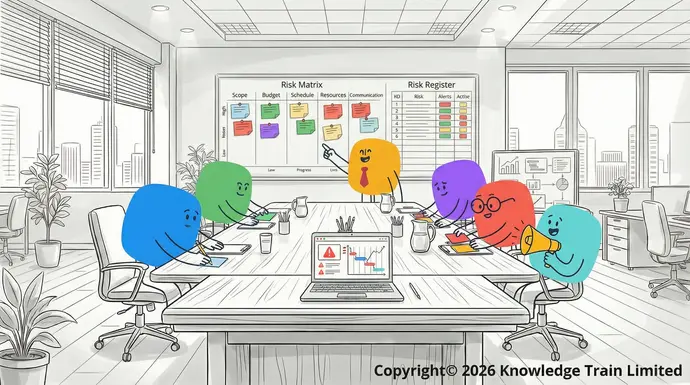
After identifying risks, assess their potential impact and likelihood of occurrence. Tools you can use include:
- Risk matrix : Plot risks on a chart based on their probability and impact
- Quantitative analysis : Assign numerical values to risks
- Qualitative analysis : Categorise risks based on severity.
Prioritise risks based on their potential impact.Copied!
Risk response planningKey takeaways
For each prioritised risk, develop a response strategy. Common responses include:Waterfall is a linear delivery model that suits stable, well-specified work but struggles when change is frequent.
- AvoidanceWaterfall runs through fixed phases, and each phase is completed and documented before the next begins.: Eliminate the threat by changing It works best when requirements are clear, unlikely to change, and acceptance criteria can be agreed upfront.project plansStrong documentation and upfront planning support predictable costs, resourcing, and stakeholder reporting.
- MitigationLate feedback can increase the risk of building the wrong thing and discovering issues near the end.: Reduce the probability or impact of the riskRegulated and high-compliance environments often prefer waterfall for traceability and control of change.
- TransferSuccess depends on rigorous requirements capture, formal change control, and thorough testing and QA.: Shift the risk to a third party (e.g. insurance)
- Acceptance : Acknowledge the risk and prepare contingency plans.
Document your response strategies in a risk management plan.Contents
Risk monitoring and control
Continuously monitor risks throughout the project lifecycle. This includes:
- Regular risk reviews and updatesContents
- Tracking risk triggers and early warning signs
- Implementing planned responses when necessaryIntroduction to the waterfall method
- Evaluating the effectiveness of risk responses.
Adjust your risk management approach as needed based on new information and changing project conditions.Waterfall phases
By following this structured process, you can effectively manage risks and increase your project’s chances of success.
Tools and techniques for project risk managementwaterfall method
Risk register of project management is a
A sequential approachrisk register to a is a document that lists all identified risks along with their potential impact and planned mitigation. Components to include are:project
- Risk description. The phases of this methodology are completed one after another in the following order:
- Probability and impact assessmentRequirements elicitation
- Risk ownerDesign
- Mitigation strategiesImplementation
- Contingency plans.Verification
Maintain your risk register throughout the project, regularly updating it as needed.Maintenance.
SWOT analysisEach of these steps should be completed and fully documented before the next step is taken. This linear approach is most known for the following characteristics:
SWOT analysisRigid structure is used to identify factors that may impact your project:Comprehensive documentation
- Strengths: Project advantagesClear milestones
- Weaknesses: Areas for improvementPredictable timelines.
- Opportunities: Potential benefitsWaterfall method is the opposite of the
- Threats: Possible risks.Agile approach
Performing a SWOT analysis gives you a well-rounded view of your project’s risk landscape.. It is less flexible and works on a fixed scope. Traditional waterfall method was not designed to be iterative like the Agile methodology. Waterfall project is best for software products and projects that have well-defined requirements that will not change much. It is good for software with certain endpoints and certain regulatory compliance checks needed for the software to function.
Brainstorming sessionsWaterfall phases
Organise structured Waterfallbrainstorming sessions is a with your team to identify potential risks. Encourage open discussion and creative thinking. Techniques you can use include:structured
- Nominal group technique, sequential approach that includes distinct phases with each phase building on the output of the previous phase. In this subsection, we will cover the phases in a waterfall lifecycle.
- Affinity diagrammingRequirements elicitation
- Mind mapping.In this phase, the team gathers and documents all project requirements. This includes defining the project scope and objectives, identifying stakeholders and their expectations, and creating a
Brainstorming sessions can help identify risks that might be overlooked otherwise.detailed specification
Project management software document.
Project management softwareSystem design is a valuable tool for helping to streamline your risk management processes. Features to consider include:Based on the requirements, the team designs the system architecture, user interface, database schemas, and detailed technical specifications.
- Risk tracking and monitoringImplementation
- Automated alerts for risk triggersDuring this phase, developers write code according to the design specifications, adhere to coding standards and best practices, and create unit tests for individual components.
- Collaboration tools for team communicationVerification
- Reporting capabilities for stakeholder updates.Testers rigorously evaluate the system by executing test cases based on requirements, performing integration and system testing, identifying and reporting bugs, and verifying bug fixes and retesting.
Project management software can greatly improve your ability to manage risks throughout your project.After testing is complete, the team:
Strategies for mitigating common project risksPrepares the production environment
Preventing scope creepMigrates data if needed
- Clearly define project boundaries and scope during the planning stageDeploys the system to users
- Implement a change control process to evaluate and approve scope changesProvides user training and documentation.
- Communicate the impact of scope changes to all stakeholders.Maintenance and support
Managing budget risksAfter the system is deployed, ongoing activities include:
- Accurate cost estimation and inclusion of contingency reservesMonitoring system performance
- Regular budget monitoring and reportingAddressing user-reported issues
- Cost control measures and prioritisation of expenses.Implementing minor enhancements
Addressing schedule delaysProviding technical support to users.
- Utilise Each phase in the waterfall process must be completed before the next phase can begin. This approach ensures that all necessary documentation is created and minimises the risk of overlooking important requirements. It can be inflexible if requirements change mid-project. The critical path analysissequential nature to identify key milestones and dependencies of waterfall requires meticulous planning and clear communication throughout the development lifecycle.
- Build buffer time into Benefits of the waterfall method