Introduction
Project managementAGILE BUSINESS ANALYSIS COURSES is a challenging process that is prone to many possible failures. Select your preferred training course below:Risk management is a key aspect of project management that can help increase the likelihood of project success. This involves the process of identifying, assessing, and mitigating risks that can threaten the project.BUSINESS ANALYSIS QUALIFICATIONS
In this article, we will explore some of the risks that can arise on projects and how to deal with them effectively. We will discuss the following topics:Select your preferred qualification.
- The definition and importance of understanding project risks
- The different types of common project risksBCS BUSINESS ANALYSIS COURSES
- The process of risk management on projectsSelect your preferred training course below:
- The tools and techniques used in risk management
- The strategies for effective risk mitigationAGILE BUSINESS ANALYSIS COURSES
- The best practices for successful risk management on projects.Select your preferred training course below:
By the end of this article, you will be able to:
- Identify potential risks on your projectsCHANGE MANAGEMENT QUALIFICATIONS
- Apply effective risk management strategiesSelect your preferred qualification.
- Improve the chances of your project’s success.
You can also learn about project risk management on a APMG CHANGE MANAGEMENT COURSESproject management courseSelect your preferred training course below: such as PRINCE2 coursePROGRAMME MANAGEMENT QUALIFICATIONS or an Select your preferred qualification.APM course .MSP COURSES
Let’s begin and explore the world of Select your preferred training course below:project risk management and how to protect your projects from potential risks.PMI COURSES
Understanding project risksSelect your preferred training course below:
Definition of project risk
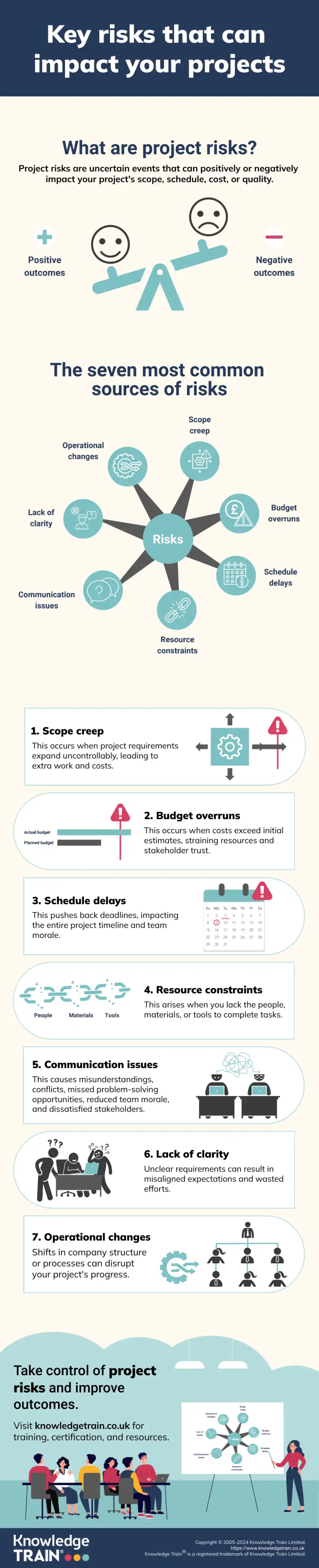
A PMI COURSESproject riskSelect your preferred training course below: refers to an uncertain event or condition that, if it occurs, has the potential to either positively or negatively affect the outcome of a project. Risks can impact project objectives such as scope, schedule, cost, or quality. Examples of project risks include changes in customer requirements, budget constraints, delays in schedules, technical issues, resource shortages, and more.
Types of project risksPRINCE2 COURSES
Project risks can be classified into various categories, including:Select your preferred training course below:
- Internal risks : These risks originate from within the project or the organisation itself. They can be related to factors such as team dynamics, resource availability, or management decisions.APM COURSES
- External risksSelect your preferred training course below:: These risks arise from factors outside the project’s control, such as economic conditions, regulatory changes, natural disasters, or market trends.
- Technical risksAGILE PROJECT MANAGEMENT COURSES: Technical risks are associated with the technology or methodologies used in the project. They may involve issues like software glitches, hardware failures, integration challenges, or inadequate technical expertise.Select your preferred training course below:
- Financial risks : Financial risks impact the project’s budget, funding, or financial resources. They can include factors like unexpected cost overruns, currency fluctuations, or inadequate financial planning.PRINCE2 AGILE COURSES
- Operational risksSelect your preferred training course below:: Operational risks affect the day-to-day functioning of the project. They can encompass issues like human errors, process inefficiencies, supply chain disruptions, or equipment failures.
- Strategic risksBUSINESS CASE COURSES: Strategic risks influence the project’s alignment with the organisation’s overall business goals. They may involve risks related to changing market demands, competitive pressures, or organisational changes.Select your preferred training course below:
Impact of risks on project success
Risks can have a variety of impacts on a project’s success:AGILE COURSES
- Positive effectsSelect your self-paced training course topic.: These could include opportunities for innovation or efficiency improvements
- Negative effectsAGILE PROJECT MANAGEMENT COURSES: These could lead to delays, cost overruns, or quality issues.Select your preferred training course below:
Effective risk managementPRINCE2 AGILE COURSES is important for minimising negative impacts and maximising the potential for opportunities and overall project success.Select your preferred training course below:
By identifying and assessing risks, project managersSCRUM COURSES can develop contingency plans and take proactive steps to mitigate potential problems. This helps increase the chances of achieving project goals and delivering value to stakeholders.Select your preferred training course below:
Common project management risks
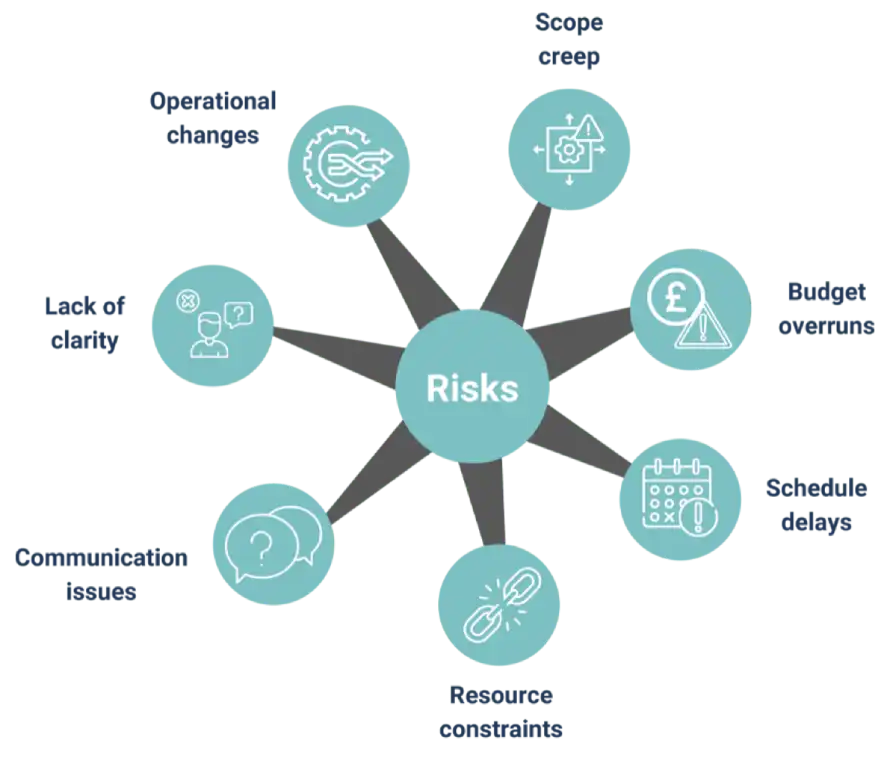
Scope creepMSP COURSES
Common causesSelect your preferred training course below:
Scope creep is the uncontrolled expansion of a project’s scope without corresponding adjustments to time, budget, and resources. Common causes of scope creep include ambiguous initial requirements, lack of change control processes, Stakeholder pressure for additional features, and insufficient stakeholder engagement.IT QUALIFICATIONS
ImpactSelect your preferred qualification.
Scope creep can have several impacts on a project:
- It can increase the project’s duration, require more resources and increase costsITIL COURSES
- It can lead to delays and missed deadlinesSelect your preferred training course below:
- It can cause the project to lose focus and drift away from its original objectives
- It can lead to team burnout and demotivation.IT QUALIFICATIONS
To prevent scope creep, it is crucial to have a clear understanding of the project’s objectives and requirements, and to establish change control processes to manage and approve any changes to the project scope.Select your preferred qualification.
Budget overruns
Common causesITIL COURSES
Budget overrunsSelect your preferred training course below: occur when the actual cost of a project exceeds the initially allocated budget. Common causes of budget overruns include inaccurate cost estimation, scope changes, unforeseen expenses, and poor resource management.
ImpactLEARNING LIBRARIES
Prevent budget problems by performing a detailed cost analysis and ensuring financial reporting is transparent throughout the project.Select your preferred training course topic.
Schedule delays
Common causesAI QUALIFICATIONS & WORKSHOPS
Schedule delaysSelect your preferred qualification or workshop. can occur due to a variety of reasons:
- Unrealistic time estimatesAIPGF COURSES
- Resource unavailabilitySelect your preferred training course below:
- Dependency conflicts
- External factors (e.g. weather, supplier delays).BCS AI COURSES
ImpactSelect your preferred training course below:
Schedule delays can lead to missed deadlines and milestones, increased costs due to prolonged project duration, reduced stakeholder satisfaction and potential loss of competitive advantage.
To address time-related risks, implement effective project scheduling techniques and regularly monitor project progress.AIPGF COURSES
Resource constraintsSelect your preferred training course below:
Types of resource risks
Resource risksAI WORKSHOPS can take various forms, such as:Select your preferred workshop below:
- Skill shortages
- Equipment or material unavailabilityKnowledge Train is a PRINCE2 Accredited Training Organization.
- Insufficient funding
- Limited time availability.Knowledge Train is an AgilePM Accredited Training Organization.
Impact on project performance
Resource constraints can result in reduced productivity, compromised quality of deliverables, increased stress on team members and potential project delays.Knowledge Train is a PRINCE2 Agile Accredited Training Organization.
Conduct thorough resource planning and maintain open communication with stakeholders to proactively address resource-related issues.
Communication issuesKnowledge Train is a Better Business Cases Accredited Training Organization.
Importance of effective communication
Effective communicationKnowledge Train is a P3O Accredited Training Organization. is vital for project success. It facilitates alignment of project objectives, timely issue resolution, stakeholder engagement and buy-in and efficient team collaboration.
Consequences of poor communicationKnowledge Train is an AgilePM Accredited Training Organization.
Poor communication can lead to misunderstandings and conflicts, missed opportunities for problem-solving, reduced team morale and productivity and stakeholder dissatisfaction.
Establish clear communication channels and protocols to promote open and transparent dialogue throughout the project.Knowledge Train is a PRINCE2 Agile Accredited Training Organization.
Lack of clarity
Sources of unclear requirementsKnowledge Train is an Agile BA Accredited Training Organization.
Unclear requirements can stem from ambiguous project objectives, insufficient stakeholder input, lack of detailed documentation and changing business needs.BCS accredited training partner for Business Analysis.
Effects on project outcomes
Lack of clarity can lead to misaligned expectations, rework and wasted resources, delayed decision-making and compromised project quality.Knowledge Train is an Agile BA Accredited Training Organization.
Invest time in gathering and documenting clear requirements and maintain ongoing stakeholder engagement to ensure alignment.
Operational changesKnowledge Train is a Change Management Accredited Training Organization.
Types of operational risks
Operational changesKnowledge Train is an MSP Accredited Training Organization. can include:
- Organisational restructuringKnowledge Train is a PRINCE2 Accredited Training Organization.
- Process modifications
- Technology upgradesKnowledge Train is an AgilePM Accredited Training Organization.
- Regulatory changes.
Impact on project executionKnowledge Train is a PRINCE2 Agile Accredited Training Organization.
Operational changes can affect projectsKnowledge Train is a Better Business Cases Accredited Training Organization. by disrupting established workflows, requiring additional training or resources, altering project priorities and necessitating scope or timeline adjustments.
Stay informed about potential organisational changes and maintain flexibility in Knowledge Train is an AgilePM Accredited Training Organization.project planning to accommodate operational shifts.Knowledge Train is a PRINCE2 Agile Accredited Training Organization.
By knowing about common project management risks, you can make specific plans to help prevent or overcome them. In addition, proactive risk management involves:
- Knowledge Train is a Change Management Accredited Training Organization.
- Clear communication with stakeholders
- Robust change management processesKnowledge Train is an MSP Accredited Training Organization.
- Continuous monitoring and adaptation.
Keep in mind that effective risk management is an ongoing process that needs careful monitoring and flexibility throughout the project. If you plan and work for these common risks, you will be able to increase the probability of success in your project.AXELOS Peoplecert accredited training organisation for ITIL (IT Infrastructure Library).
Risk management process
Risk identificationAXELOS Peoplecert accredited training organisation for ITIL (IT Infrastructure Library).
The first step in risk management is to identify potential risks that could impact your project. Some common techniques include:
- Brainstorming with team membersKnowledge Train is an AIPGF Accredited Training Organization.
- Reviewing historical information from similar projectsKnowledge Train is an AIPGF Accredited Training Organization.
- Conducting stakeholder interviews
- Analysing project documentation.BCS accredited training partner for Business Analysis.
Create a risk registerWHAT YOU WILL GET to document all identified risks.Our courses and workshops include:
Risk assessment and prioritisationCertification exam(s) where applicable
After identifying risks, assess their potential impact and likelihood of occurrence. Tools you can use include:Accredited training course materials
- Risk matrixExpert, experienced trainers to support you: Plot risks on a chart based on their probability and impactCourse manual where applicable.
- Quantitative analysis : Assign numerical values to risksSELF-PACED ONLINE TRAINING COURSES
- Qualitative analysisSelf-paced online training courses (e-learning) include:: Categorise risks based on severity.Certification exam(s) where applicable
Prioritise risks based on their potential impact.Accredited training course materials
Risk response planningSupport from expert, experienced trainers
For each prioritised risk, develop a response strategy. Common responses include:Latest educational technology.
- Avoidance : Eliminate the threat by changing BUSINESS SOLUTIONSproject plans
- Mitigation : Reduce the probability or impact of the riskTO HELP ORGANISATIONS IMPROVE
- TransferWe offer solutions to help improve team performance including:: Shift the risk to a third party (e.g. insurance)Consultancy services
- AcceptanceStaff development: Acknowledge the risk and prepare contingency plans.Compliance training
Document your response strategies in a risk management plan.Apprenticeship training
Risk monitoring and controlCustom e-Learning development
Continuously monitor risks throughout the project lifecycle. This includes:
- Regular risk reviews and updates
- Tracking risk triggers and early warning signsFind out more
- Implementing planned responses when necessary
- Evaluating the effectiveness of risk responses.
Adjust your risk management approach as needed based on new information and changing project conditions.
By following this structured process, you can effectively manage risks and increase your project’s chances of success.
Tools and techniques for project risk managementSubmit
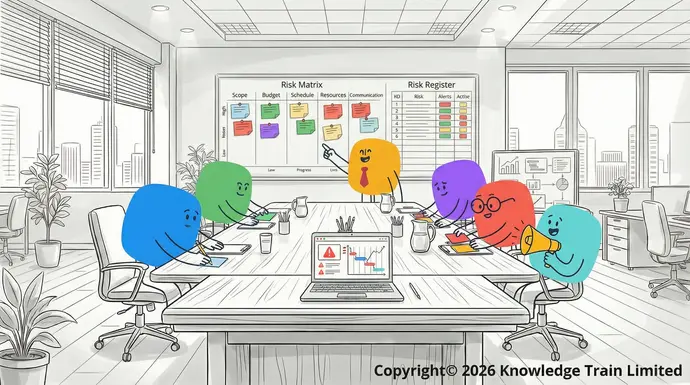
Risk register
A risk register is a document that lists all identified risks along with their potential impact and planned mitigation. Components to include are:OUR VALUES
- Risk descriptionOur 6 core values are everything we do. They include:
- Probability and impact assessmentIntegrity
- Risk ownerDiversity
- Mitigation strategiesFairness
- Contingency plans.Quality
Maintain your risk register throughout the project, regularly updating it as needed.Innovation
SWOT analysisSocial responsibility
SWOT analysis is used to identify factors that may impact your project:SOCIAL RESPONSIBILITY
- Strengths: Project advantagesSome of the charities we have helped over the years:
- Weaknesses: Areas for improvement
- Opportunities: Potential benefits
- Threats: Possible risks.
Performing a SWOT analysis gives you a well-rounded view of your project’s risk landscape.
Brainstorming sessions
Organise structured brainstorming sessionsAWARDS with your team to identify potential risks. Encourage open discussion and creative thinking. Techniques you can use include:We don’t go seeking awards, but here are two of the awards we have received for our training.
- Nominal group technique
- Affinity diagramming
- Mind mapping. Request a quote
Brainstorming sessions can help identify risks that might be overlooked otherwise.
Project management software
Project management software is a valuable tool for helping to streamline your risk management processes. Features to consider include:
- Risk tracking and monitoring+44 (0)207 148 5985
- Automated alerts for risk triggers
- Collaboration tools for team communication[email protected]
- Reporting capabilities for stakeholder updates.
Project management software can greatly improve your ability to manage risks throughout your project.
Regular risk assessmentSweden
- Hold Other countriesregular check-ins to reviewHome identified risks and their status
- Re-evaluate risks as the project progresses and circumstances changeProject management
- Revise risk mitigation plans as necessary.Project management short course
Stakeholder involvement in risk management
- Include stakeholders in identifying and assessing risks{"@context":"http://schema.org","@type":"BreadcrumbList","itemListElement":[{"@type":"ListItem","position":1,"name":"Home","item":"https://www.knowledgetrain.co.uk/"},{"@type":"ListItem","position":2,"name":"Project management","item":"https://www.knowledgetrain.co.uk/project-management"},{"@type":"ListItem","position":3,"name":"Project management short courses","item":"https://www.knowledgetrain.co.uk/project-management/project-management-short-course"}]}
- Keep stakeholders informed of risk management plans and progress
- Seek stakeholder input on risk mitigation strategies.
Continuous learning and improvement
- Record lessons learnt from risk management successes and failures
- Share information with other project teams to improve organisational risk management
- Invest in ongoing training and development of risk management skills.Instructor-led
Follow these tips to help you establish a positive risk management culture and improve project success.