IntroductionPRINCE2 Agile Practitioner (with Foundation) self-paced online
Project management is a challenging process that is prone to many possible failures. £1,399 +vatRisk management is a key aspect of project management that can help increase the likelihood of project success. This involves the process of identifying, assessing, and mitigating risks that can threaten the project.
In this article, we will explore some of the risks that can arise on projects and how to deal with them effectively. We will discuss the following topics:
- The definition and importance of understanding project risksSelf-paced
- The different types of common project risksAgilePM Practitioner (with Foundation) self-paced online
- The process of risk management on projects
- The tools and techniques used in risk management£1,299 +vat
- The strategies for effective risk mitigationFAQs
- The best practices for successful risk management on projects.What is the difference between traditional and sustainable project management?
By the end of this article, you will be able to:Sustainable project management focuses on incorporating environmental, social, and economic factors throughout the project lifecycle, while traditional project management emphasises time, cost, and scope constraints.
- Identify potential risks on your projectsHow can I incorporate sustainability into my existing project management framework?
- Apply effective risk management strategiesIncorporate sustainability goals into the project charter, conduct a sustainability-focused stakeholder analysis, and integrate sustainability metrics into monitoring and control processes.
- Improve the chances of your project’s success.What are some common sustainability metrics used in project management?
You can also learn about project risk management on a Common metrics include carbon footprint, waste reduction, energy efficiency, water usage, social impact scores, and sustainable procurement percentages.project management courseHow does sustainable project management contribute to a company’s overall CSR strategy? such as It aligns project outcomes with the organisation’s broader sustainability goals, improving environmental and social performance while supporting long-term economic viability.PRINCE2 courseWhat skills do project managers need to develop for sustainable project management? or an Project managers should develop skills in sustainability assessment, stakeholder engagement, life cycle thinking, and balancing competing priorities.APM courseHow can sustainable project management help reduce project risks?.Sustainable practices help manage long-term environmental and social risks, reducing potential reputational, regulatory, and operational risks.
Let’s begin and explore the world of What are some industry-specific challenges in implementing sustainable project management?project risk managementChallenges vary but may include regulatory compliance, technology limitations, and supply chain complexity. and how to protect your projects from potential risks.How can small businesses benefit from sustainable project management practices?
Understanding project risksSmall businesses can gain a competitive edge, reduce operational costs, and enhance their reputation by implementing sustainable project management practices.
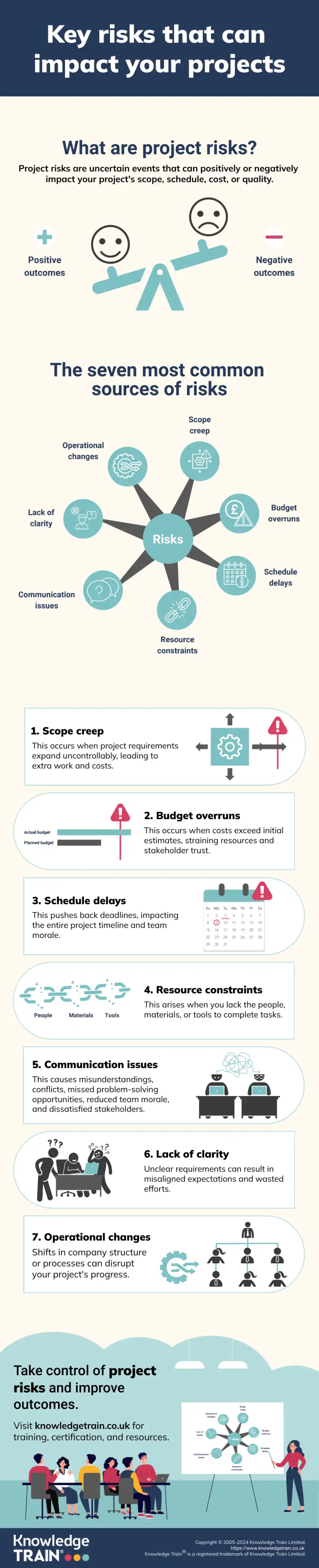
Definition of project riskInfographic
A Subscribe to our exclusive offers and promotionsproject risk refers to an uncertain event or condition that, if it occurs, has the potential to either positively or negatively affect the outcome of a project. Risks can impact project objectives such as scope, schedule, cost, or quality. Examples of project risks include changes in customer requirements, budget constraints, delays in schedules, technical issues, resource shortages, and more.Subscribe now
Types of project risks
Project risks can be classified into various categories, including:
- Internal risks{"@context":"https://schema.org","@type":"ImageObject","contentUrl":"https://www.knowledgetrain.co.uk/training-courses/sustainable-project-management-infographic-v1.0.webp","description":"Sustainable project management infographic","license":"https://www.knowledgetrain.co.uk/license","acquireLicensePage":"https://www.knowledgetrain.co.uk/license","creditText":"Knowledge Train","uploadDate":"2024-11-04T09:00:59.000Z","copyrightNotice":"© 2024 Knowledge Train Limited. All rights reserved.","creator":{"@type":"Organization","name":"Knowledge Train","url":"https://www.knowledgetrain.co.uk"}}: These risks originate from within the project or the organisation itself. They can be related to factors such as team dynamics, resource availability, or management decisions.
- External risksRelated articles: These risks arise from factors outside the project’s control, such as economic conditions, regulatory changes, natural disasters, or market trends.
- Technical risks
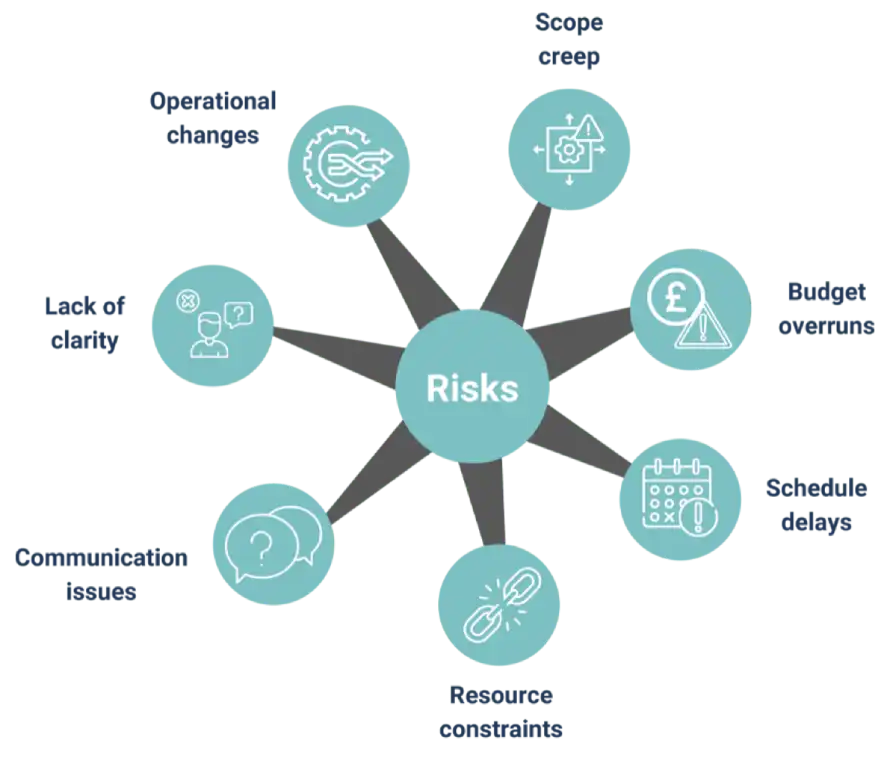
- It can lead to delays and missed deadlines
- It can cause the project to lose focus and drift away from its original objectives
- It can lead to team burnout and demotivation.
To prevent scope creep, it is crucial to have a clear understanding of the project’s objectives and requirements, and to establish change control processes to manage and approve any changes to the project scope.
Budget overruns
Common causesInterview with Madeleine Parsley
Budget overruns occur when the actual cost of a project exceeds the initially allocated budget. Common causes of budget overruns include inaccurate cost estimation, scope changes, unforeseen expenses, and poor resource management.Sevcan Yasa
Impact19 Feb 2026
Prevent budget problems by performing a detailed cost analysis and ensuring financial reporting is transparent throughout the project.
Schedule delaysIn this video, Madeleine Parsley describes how her career was helped by taking a PRINCE2 Foundation and Practitioner course with Knowledge Train.
Document your response strategies in a risk management plan.Give us a call
Adjust your risk management approach as needed based on new information and changing project conditions.
By following this structured process, you can effectively manage risks and increase your project’s chances of success.
- Communicate the impact of scope changes to all stakeholders.
Managing budget risks
- Accurate cost estimation and inclusion of contingency reserves
- Regular budget monitoring and reporting Request a quote
- Cost control measures and prioritisation of expenses.
Addressing schedule delays
- Utilise critical path analysis to identify key milestones and dependencies
- Build buffer time into project schedules
- Regularly review and adjust timelines based on progress updates. Manage Consent
Optimising resource allocation
- Conduct thorough resource planning at the outset of the project To provide the best experiences, we use technologies like cookies to store and/or access device information. Consenting to these technologies will allow us to process data such as browsing behavior or unique IDs on this site. Not consenting or withdrawing consent, may adversely affect certain features and functions.
- Utilise resource levelling techniques to balance workloads
- Maintain a skills inventory to quickly identify and address skill gaps.
Improving communication Functional
- Establish clear communication channels and protocols
- Schedule regular team meetings and stakeholder updates
- Utilise collaboration tools to facilitate information sharing.
Ensuring clarity in project requirements
- Conduct thorough requirements gathering sessions with stakeholders Functional
- Create detailed, unambiguous project specifications
- Implement formal requirements review and approval process. Always active
Adapting to changes
- Stay informed of potential changes within the organisation
- Build flexibility into project plans to accommodate operational shifts
- Develop contingency plans for significant operational disruptions.
By following these tips, you can avoid most of the common pitfalls that can cause problems in your projects. Keep in mind that risk management is a continuous process. It is important to revisit the steps in this process as you continue with your project. The technical storage or access is strictly necessary for the legitimate purpose of enabling the use of a specific service explicitly requested by the subscriber or user, or for the sole purpose of carrying out the transmission of a communication over an electronic communications network.
Best practices for effective risk management
Proactive approach to risk identification
- Try to spot potential risks at the start of a project
- Ask team members to raise red flags as soon as possible Preferences
- Look at past data and apply any relevant lessons learnt.
Regular risk assessment
- Hold regular check-ins to review Preferences identified risks and their status
- Re-evaluate risks as the project progresses and circumstances change
- Revise risk mitigation plans as necessary.
Stakeholder involvement in risk management
- Include stakeholders in identifying and assessing risks
- Keep stakeholders informed of risk management plans and progress
- Seek stakeholder input on risk mitigation strategies.
Continuous learning and improvement The technical storage or access is necessary for the legitimate purpose of storing preferences that are not requested by the subscriber or user.
- Record lessons learnt from risk management successes and failures
- Share information with other project teams to improve organisational risk management
- Invest in ongoing training and development of risk management skills.
Follow these tips to help you establish a positive risk management culture and improve project success.
Conclusion
Recap of key points Marketing
Effective project risk management is a multi-faceted approach that involves identifying and assessing potential risks, developing mitigation strategies, utilising appropriate tools and techniques, and implementing best practices for continuous improvement.
These elements form a comprehensive framework for managing uncertainties in project management.
Importance of ongoing risk management
Risk management Marketing is an ongoing process that requires constant vigilance, regular reassessment and adaptation to changing project conditions.
By prioritising risk management throughout the project lifecycle, you increase the likelihood of project success. Remember, proactive risk management is an investment in your project’s future, safeguarding its objectives and deliverables.
FAQs
What is the difference between internal and external project risks?
Internal risks are those that originate within the project or organisation, while external risks stem from outside factors beyond the direct control of the project team.
How often should risk assessments be conducted during a project?
Risk assessments should be conducted regularly throughout a project, often at predetermined intervals or key project milestones. Monthly risk assessments are typical for most projects.
What role do stakeholders play in project risk management?The technical storage or access is required to create user profiles to send advertising, or to track the user on a website or across several websites for similar marketing purposes.
Stakeholders can provide valuable input in identifying risks, assessing their potential impact, and helping to develop risk mitigation strategies.
Can all project risks be eliminated?Manage options
No, not all project risks can be eliminated. The focus should be on effectively managing and mitigating risks.Manage services
How can small teams effectively manage project risks with limited resources?Manage {vendor_count} vendors
Small teams can prioritise risks based on their potential impact, use simple risk assessment tools, and leverage the diverse expertise of team members to ensure comprehensive risk management.Read more about these purposes
Infographic