Belgium{"@context":"http://schema.org","@type":"EducationEvent","name":"BCS Business Analysis Practice course","startDate":"2026-09-14","endDate":"2026-09-16","description":"BCS Business Analysis Practice course","url":"https://www.knowledgetrain.co.uk/business-analysis/business-analyst-course/bcs-business-analysis-certification/bcs-business-analysis-practice","eventStatus":"EventScheduled","eventAttendanceMode":"OnlineEventAttendanceMode","audience":{"@type":"Audience","name":"
The BCS Business Analysis Practice course is suitable for business analysts, business managers and team members, business change managers, software development professionals, and project managers seeking continuing professional development (CPD), and employees wanting an understanding of business analysis techniques and best practices.
FranceBCS Business Analysis Practice course (Online)
Germany
Greece £1,299
Ireland
Italy£1,599
Latvia
LithuaniaEnrol now
Luxemburg
Malta
Netherlands
Poland
{"@context":"http://schema.org","@type":"EducationEvent","name":"BCS Business Analysis Practice course","startDate":"2026-11-09","endDate":"2026-11-11","description":"BCS Business Analysis Practice course","url":"https://www.knowledgetrain.co.uk/business-analysis/business-analyst-course/bcs-business-analysis-certification/bcs-business-analysis-practice","eventStatus":"EventScheduled","eventAttendanceMode":"OnlineEventAttendanceMode","audience":{"@type":"Audience","name":"Romania<
p>The BCS Business Analysis Practice course is suitable for business analysts, business managers and team members, business change managers, software development professionals, and project managers seeking continuing professional development (CPD), and employees wanting an understanding of business analysis techniques and best practices.Slovakia
{"@context":"http://schema.org","@type":"Course","name":"BCS Business Analysis Practice course","description":"BCS Business Analysis Practice course","image":"https://www.knowledgetrain.co.uk/training-courses/res/logos/bcs-accredited-training-partner-logo.svg","url":"https://www.knowledgetrain.co.uk/business-analysis/business-analyst-course/bcs-business-analysis-certification/bcs-business-analysis-practice","provider":{"@type":"Organization","name":"Knowledge Train","logo":{"@type":"ImageObject","url":"https://www.knowledgetrain.co.uk/business-analysis/business-analyst-course/bcs-business-analysis-certification/bcs-business-analysis-practice"}},"courseCode":"BCSBAPC","coursePrerequisites":"None.","educationalCredentialAwarded":"BCS Practitioner Certificate in Business Analysis Practice","audience":{"@type":"Audience","name":"Other countries<
ul> <li> <
span>The strategic contextRisk management on projects
>","learningResourceType":"presentation","teaches":" <h3>Curriculum 3> <h4>BCS Business Analysis Practice 4> <p>The BCS Business Analysis Practice course covers all topics from the BCS Practitioner Certificate in Business Analysis Practice syllabus. >Copied!<
p>The course covers the following topics:Key takeaways
>Strong risk management improves delivery certainty by surfacing threats early and agreeing responses.<
ul>Define risks as uncertain events that can help or harm scope, schedule, cost, or quality.<
Project managementEnrol now is a challenging process that is prone to many possible failures. Risk management is a key aspect of project management that can help increase the likelihood of project success. This involves the process of identifying, assessing, and mitigating risks that can threaten the project.
In this article, we will explore some of the risks that can arise on projects and how to deal with them effectively. We will discuss the following topics:
The definition and importance of understanding project risks{"@context":"http://schema.org","@type":"Course","name":"BCS Business Analysis Practice self-paced online","description":"Complete online at your own pace (Self-paced)","image":"https://www.knowledgetrain.co.uk/training-courses/res/logos/bcs-accredited-training-partner-logo.svg","url":"https://www.knowledgetrain.co.uk/business-analysis/business-analyst-course/bcs-business-analysis-certification/bcs-business-analysis-practice","provider":{"@type":"Organization","name":"Knowledge Train","logo":{"@type":"ImageObject","url":"https://www.knowledgetrain.co.uk/business-analysis/business-analyst-course/bcs-business-analysis-certification/bcs-business-analysis-practice"}},"assesses":"
Learning outcomes
BCS Business Analysis Practice training helps you learn how to apply a range of business analysis methods and best practice techniques and looks at a range of topics including:
The BCS Business Analysis Practice course covers all topics from the BCS Practitioner Certificate in Business Analysis Practice syllabus.
The course covers the following topics:
<: Operational risks affect the day-to-day functioning of the project. They can encompass issues like human errors, process inefficiencies, supply chain disruptions, or equipment failures.li>Business analysis rationale
<: Strategic risks influence the project’s alignment with the organisation’s overall business goals. They may involve risks related to changing market demands, competitive pressures, or organisational changes.li>Strategic analysis in context
A project approach to business analysis
<: These could include opportunities for innovation or efficiency improvementsli>Understanding the situation/issues
<: These could lead to delays, cost overruns, or quality issues.li>Business perspectives
Analysing and modelling the business activities
Creative problem solving< can develop contingency plans and take proactive steps to mitigate potential problems. This helps increase the chances of achieving project goals and delivering value to stakeholders.li>Identifying potential solutions
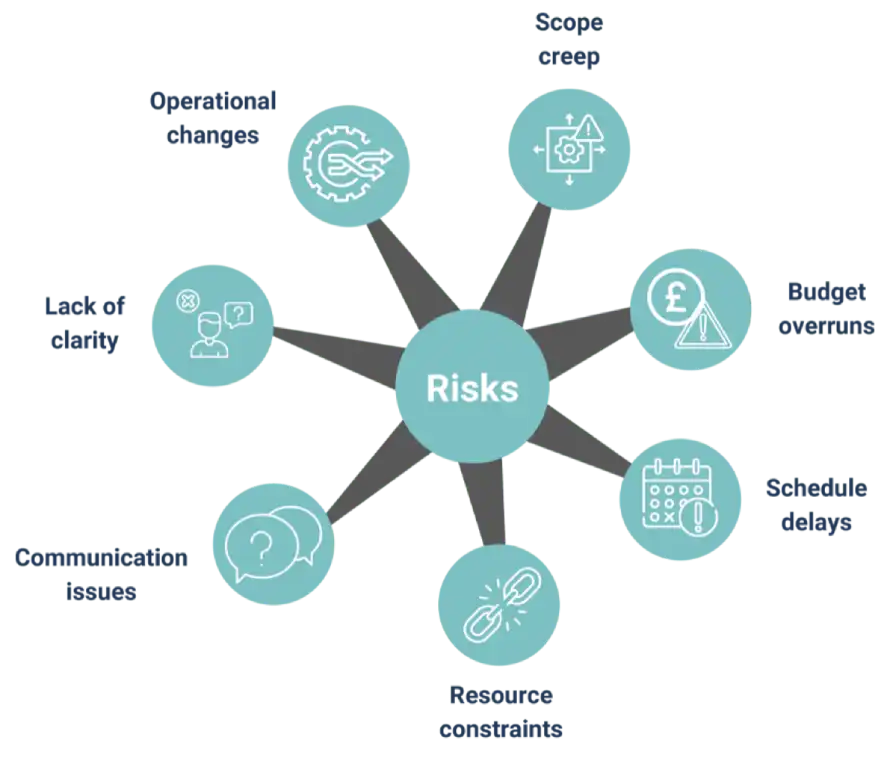
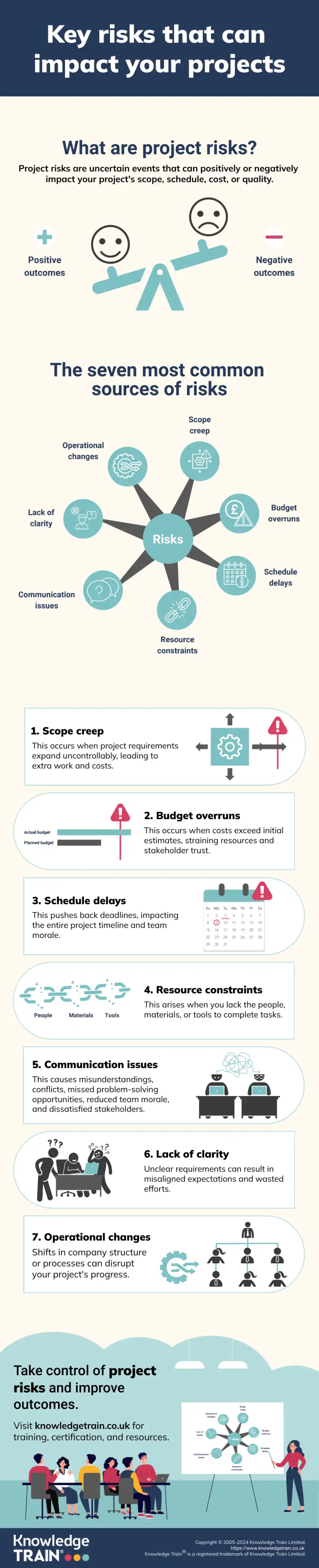
Common project management risksrequest a bespoke quote
Scope creep for tailored group training.
Common causes
Scope creep is the uncontrolled expansion of a project’s scope without corresponding adjustments to time, budget, and resources. Common causes of scope creep include ambiguous initial requirements, lack of change control processes, Stakeholder pressure for additional features, and insufficient stakeholder engagement.
ImpactBusiness Analysis Practice helped me join the dots between strategy, change initiatives, and detailed analysis work. I now approach assignments with a much clearer framework.
Scope creep can have several impacts on a project:Laura D., Senior Business Analyst
It can increase the project’s duration, require more resources and increase costsOverview
It can lead to delays and missed deadlines Develop practical, practitioner-level business analysis skills focused on pre-project work. Learn how to analyse business situations, define options, and support change with a robust business case – without needing to complete the Foundation course first.
It can cause the project to lose focus and drift away from its original objectives What you will gain
It can lead to team burnout and demotivation.Apply proven tools to analyse business situations
To prevent scope creep, it is crucial to have a clear understanding of the project’s objectives and requirements, and to establish change control processes to manage and approve any changes to the project scope.Model target operating states and define options
Budget overrunsEngage stakeholders and manage differing viewpoints
Common causesBuild persuasive business cases that support change
Budget overruns Who this course is for occur when the actual cost of a project exceeds the initially allocated budget. Common causes of budget overruns include inaccurate cost estimation, scope changes, unforeseen expenses, and poor resource management.Business analysts and aspiring business analysts
Analyse stakeholders effectively
Prevent budget problems by performing a detailed cost analysis and ensuring financial reporting is transparent throughout the project.
Schedule delays Use practical tools to understand power, interest, and perspectives.
Common causes Model current and target states
Schedule delays can occur due to a variety of reasons: Apply BAMs, TOMs, and gap analysis to real situations.
Unrealistic time estimates Design feasible solutions
Resource unavailability
Dependency conflicts Explore options and assess business, technical, and financial viability.
External factors (e.g. weather, supplier delays). Build stronger business cases
IncludedTechnology upgrades
10 hours
Clear communication with stakeholders
Robust change management processesTutor and technical support via email and phone
Continuous monitoring and adaptation.
Keep in mind that effective risk management is an ongoing process that needs careful monitoring and flexibility throughout the project. If you plan and work for these common risks, you will be able to increase the probability of success in your project.Start anytime
Risk management process
Risk identificationIncluded
The first step in risk management is to identify potential risks that could impact your project. Some common techniques include:
Brainstorming with team membersInteractive content
Analysing project documentation.Learners who prefer flexibility & self-study
Create a risk registerEngaging, interactive e-learning to document all identified risks.
Risk assessment and prioritisationAbout our e-learning design
After identifying risks, assess their potential impact and likelihood of occurrence. Tools you can use include: Our Business Analysis Practice self-paced course uses interactive scenarios, case studies, and knowledge checks that mirror real analysis work. Content is broken into short, focused modules, fully responsive on desktop, tablet, and mobile, so you can learn when it suits you.
Risk matrixCourse: Plot risks on a chart based on their probability and impact This course focuses on how to do business analysis in practice - from understanding strategic drivers and stakeholder needs to defining solutions and building a compelling business case.
Quantitative analysis Set the strategic context: Assign numerical values to risks
Qualitative analysis Relate analysis work to vision, objectives, and performance measures.: Categorise risks based on severity.
Prioritise risks based on their potential impact.
Risk response planning Engage and manage stakeholders
For each prioritised risk, develop a response strategy. Common responses include:
Implementing planned responses when necessary
Tools and techniques for project risk managementCreating consensus BAMs to achieve shared stakeholder views
Risk registerUsing target operating models (TOMs) based on POPIT™ to define the future state
A Designing and defining the solutionrisk registerApplying design thinking stages and the Double Diamond model is a document that lists all identified risks along with their potential impact and planned mitigation. Components to include are:Using gap analysis to compare current and target states
Risk descriptionDeveloping and refining solution options for business change
Probability and impact assessmentDeveloping a business case
Risk ownerPurpose and structure of the business case and its contents
Mitigation strategiesAnalysing costs, benefits, and risks – including tangible and intangible aspects
resource levelling techniques to balance workloads
Schedule regular team meetings and stakeholder updates
Utilise collaboration tools to facilitate information sharing.
Ensuring clarity in project requirements
Conduct thorough requirements gathering sessions with stakeholdersKnowledge Train’s team were helpful and responsive from the moment I enquired, through booking, to the day of the exam. Everything felt organised and professional.
Create detailed, unambiguous project specificationsAdam C., Business Architect
Share information with other project teams to improve organisational risk management
ConclusionFAQs
Recap of key pointsWhy choose BCS Business Analysis Practice?
Effective project risk management is a multi-faceted approach that involves identifying and assessing potential risks, developing mitigation strategies, utilising appropriate tools and techniques, and implementing best practices for continuous improvement.
These elements form a comprehensive framework for managing uncertainties in project management.
Importance of ongoing risk managementOpting for the BCS Business Analysis Practice certification offers several benefits:
Risk managementCareer opportunities is an ongoing process that requires constant vigilance, regular reassessment and adaptation to changing project conditions.: Enhance your job prospects.
By prioritising risk management throughout the project lifecycle, you increase the likelihood of project success. Remember, proactive risk management is an investment in your project’s future, safeguarding its objectives and deliverables.Professional development
FAQs: Gain valuable skills for growth.
What is the difference between internal and external project risks?Employer recognition
Internal risks are those that originate within the project or organisation, while external risks stem from outside factors beyond the direct control of the project team.: Increase your value to employers.
How often should risk assessments be conducted during a project?Job advancement
Risk assessments should be conducted regularly throughout a project, often at predetermined intervals or key project milestones. Monthly risk assessments are typical for most projects.: Open doors for career advancement.
What role do stakeholders play in project risk management?Future potential
Stakeholders can provide valuable input in identifying risks, assessing their potential impact, and helping to develop risk mitigation strategies.: Secure a promising future in Business Analysis.
Can all project risks be eliminated?What will you learn in the BCS Business Analysis Practice course?
No, not all project risks can be eliminated. The focus should be on effectively managing and mitigating risks.
How can small teams effectively manage project risks with limited resources?
Small teams can prioritise risks based on their potential impact, use simple risk assessment tools, and leverage the diverse expertise of team members to ensure comprehensive risk management.This BCS course covers a broad curriculum designed to provide practical and theoretical knowledge:
SearchRequest a quote
Manage Consent
Request a quote
To provide the best experiences, we use technologies like cookies to store and/or access device information. Consenting to these technologies will allow us to process data such as browsing behavior or unique IDs on this site. Not consenting or withdrawing consent, may adversely affect certain features and functions.
Functional Manage Consent To provide the best experiences, we use technologies like cookies to store and/or access device information. Consenting to these technologies will allow us to process data such as browsing behavior or unique IDs on this site. Not consenting or withdrawing consent, may adversely affect certain features and functions.
The technical storage or access is necessary for the legitimate purpose of storing preferences that are not requested by the subscriber or user.
Preferences
The technical storage or access that is used exclusively for statistical purposes. Marketing
To provide the best experiences, we use technologies like cookies to store and/or access device information. Consenting to these technologies will allow us to process data such as browsing behavior or unique IDs on this site. Not consenting or withdrawing consent, may adversely affect certain features and functions.Save preferences
View preferences {title} {title}Functional{title} Manage Consent To provide the best experiences, we use technologies like cookies to store and/or access device information. Consenting to these technologies will allow us to process data such as browsing behavior or unique IDs on this site. Not consenting or withdrawing consent, may adversely affect certain features and functions. Always active Functional
FunctionalThe technical storage or access is strictly necessary for the legitimate purpose of enabling the use of a specific service explicitly requested by the subscriber or user, or for the sole purpose of carrying out the transmission of a communication over an electronic communications network.
Always active Preferences The technical storage or access is strictly necessary for the legitimate purpose of enabling the use of a specific service explicitly requested by the subscriber or user, or for the sole purpose of carrying out the transmission of a communication over an electronic communications network. Preferences
The technical storage or access is necessary for the legitimate purpose of storing preferences that are not requested by the subscriber or user.Preferences