Risk management on projectsAccredited training course materials

Key takeaways
Strong risk management improves delivery certainty by surfacing threats early and agreeing responses.
- Define risks as uncertain events that can help or harm scope, schedule, cost, or quality.Name
- Classify risks (internal, external, technical, financial, operational, strategic) to avoid blind spots.
- Use a repeatable cycle: identify, assess likelihood and impact, plan responses, then monitor and adapt.
- Maintain a live risk register, supported by tools such as a risk matrix, SWOT, and project software alerts.Email
- Prevent common failures by controlling scope changes, monitoring budgets, managing dependencies, and planning resources.
- Keep stakeholders engaged with clear communication so risks are understood, owned, and acted on.
- : These could include opportunities for innovation or efficiency improvementsMalta
- Negative effectsNetherlands: These could lead to delays, cost overruns, or quality issues.Poland
Effective Portugalrisk managementRomania is important for minimising negative impacts and maximising the potential for opportunities and overall project success.Slovakia
By identifying and assessing risks, Sloveniaproject managersSpain can develop contingency plans and take proactive steps to mitigate potential problems. This helps increase the chances of achieving project goals and delivering value to stakeholders.Sweden
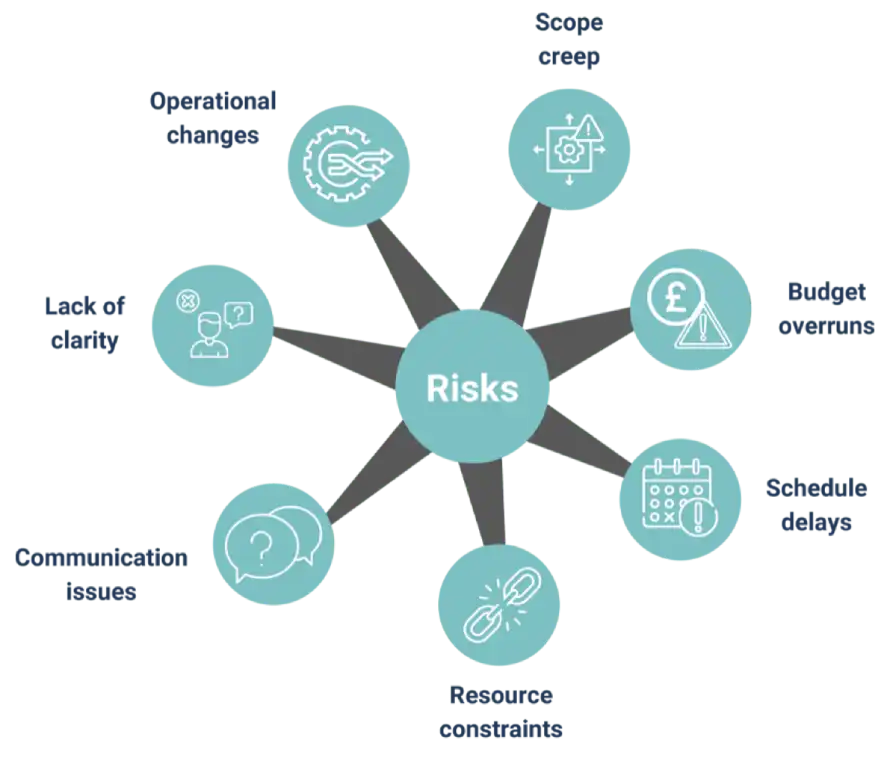
Sources of unclear requirements
Unclear requirementsFAQs can stem from ambiguous project objectives, insufficient stakeholder input, lack of detailed documentation and changing business needs.What is change management?
Effects on project outcomesChange management
Lack of clarity can lead to misaligned expectations, rework and wasted resources, delayed decision-making and compromised project quality. refers to the systematic process of planning, implementing, and overseeing organisational changes to achieve desired business outcomes.
Invest time in gathering and documenting clear requirements and maintain ongoing stakeholder engagement to ensure alignment.Change management encompasses strategies, techniques, and tools that help organisations prepare for, execute, and sustain change, whether related to processes, technologies, culture, or organisational structure.
Operational changesEffective change management seeks to minimise disruption, address resistance to change, and strengthen engagement among all
Types of operational risksstakeholders
- Kotter’s 8-Step ProcessMitigation strategies
- Contingency plans.Establish a sense of urgency
Maintain your risk register throughout the project, regularly updating it as needed.Form a guiding coalition
SWOT analysisCreate a vision for change
SWOT analysisCommunicate the vision is used to identify factors that may impact your project:Empower broad-based action
- Strengths: Project advantagesGenerate short-term wins
- Weaknesses: Areas for improvementConsolidate gains and produce more change
- Opportunities: Potential benefitsAnchor new approaches in the culture
- Threats: Possible risks.Example: A retailer launching a new digital platform began with urgency around changing customer expectations, formed a cross-functional team, communicated a compelling vision, and celebrated early improvements to build momentum.
Performing a SWOT analysis gives you a well-rounded view of your project’s risk landscape.Lewin’s Change Model
Brainstorming sessionsUnfreeze
Organise structured : Prepare the organisation to accept change by challenging the status quo.brainstorming sessionsChange with your team to identify potential risks. Encourage open discussion and creative thinking. Techniques you can use include:: Transition through adoption of new behaviours and processes.
- Nominal group techniqueRefreeze
- Affinity diagramming: Stabilise the organisation by embedding changes into everyday practice.
- Mind mapping.Example: A manufacturer seeking to improve quality first destabilised old habits, implemented new protocols, then reinforced behaviours through training and recognition.
Brainstorming sessions can help identify risks that might be overlooked otherwise.ADKAR model
Project management softwareAwareness
Project management software of the need for change is a valuable tool for helping to streamline your risk management processes. Features to consider include:Desire
- Risk tracking and monitoring to support the change
- Automated alerts for risk triggersKnowledge
- Collaboration tools for team communication of how to change
- Reporting capabilities for stakeholder updates.Ability
Project management software can greatly improve your ability to manage risks throughout your project. to implement change
Strategies for mitigating common project risksReinforcement
Preventing scope creep to sustain change
- Clearly define project boundaries and scope during the planning stageExample: In a software roll-out, employees learned why the upgrade was essential (Awareness, Desire), received hands-on workshops (Knowledge, Ability), and were rewarded for adoption (Reinforcement).
- Implement a change control process to evaluate and approve scope changesChange management challenges
- Communicate the impact of scope changes to all stakeholders.Organisations frequently encounter obstacles when managing change. Common challenges include:
Managing budget risksResistance to change
- Accurate cost estimation and inclusion of contingency reserves: Employees may fear job loss, uncertainty, or increased responsibilities.
- Regular budget monitoring and reporting
- Cost control measures and prioritisation of expenses.Solution
Addressing schedule delays: Foster open communication, involve employees in decision-making, and provide adequate support.
- Utilise Poor communicationcritical path analysis: Inadequate information can cause confusion and low morale. to identify key milestones and dependencies