Key takeawaysPerformance monitoring
Strong risk management improves delivery certainty by surfacing threats early and agreeing responses.Project closure.
- Define risks as uncertain events that can help or harm scope, schedule, cost, or quality.Project control cycle
- Classify risks (internal, external, technical, financial, operational, strategic) to avoid blind spots.: This element of project management principles is the cycle of controlling and monitoring a project from its start through to the end of the lifecycle. It involves developing the plan, monitoring, reporting actual progress, assessing progress against the plan, recognising deviations, and taking corrective action as necessary.
- Use a repeatable cycle: identify, assess likelihood and impact, plan responses, then monitor and adapt.Tools and templates
- Maintain a live risk register, supported by tools such as a risk matrix, SWOT, and project software alerts.: This element of project management principles is concerned with the use of tools and templates to support a project. This could include a
- Prevent common failures by controlling scope changes, monitoring budgets, managing dependencies, and planning resources.project plan
- Keep stakeholders engaged with clear communication so risks are understood, owned, and acted on., risk log, performance report, etc.
: Understand the needs and expectations of key stakeholders. Some frameworks, like PRINCE2, place a strong emphasis on stakeholdScope creep is the uncontrolled expansion of a project’s scope without corresponding adjustments to time, budget, and resources. Common causes of scope creep include ambiguous initial requirements, lack of change control processes, Stakeholder pressure for additional features, and insufficient stakeholder engagement.er engagement and communication.
ImpactProject goals and constraints
Scope creep can have several impacts on a project:: Consider the objectives, timeline, and budget of your projects. Certain frameworks may better align with your project’s goals and constraints.
- It can increase the project’s duration, require more resources and increase costsFive steps to select a framework
- It can lead to delays and missed deadlinesAssess project needs and constraints
- It can cause the project to lose focus and drift away from its original objectives: Evaluate the project’s objectives, scope, and limitations. This will help narrow down the frameworks that are a good fit.
- It can lead to team burnout and demotivation.Evaluate team capabilities
To prevent scope creep, it is crucial to have a clear understanding of the project’s objectives and requirements, and to establish change control processes to manage and approve any changes to the project scope.: Assess your team’s skills and experience. Determine if they have prior exposure to any frameworks or if training will be necessary.
Budget overrunsConsider organisational culture
Common causes: Choose a framework that aligns with your organisation’s culture and values. An approach that complements your culture will be more readily adopted.
Budget overrunsAnalyse available resources occur when the actual cost of a project exceeds the initially allocated budget. Common causes of budget overruns include inaccurate cost estimation, scope changes, unforeseen expenses, and poor resource management.: Look at the tools, software, and resources available to your team. Some frameworks may require specific tools or software.
ImpactPilot test and gather feedback
Prevent budget problems by performing a detailed cost analysis and ensuring financial reporting is transparent throughout the project.: Implement the chosen framework on a small scale or for a short period. Collect feedback from the team and stakeholders to gauge its effectiveness.
Schedule delaysFollowing these steps and considering the listed factors will guide you in selecting a project management framework that best suits your organisation’s needs. It is important to remember that the chosen framework may evolve over time, and flexibility is key.
Common causesImplementing a project management framework
Schedule delaysPreparation phase can occur due to a variety of reasons:Training and education
- Unrealistic time estimates: Ensure that team members receive comprehensive training on the selected framework. This includes understanding its principles, processes, and tools.
- Resource unavailabilityTool selection and setup
- Dependency conflicts: Choose
- External factors (e.g. weather, supplier delays).software tools
Impact that are compatible with the framework. Set up the tools to mirror your organisation’s unique processes and workflows.
Schedule delays can lead to missed deadlines and milestones, increased costs due to prolonged project duration, reduced stakeholder satisfaction and potential loss of competitive advantage.Rollout strategy
To address time-related risks, implement effective project scheduling techniques and regularly monitor project progress.Phased approach vs full implementation
Resource constraints: Decide whether to implement the framework gradually (phased approach) or all at once (full implementation). Consider your organisation’s size and project complexity.
Types of resource risksMonitoring and adjusting
Resource risks: Continuously monitor the framework’s effectiveness and make necessary adjustments based on feedback and results. can take various forms, such as:Common challenges and solutions
- Skill shortagesResistance to change
- Equipment or material unavailability: Overcome resistance by clearly communicating the benefits of the new framework and involving team members in the decision-making process.
- Insufficient fundingLack of alignment with existing processes
- Limited time availability.: Carefully map out how the new framework integrates with existing processes and address any conflicts.
Impact on project performanceInadequate resources or support
Resource constraints can result in reduced productivity, compromised quality of deliverables, increased stress on team members and potential project delays.: Ensure that the implementation is adequately resourced and supported by the organisation’s leadership.
Conduct thorough resource planning and maintain open communication with stakeholders to proactively address resource-related issues.Implementing a project management framework requires careful planning and execution. By addressing these key areas, you can increase the chances of successful adoption and reap the benefits of improved
Communication issuesproject management practices
Importance of effective communication.
Effective communicationEnhance your skills with our expert-led courses is vital for project success. It facilitates alignment of project objectives, timely issue resolution, stakeholder engagement and buy-in and efficient team collaboration.
Consequences of poor communication
Poor communication can lead to misunderstandings and conflicts, missed opportunities for problem-solving, reduced team morale and productivity and stakeholder dissatisfaction.
Establish clear communication channels and protocols to promote open and transparent dialogue throughout the project.Self-paced
Lack of clarityAPM PFQ blended online
Sources of unclear requirements
Unclear requirements£749 +vat can stem from ambiguous project objectives, insufficient stakeholder input, lack of detailed documentation and changing business needs.
Effects on project outcomes
Lack of clarity can lead to misaligned expectations, rework and wasted resources, delayed decision-making and compromised project quality.
Invest time in gathering and documenting clear requirements and maintain ongoing stakeholder engagement to ensure alignment.Self-paced
Operational changesPRINCE2 Agile Practitioner (with Foundation) self-paced online
- and platforms. These technologies can automate resource allocation, perform risk assessments, and provide predictive analytics, leading to better decision-making and project outcomes.
- Clear communication with stakeholdersIncreased focus on remote and distributed teams
- Robust change management processesThe shift towards remote work and the rise of
- Continuous monitoring and adaptation.distributed teams
Keep in mind that effective risk management is an ongoing process that needs careful monitoring and flexibility throughout the project. If you plan and work for these common risks, you will be able to increase the probability of success in your project. have prompted the development of frameworks that support these new working arrangements. This includes the use of collaboration tools, virtual project rooms, and asynchronous communication methods to ensure effective teamwork.
Risk management processEmphasis on sustainability and social responsibility
Risk identificationProject management frameworks are also beginning to incorporate principles of
The first step in risk management is to identify potential risks that could impact your project. Some common techniques include:sustainability
- Brainstorming with team membersand social responsibility. This trend reflects a growing awareness of the environmental and social impact of projects. Frameworks may include guidelines for measuring and reducing a project’s carbon footprint and social impact.
- Reviewing historical information from similar ConclusionprojectsProject management frameworks provide structure and guidance for managing projects effectively. We have discussed various factors to consider when selecting a framework and provided a six-step process to help you choose the right one. We have also covered the key aspects of implementing a project management approach, future trends in the field, and the differences between frameworks and methodologies.
- Conducting stakeholder interviewsRemember that the process of selecting and implementing a project management framework is not set in stone. You should
- Analysing project documentation.continually assess
Create a its effectiveness and make adjustments as necessary. As your organisation grows and risk registeradapts to document all identified risks. to new trends, be open to refining your approach to project management. By doing so, you can ensure that your chosen framework continues to serve your team’s needs and contributes to successful project outcomes.
Risk assessment and prioritisationEnhance your skills with our expert-led courses
After identifying risks, assess their potential impact and likelihood of occurrence. Tools you can use include:
- Risk matrix : Plot risks on a chart based on their probability and impact
- Quantitative analysisSelf-paced: Assign numerical values to risksAPM PFQ blended online
- Qualitative analysis : Categorise risks based on severity.£749 +vat
Prioritise risks based on their potential impact.
Risk response planning
For each prioritised risk, develop a response strategy. Common responses include:
- AvoidanceSelf-paced: Eliminate the threat by changing PRINCE2 Agile Practitioner (with Foundation) self-paced onlineproject plans
- Mitigation£1,399 +vat: Reduce the probability or impact of the risk
- Transfer : Shift the risk to a third party (e.g. insurance)
- AcceptanceSelf-paced: Acknowledge the risk and prepare contingency plans.AgilePM Practitioner (with Foundation) self-paced online
Document your response strategies in a risk management plan.
Risk monitoring and control£1,299 +vat
Continuously monitor risks throughout the project lifecycle. This includes:FAQs
- Regular risk reviews and updatesWhat is the difference between a project management framework and a methodology?
- Tracking risk triggers and early warning signsA project management framework is an overarching structure that guides you through the various stages of a project, while a methodology refers to a specific set of practices, processes, and tools used to manage
- Implementing planned responses when necessaryprojects
- Evaluating the effectiveness of risk responses.. A framework can incorporate one or more methodologies.
Adjust your risk management approach as needed based on new information and changing project conditions.Can I use multiple project management frameworks within my organisation?
By following this structured process, you can effectively manage risks and increase your project’s chances of success.Yes, you can use multiple project management frameworks in your organisation. In fact, many organisations use a combination of frameworks to suit different types of projects or team preferences.
Tools and techniques for project risk management
Risk register
A risk register is a document that lists all identified risks along with their potential impact and planned mitigation. Components to include are:
- Risk description
- Probability and impact assessment
- Risk owner
- Mitigation strategies
- Contingency plans.
Maintain your risk register throughout the project, regularly updating it as needed.
SWOT analysis
SWOT analysis is used to identify factors that may impact your project:Project controls – your driver to project success
- Strengths: Project advantages
- Weaknesses: Areas for improvementKnowledge Train
- Opportunities: Potential benefits19 Feb 2026
- Threats: Possible risks.
Performing a SWOT analysis gives you a well-rounded view of your project’s risk landscape.Project controls are an essential part of project management. Find out how you can use them to measure project progress, predict outcomes and steer projects on the right course.
Brainstorming sessions
Organise structured brainstorming sessions with your team to identify potential risks. Encourage open discussion and creative thinking. Techniques you can use include:
- Nominal group technique
- Affinity diagramming
- Mind mapping.
Brainstorming sessions can help identify risks that might be overlooked otherwise.PRINCE2 exam pass rates
Project management software
Project management softwareSimon Buehring is a valuable tool for helping to streamline your risk management processes. Features to consider include:19 Feb 2026
- Risk tracking and monitoring
- Automated alerts for risk triggersCurious about PRINCE2 exam pass rates? Read this article to understand the statistics and how they may influence your training choice.
- Collaboration tools for team communication
- Reporting capabilities for stakeholder updates.
Project management software can greatly improve your ability to manage risks throughout your project.
Strategies for mitigating common project risks
Preventing scope creep
- Clearly define project boundaries and scope during the planning stage
- Implement a change control process to evaluate and approve scope changes
- Communicate the impact of scope changes to all stakeholders.Project management vs product management
Managing budget risks
- Accurate cost estimation and inclusion of contingency reservesKnowledge Train
- Regular budget monitoring and reporting19 Feb 2026
- Cost control measures and prioritisation of expenses.
Addressing schedule delaysGet insights on how project management and product management differ, and how these two skills impact each other. Understanding their importance in the business landscape is fundamental for achieving success. Read this article to learn about the key differences and similarities.
- Utilise critical path analysis to identify key milestones and dependencies
- Build buffer time into project schedules
- Regularly review and adjust timelines based on progress updates.
Optimising resource allocation
- Conduct thorough resource planning at the outset of the projectPortfolios and portfolio management
- Utilise resource levellingSimon Buehring techniques to balance workloads19 Feb 2026
- Maintain a skills inventory to quickly identify and address skill gaps.
Improving communicationUnderstand the strategic benefits of project portfolio management in aligning projects with organizational goals. Learn more by reading on.
- Establish clear communication channels and protocols
- Schedule regular team meetings and stakeholder updates
- Utilise collaboration tools to facilitate information sharing.
Ensuring clarity in project requirements
- Conduct thorough requirements gathering sessions with stakeholders
- Create detailed, unambiguous project specifications
- Implement formal requirements review and approval process.
Adapting to changesStrategic project management
- Stay informed of potential changes within the organisation
- Build flexibility into Knowledge Trainproject plans19 Feb 2026 to accommodate operational shifts
- Develop contingency plans for significant operational disruptions.
By following these tips, you can avoid most of the common pitfalls that can cause problems in your projects. Keep in mind that risk management is a continuous process. It is important to revisit the steps in this process as you continue with your project.
Best practices for effective risk management
Proactive approach to risk identification
- Try to spot potential risks at the start of a projectLearn how to connect projects to business strategy and objectives. Select and prioritise initiatives that will help your organisation move forward. Find out how to do it, and improve the results you get from projects, for improved performance overall.
- Ask team members to raise red flags as soon as possible
- Look at past data and apply any relevant lessons learnt.
Regular risk assessment
- Hold regular check-ins to review identified risks and their status
Conclusion19 Feb 2026
Recap of key points
Effective project risk management is a multi-faceted approach that involves identifying and assessing potential risks, developing mitigation strategies, utilising appropriate tools and techniques, and implementing best practices for continuous improvement.Learn about embedding PRINCE2 in your organization to enhance project management practices. Scroll down to understand the process and benefits.
These elements form a comprehensive framework for managing uncertainties in project management.
Importance of ongoing risk management
Risk management is an ongoing process that requires constant vigilance, regular reassessment and adaptation to changing project conditions.
By prioritising risk management throughout the project lifecycle, you increase the likelihood of project success. Remember, proactive risk management is an investment in your project’s future, safeguarding its objectives and deliverables.
FAQs
What is the difference between internal and external project risks?
Internal risks are those that originate within the project or organisation, while external risks stem from outside factors beyond the direct control of the project team.Interview with Myles Benham
How often should risk assessments be conducted during a project?
Risk assessments should be conducted regularly throughout a project, often at predetermined intervals or key project milestones. Monthly risk assessments are typical for most projects.Sevcan Yasa
What role do stakeholders play in project risk management?19 Feb 2026
Stakeholders can provide valuable input in identifying risks, assessing their potential impact, and helping to develop risk mitigation strategies.
Can all project risks be eliminated?In this video, Myles Benham’s shares his transformative journey with his insightful review of taking a PRINCE2 course with Knowledge Train.
No, not all project risks can be eliminated. The focus should be on effectively managing and mitigating risks.
How can small teams effectively manage project risks with limited resources?
Small teams can prioritise risks based on their potential impact, use simple risk assessment tools, and leverage the diverse expertise of team members to ensure comprehensive risk management.
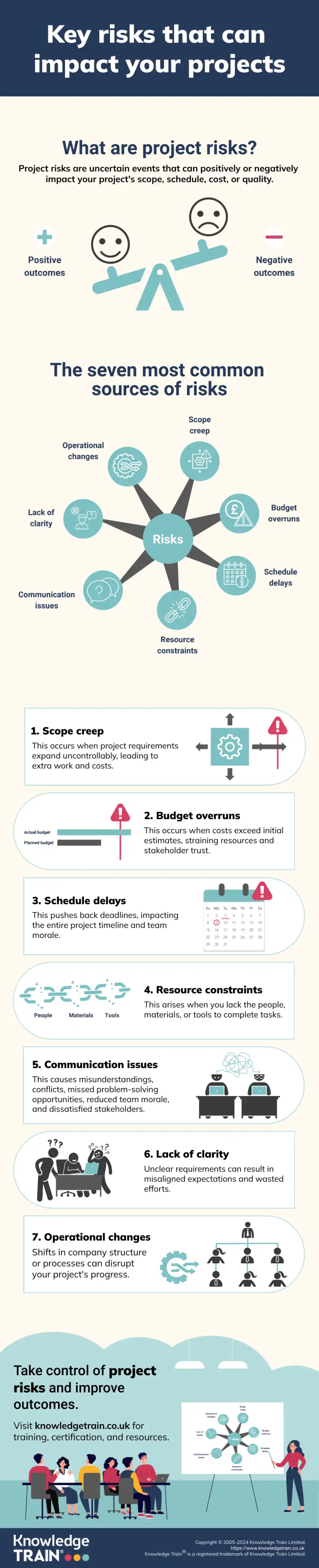
Infographic