
Key takeawaysHistorical origins and evolution of Agile
Project and product management are distinct roles that work best as a coordinated pair.
- Project management focuses on delivering defined work on time, within budget, and to agreed quality.Benefits of Agile
- Product management owns product vision, market fit, and lifecycle decisions from concept to retirement.
- Project managers make tactical trade-offs inside constraints, while product managers make strategic scope and positioning calls.Agile vs waterfall model
- Both roles rely on shared skills like communication, problem-solving, and stakeholder management, but apply them differently.
- Clear role boundaries, shared documentation, and regular touchpoints reduce conflict and keep delivery aligned to product value.Agile frameworks and practices
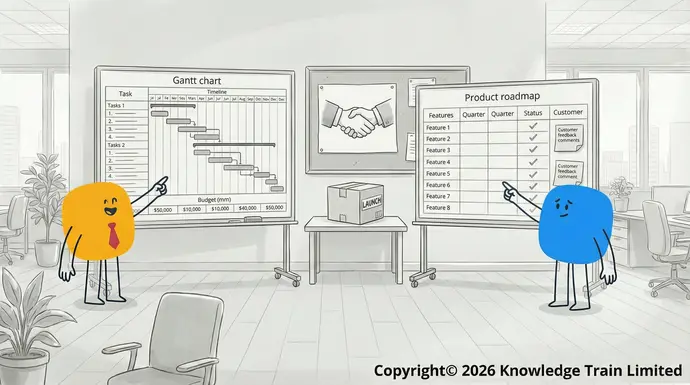
IntroductionSummary of the Agile Manifesto and Its values
Project management and product managementThe are two essential aspects of any business that are often used interchangeably, even though they are distinct from each other. Both play a critical role in the success of any organisation, but they have different functions and responsibilities.Agile Manifesto
Project managers are typically responsible for the successful delivery of specific projects within a defined timeframe. Product managers, on the other hand, oversee the entire lifecycle of a product, from inception to delivery, and are responsible for driving its success., published in 2001 by 17 software development experts, established the foundation for
It is important to understand the differences between the two to make informed decisions regarding resource allocation, optimise decision-making processes, and foster effective collaboration across teams.Agile methodologies
As . It promotes four core values and twelve underlying principles to guide teams toward continuous improvement and customer satisfaction.
- ScrumResource allocation: Ensuring optimal use of team members, budget, and materials throughout the project. is a widely adopted Agile framework structured around short, timeboxed periods called
- Communication and leadershipsprints: Project managers should be able to clearly communicate project goals, delegate tasks, and motivate team members to achieve objectives. These skills also help with stakeholder management and reporting.. Teams maintain a
Product manager skillsproduct backlog
Product managers of features and tasks, delivering increments of working software at the end of each sprint. Roles in Scrum include Product Owner, , on the other hand, require a different skill set to guide product development and strategy. Key skills for product managers include:Scrum Master
- Market research and analysis, and Development Team. Daily stand-ups, sprint planning, reviews, and retrospectives reinforce team collaboration and transparency.: Product managers should be able to conduct thorough market research, identify customer needs, and understand market trends.Kanban
- Strategic thinkingKanban emphasises visualising work, limiting work in progress, and optimising flow. Teams use Kanban boards to track tasks and identify bottlenecks, often integrating continuous improvement practices.: Developing product roadmaps, making informed decisions, and prioritising features based on market demands and business goals.User stories and Product Backlog
- User experience and customer focusFeatures are typically described as : Product managers need to have a strong understanding of their target audience and create products that resonate with them.user stories
- Technical understanding in a product backlog. This backlog is prioritised by the Product Owner and guides the work to be pulled into each sprint or iteration.: While coding skills may not be essential, product managers should have a basic understanding of technology and development processes to communicate effectively with development teams and make informed product decisions.Agile project management
Overlapping skills for both rolesAgile project management
In addition to the distinct skills mentioned above, there are also skills that are important for both project and product managers. These skills include: focuses on iterative planning, adaptive resource allocation, and continuous stakeholder engagement. Leaders support self-organising, cross-functional teams, encourage regular customer feedback, and facilitate incremental value delivery.
- Problem-solvingKey concepts: Iterative and incremental delivery: Both roles often involve solving complex problems, whether during project execution or product development.Agile projects proceed in small iterations, each resulting in an incrementally improved product. This iterative approach enables rapid adaptation, regular feedback, and incremental value to stakeholders.
- Stakeholder managementTeam collaboration and cross-functional teams: Navigating complex organisational structures and maintaining support for initiatives.Agile emphasises collaboration between customers, stakeholders, and team members from diverse disciplines. Cross-functional teams are empowered to make decisions and deliver complete solutions within each iteration.
- CommunicationContinuous improvement practices: The ability to convey complex information clearly, facilitate collaboration, and present ideas persuasively to various stakeholders is crucial for both project and product managers.Agile teams conduct regular retrospectives to identify areas for improvement and adjust their processes. This culture of continuous improvement leads to increased quality, productivity, and team morale over time.
The contexts in which these skills are applied might be different between project and product management, but those skills are useful and necessary in both roles. If you are working as a professional in either of these areas, the skills required might form part of a pathway to moving from one to another.Further Resources
Tools and methodologiesAgile software development (Encyclopaedia)
Project management tools and frameworksAgile Alliance: Agile Manifesto
Project managersFAQs use a variety of tools and frameworks to plan, execute, and monitor projects effectively. Some common tools and frameworks include:What is Agile methodology?
- Gantt chartsAgile methodology: Visual representations of project timelines, dependencies, and milestones. is a set of practices and values that promote adaptive planning, evolutionary development, early delivery, and continual improvement. Agile methods empower teams to respond quickly to change and collaborate closely with stakeholders.Project management softwareWhat are the 12 principles of Agile? like Microsoft Project or Asana can provide comprehensive solutions for task assignment, progress tracking, and resource management.The
- Agile12 Agile principles and include prioritising customer satisfaction through early and continual delivery, welcoming changing requirements, delivering working software frequently, fostering daily collaboration, supporting motivated teams, preferring face-to-face communication, using working software as the main progress measure, maintaining a sustainable pace, focusing on technical excellence, maximising simplicity, enabling self-organising teams, and reflecting regularly for process improvement.ScrumWhat is the difference between Agile and waterfall?: Agile and Scrum methodologies have become increasingly popular in project management, particularly in software development. These approaches emphasise flexibility, iterative development, and continuous improvement. Scrum boards and Sprint planning tools are commonly used to support these methodologies.Agile is iterative, adaptable, and focuses on incremental delivery with frequent stakeholder feedback.
Project managers and product managers both rely on collaboration and communication platforms such as Slack, Microsoft Teams, or Zoom to facilitate real-time communication and information sharing among team members and stakeholders. These tools allow both types of managers to keep everyone aligned and informed, and to quickly address any issues that may arise.Subscribe now
Data analysis and reporting tools such as Tableau or Power BI are also valuable for both project managers and product managers. These tools allow managers to analyse performance metrics, create visualisations, and generate reports for stakeholders. They help both types of managers to make data-driven decisions and to demonstrate the impact of their work.
By leveraging the appropriate tools and methodologies, both project and product managers can enhance their effectiveness, improve team collaboration, and drive successful outcomes in their respective domains.
- : This is a more qualitative metric but is just as important. It includes the satisfaction of team members, clients, and any other stakeholders. High levels of satisfaction can often be a sign of well-executed project management and communication.
Product management success metrics
Product managers, on the other hand, often use different metrics to measure success:
- User adoption and engagementWhat is Scrum certification? Guide to providers, costs, and benefits: These metrics help understand how well a product is meeting customer needs and how often it’s being used. They can include daily active users, feature usage, or time spent on the product.
- Revenue and market shareSimon Buehring: For a product manager, these are key indicators of a product’s commercial success. They show the product’s financial contribution and its position in the market relative to competitors. Growth in these areas can indicate a successful product strategy and a good market fit.30 Apr 2026
- Customer satisfaction and retention : These metrics offer insights into a product’s long-term viability. Measures like Net Promoter Score (NPS) or churn rate fall into this category. High satisfaction and retention rates suggest that the product continues to meet users’ needs over time.Achieving a Scrum Certification can boost your career in Agile project management. Learn the steps, compare providers, and understand the benefits of becoming certified today.
In conclusion, while there are some overlaps, project and product managers often focus on different success metrics that are specific to their roles and responsibilities.
Future trends and evolving rolesThe 4 Kanban principles: A visual guide
Impact of digital transformation on both roles
Digital transformationSimon Buehring is redefining both project and product management roles. Project managers are increasingly adopting 19 Feb 2026Agile methodologies and remote collaboration tools to manage distributed teams and resources more effectively. On the other hand, product managers are prioritising data-driven decision-making and continuous product iteration based on real-time user feedback.Visualize the 4 Kanban principles and how they apply across various projects and workflows. Discover more by scrolling down.
Emerging technologies and their influence
Artificial intelligence and machine learning are two emerging technologies that are impacting both roles. Project managers are leveraging AI-powered project management tools for optimising resource allocation and predicting project risks. Product managers are utilising ML algorithms to create personalised user experiences and predictive analytics for product development.
Predictions for future skill requirements
In the future, project managers will require stronger skills in managing virtual teams Agile methodologiesand data analysisSimon Buehring. Additionally, they will need to be proficient in integrating AI-driven project management tools into their workflows. Product managers, on the other hand, will need to develop a deeper technical literacy23 Feb 2026, particularly in AI and data science. They will also require more advanced skills in user experience designDiscover the variety of Agile methodologies and their unique implementations across sectors. Read more to see which fits your needs. and ethical product development .
It is expected that there will be an increased overlap between the skills required for both project and product managers. Professionals in both roles will need to possess a cross-functional expertise that enables them to adapt to the rapidly changing business environment. Adaptability, continuous learning, and technological proficiency will be crucial for success in both project and product management. The ability to navigate complex digital ecosystems while focusing on human-centric outcomes will be a key success factor for both roles.
Conclusion
Project management and product management are two different but equally important skills and roles for any organisation. Project managers are focused on execution, timeline, and resource management, while Agile certification: your guide to qualifications, comparisons, and career valueproduct managers are focused on strategy, market fit, and long-term vision for a product. Both roles require strong communication skills and the ability to manage stakeholders.Knowledge Train
While project and product managers have different responsibilities, they work towards the same goal of delivering value to the organisation. Collaboration between project and product managers is essential to ensure that the product vision is translated into a successful outcome. In today’s fast-paced and complex digital landscape, the importance of both project and product management is becoming increasingly critical, and organisations that can effectively leverage the strengths of both roles are more likely to innovate, adapt, and succeed in competitive markets.23 Apr 2026
FAQs
Can a project manager become a product manager?Discover how Agile certification can boost your career, enhance professional skills, and deliver greater value to organisations. Compare leading certifications and learn which is right for you.
Yes. With additional training in market analysis, strategy, and user experience, project managers can transition into product management roles. Their organisational and leadership skills are valuable assets in product management.
What are the main challenges faced by project managers and product managers?
Project managers commonly face challenges such as scope creep and resource constraints. Product managers often grapple with prioritising features and balancing stakeholder expectations with user needs.
How do Agile methodologies impact the roles of project and product managers?
Agile methodologies blur the traditional boundaries of project and product managers. Project managers may take on the role of Scrum Masters, focusing on team processes. Product managers often assume the responsibilities of Product Owners, managing the product backlog.
What industries typically employ both project managers and product managers?
rom having both project and product managers.19 Feb 2026
How do project managers and product managers handle conflicts in priorities?
Open communication and data-driven decision-making are essential. They should align on overall goals, negotiate trade-offs, and escalate to senior leadership when necessary.Explore the 6 essential principles of the Scrum framework that guide successful projects. Scroll down for an in-depth look.
What certifications are valuable for project managers and product managers?
For project managers, APM PMQ (Project Management Qualification) is highly respected in the UK. Product managers can benefit from certifications such as AIPMM (Association of International Product Marketing and Management) or Pragmatic Institute’s product management certifications.
How do project managers and product managers collaborate on a product launch?
Product managers define launch requirements and success criteria, while project managers create and execute the launch plan, coordinating cross-functional teams. Both roles work closely to ensure timely delivery and alignment with the product vision.