Project management vs product management

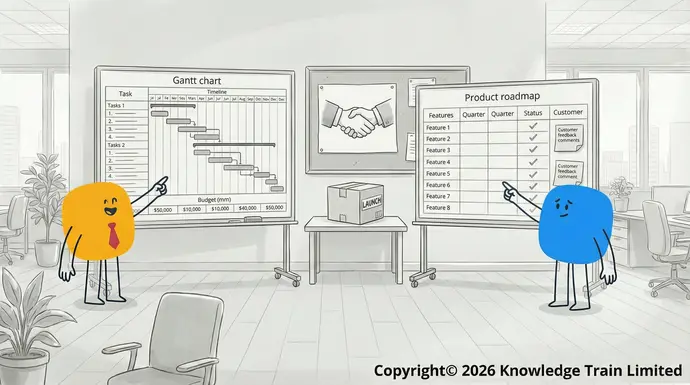
Key differences between project managers and product managers
Role focus and scope
Project managers are primarily focused on execution and delivery. They drive the implementation of specific projects and are responsible for managing the team to deliver project goals within constraints. Project managers focus on getting the job done.
Product managers , on the other hand, are responsible for strategy and vision. They are tasked with defining what should be built and why, shaping the product roadmap and ensuring alignment with business objectives. In essence, product managers think about the product’s life cycle and market position, while project managers are more concerned with the day-to-day activities.
Timeline and lifecycle involvement
Project managers work within defined start and end dates, whereas product managers are involved in a product’s lifecycle indefinitely. A project manager guides a project from initiation to closure and then transitions to the next project or opportunity. On the other hand, a product manager’s responsibilities continue as long as the product exists in the market. They manage updates, improvements and adapt to market needs, so their involvement is ongoing.
Decision-making authority
Project managers are tactical decision-makers, operating within project constraints. They are responsible for decisions about task prioritisation, resource allocation, and risk management, but they typically don’t have authority to make decisions about the overall project’s scope or direction. In contrast, product managers have strategic decision-making power. They decide what features the product should have, how it should be positioned in the market, and when to pivot based on customer feedback or market changes. Product managers make decisions that have long-term implications for the product.
Stakeholder management
Project managers primarily work with internal teams and stakeholders directly involved in project execution. They coordinate between team members, manage project-related communication, and report to project sponsors or department heads. Product managers interact with a wider range of stakeholders. This includes not only internal teams like engineering, design, marketing and sales but also external ones. They gather insights from customers, understand market trends and work with multiple departments to ensure product-market fit.
These differences in roles, responsibilities and operational focus highlight the unique contributions of both project managers and product managers to an organisation. While project managers are essential for executing specific initiatives, product managers play a pivotal role in setting strategic direction, thus guiding the overall product development and market success.
Skills and qualifications
Project manager skills
Project managers need to possess a range of skills to lead projects effectively. Some of the key skills include:
- Planning and scheduling : Project managers should be skilled in developing realistic timelines, managing project milestones, and keeping projects on track.
- Risk management : Identifying and proactively addressing potential risks and developing strategies to mitigate them.
- Resource allocation : Ensuring optimal use of team members, budget, and materials throughout the project.
- Communication and leadership : Project managers should be able to clearly communicate project goals, delegate tasks, and motivate team members to achieve objectives. These skills also help with stakeholder management and reporting.
Product manager skills
Product managers , on the other hand, require a different skill set to guide product development and strategy. Key skills for product managers include:
- Market research and analysis : Product managers should be able to conduct thorough market research, identify customer needs, and understand market trends.
- Strategic thinking : Developing product roadmaps, making informed decisions, and prioritising features based on market demands and business goals.
- User experience and customer focus : Product managers need to have a strong understanding of their target audience and create products that resonate with them.
- Technical understanding : While coding skills may not be essential, product managers should have a basic understanding of technology and development processes to communicate effectively with development teams and make informed product decisions.
Overlapping skills for both roles
In addition to the distinct skills mentioned above, there are also skills that are important for both project and product managers. These skills include:
- Problem-solving : Both roles often involve solving complex problems, whether during project execution or product development.
- Stakeholder management : Navigating complex organisational structures and maintaining support for initiatives.
- Communication : The ability to convey complex information clearly, facilitate collaboration, and present ideas persuasively to various stakeholders is crucial for both project and product managers.
The contexts in which these skills are applied might be different between project and product management, but those skills are useful and necessary in both roles. If you are working as a professional in either of these areas, the skills required might form part of a pathway to moving from one to another.
Tools and methodologies
Project management tools and frameworks
Project managers use a variety of tools and frameworks to plan, execute, and monitor projects effectively. Some common tools and frameworks include:
- Gantt charts : Visual representations of project timelines, dependencies, and milestones. Project management software like Microsoft Project or Asana can provide comprehensive solutions for task assignment, progress tracking, and resource management.
- Agile and Scrum : Agile and Scrum methodologies have become increasingly popular in project management, particularly in software development. These approaches emphasise flexibility, iterative development, and continuous improvement. Scrum boards and Sprint planning tools are commonly used to support these methodologies.
Product management tools and frameworks
Product managers utilise specialised tools to define and communicate product strategy effectively. Some tools and frameworks commonly used by product managers include: Request a quote
- Product road mapping software : Tools like ProductPlan or Aha! help create visual roadmaps that outline product vision, features, and timelines. These tools are used to align stakeholders and guide development efforts.
- User story mapping and prioritisation[email protected]: Techniques such as the MoSCoW +44 (0)207 148 5985 method or story mapping workshops can assist product managers in organising and prioritising features based on user needs and business value. These approaches ensure that product development focuses on delivering maximum value to customers.Courses
Shared tools and methodologiesPROJECT MANAGEMENT
Project managers and product managers both rely on collaboration and communication platforms such as Slack, Microsoft Teams, or Zoom to facilitate real-time communication and information sharing among team members and stakeholders. These tools allow both types of managers to keep everyone aligned and informed, and to quickly address any issues that may arise.PRINCE2
Data analysis and reporting tools such as Tableau or Power BI are also valuable for both project managers and product managers. These tools allow managers to analyse performance metrics, create visualisations, and generate reports for stakeholders. They help both types of managers to make data-driven decisions and to demonstrate the impact of their work.®
By leveraging the appropriate tools and methodologies, both project and product managers can enhance their effectiveness, improve team collaboration, and drive successful outcomes in their respective domains.Foundation
Career paths and progression Agile
Project management career trajectoryFoundation
Project managementLearn the fundamentals of the PRINCE2 Agile method. careersPractitioner often start with entry-level positions like project coordinator or project assistant. In these roles, individuals could learn the basics of project execution and team coordination. As they gain experience, project managers can progress to managing more complex and high-stakes projects.Includes Foundation & Practitioner combined option.
Senior project managers are responsible for overseeing multiple projects or programs and may also take on mentoring roles for junior team members. Career advancement opportunities include roles such as portfolio manager or director of AI Project Governance Framework (AIPGF)project managementFoundation . These positions involve more strategic planning and the allocation of organisational resources.Learn the fundamentals of the governance framework.
Product management career trajectoryPractitioner
Product managementIncludes Foundation & Practitioner combined option. careers typically begin with associate product manager or junior product manager positions. These roles are focused on supporting senior product managers and gaining experience with market research and product development processes. As professionals develop their skills, they can advance to product manager positions, where they take ownership of specific products or features.Better Business Cases
Senior product managers often have responsibility for leading product lines or portfolios. Career advancement may lead to roles like director of product management or chief product officer. These executive positions are focused on shaping the overall product strategy and contributing to company-wide decision-making.™
Transitioning between project and product managementFoundation
Transitioning between project and product management is possible and can open additional career opportunities. Learn the fundamentals of Better Business cases.Project managersPractitioner looking to move into product roles should emphasise their strategic thinking abilities and customer-focused skills. Product managers transitioning into project management should highlight their organisational and execution capabilities.Includes Foundation & Practitioner combined option.
Both career paths offer opportunities for professional growth and leadership development, with success in either field depending on continuous learning, adaptability, and a strong understanding of business objectives.P3O
How project managers and product managers work together®
Collaborative aspects of the rolesFoundation
Project managersLearn the fundamentals of the P3O project management office. and Practitioner product managersIncludes Foundation & Practitioner combined option. can often work closely together to achieve success in developing and delivering products. Their skills and focus areas are generally seen as complementary, and they can provide different but overlapping perspectives. Product managers are typically responsible for providing the overall vision and market understanding for a product, while project managers focus on planning and execution to deliver the product on time and within budget.Workshops
Typical interactions and touchpointsIntroduction to Project Management
The primary touchpoints between these roles are throughout the product lifecycle. For example, during product planning, product managers communicate feature requirements and priorities with project managers. Project managers then create detailed 1-day workshop to learn the basics of project management.project plansProject Management Essentials , timelines, and resource allocations. Throughout the development phase, they have frequent communication to troubleshoot, manage scope changes, and ensure alignment with product objectives.2-day workshop to learn how to manage projects without getting certified.
Project managers may also be involved in product strategy meetings to gain a better understanding of the larger context for their projects. Likewise, product managers may be present in project status updates to track progress and provide input on feature prioritisation or implementation. This ongoing interaction helps to ensure that project execution stays aligned with product vision and market demands.Writing Business Cases
Challenges and best practices for effective collaborationHalf-day workshop to learn to write robust business cases.
Collaboration can be challenged by differing priorities and viewpoints. Project managers might prioritise deadlines and budgets, whereas product managers focus on market fit and customer satisfaction. Conflicts can occur when deciding on resource allocation and trade-offs.AI in Project Management
Guidelines for effective collaboration are as follows:Learn how to use AI tools in everyday project work.
- Set up clear communication channels and regular meetingsARTIFICIAL INTELLIGENCE (AI)
- Explicitly define roles and responsibilities to prevent overlap or gapsBCS AI
- Create shared documentation for product requirements and Foundation project plansLearn the fundamentals of artificial intellegence.
- Cultivate a culture of respect and appreciation for the value each role brings.AI Project Governance Framework (AIPGF)
By following these guidelines, organisations can harness the strengths of both roles and work together toward successful product outcomes.Foundation
Measuring success: Metrics and KPIsLearn the fundamentals of the governance framework.
Project management success metricsPractitioner
Project managersIncludes Foundation & Practitioner combined option. often define success using a mix of quantitative and qualitative metrics:Workshops
- On-time deliveryAI in Project Management : This is a critical measure, indicating whether a project meets its milestones and deadlines. It can often be linked to efficient planning and Learn how to use AI tools in everyday project work.risk managementAGILE.AgilePM
- Budget adherence®: Staying within the pre-planned budget is a common KPI for – Agile Project Managementproject managersFoundation . It reflects efficient resource allocation and the ability to handle unforeseen expenses. Deviations from the budget should be minimal and justified.Learn the key principles of Agile Project Management.
- Stakeholder satisfactionPractitioner : This is a more qualitative metric but is just as important. It includes the satisfaction of team members, clients, and any other stakeholders. High levels of satisfaction can often be a sign of well-executed project management and communication.Includes Foundation & Practitioner combined option.
Product management success metricsPRINCE2
Product managers®, on the other hand, often use different metrics to measure success: Agile
- User adoption and engagementFoundation : These metrics help understand how well a product is meeting customer needs and how often it’s being used. They can include daily active users, feature usage, or time spent on the product.Learn the fundamentals of the PRINCE2 Agile method.
- Revenue and market sharePractitioner : For a product manager, these are key indicators of a product’s commercial success. They show the product’s financial contribution and its position in the market relative to competitors. Growth in these areas can indicate a successful product strategy and a good market fit.Includes Foundation & Practitioner combined option.
- Customer satisfaction and retentionScrum: These metrics offer insights into a product’s long-term viability. Measures like Net Promoter Score (NPS) or churn rate fall into this category. High satisfaction and retention rates suggest that the product continues to meet users’ needs over time.Scrum Essentials
In conclusion, while there are some overlaps, project and product managers often focus on different success metrics that are specific to their roles and responsibilities.Self-paced training course to learn the essentials of Scrum.
Future trends and evolving rolesEstimating for Agile Foundation
Impact of digital transformation on both rolesAgile Learning Library (ALL)™
Digital transformationBUSINESS ANALYSIS is redefining both project and product management roles. Project managers are increasingly adopting BCS Business AnalysisAgile methodologiesBusiness Analysis Foundation and remote collaboration tools to manage distributed teams and resources more effectively. On the other hand, product managers are prioritising data-driven decision-making and continuous product iteration based on real-time user feedback.Learn the fundamentals of business analysis.
Emerging technologies and their influenceModelling Business Processes
Artificial intelligenceGain practitioner certificate in modelling business processes. and Business Analysis Practices machine learningGain practitioner certificate in business analysis practices. are two emerging technologies that are impacting both roles. Project managers are leveraging AI-powered project management tools for optimising resource allocation and predicting project risks. Product managers are utilising ML algorithms to create personalised user experiences and predictive analytics for product development.Requirements Engineering
Predictions for future skill requirementsGain practitioner certificate in requirements engineering.
In the future, project managers will require stronger skills in managing Business Analysis International Diploma virtual teams All 4 courses bundled into this Diploma certification package.and AgileBAdata analysis®. Additionally, they will need to be proficient in integrating AI-driven project management tools into their workflows. Product managers, on the other hand, will need to develop a deeper – Agile Business Analysistechnical literacyFoundation training , particularly in AI and data science. They will also require more advanced skills in Learn the fundamentals of Agile Business Analysis.user experience designPractitioner and 4-day course including Foundation.ethical product developmentPMI.®
It is expected that there will be an increased overlap between the skills required for both project and product managers. Professionals in both roles will need to possess a cross-functional expertise that enables them to adapt to the rapidly changing business environment. Adaptability, continuous learning, and technological proficiency will be crucial for success in both project and product management. The ability to navigate complex digital ecosystems while focusing on human-centric outcomes will be a key success factor for both roles.PMI-PBA
ConclusionSelf-paced course to prepare you for the exam (exam not included).
Project management and product management are two different but equally important skills and roles for any organisation. Business Analysis Learning Library (BALL)™Project managersCHANGE MANAGEMENT are focused on execution, timeline, and resource management, while APMG Change Managementproduct managersFoundation Includes Foundation & Practitioner combined option.
While project and product managers have different responsibilities, they work towards the same goal of delivering value to the organisation. Collaboration between project and product managers is essential to ensure that the product vision is translated into a successful outcome. In today’s fast-paced and complex digital landscape, the importance of both project and product management is becoming increasingly critical, and organisations that can effectively leverage the strengths of both roles are more likely to innovate, adapt, and succeed in competitive markets.PROGRAMME MANAGEMENT
FAQsMSP
Can a project manager become a product manager?®
Yes. With additional training in market analysis, strategy, and user experience, project managers can transition into product management roles. Their organisational and leadership skills are valuable assets in product management.Foundation
What are the main challenges faced by project managers and product managers?Learn the fundamentals of programme management.
Project managers commonly face challenges such as scope creep and resource constraints. Product managers often grapple with prioritising features and balancing stakeholder expectations with user needs.Practitioner
How do Agile methodologies impact the roles of project and product managers?Includes Foundation & Practitioner combined option.
Agile methodologiesINFORMATION TECHNOLOGY (IT) blur the traditional boundaries of project and product managers. Project managers may take on the role of Scrum Masters, focusing on team processes. Product managers often assume the responsibilities of Product Owners, managing the product backlog.ITIL
What industries typically employ both project managers and product managers?®
rom having both project and product managers.3-day ITIL Strategist: Direct, Plan & Improve (DPI) course.
How do project managers and product managers handle conflicts in priorities?Specialist: DSV
Open communication and data-driven decision-making are essential. They should align on overall goals, negotiate trade-offs, and escalate to senior leadership when necessary.3-day ITIL Specialist: Drive Stakeholder Value (DSV) course.
What certifications are valuable for project managers and product managers?Specialist: CDS
For project managers, 3-day ITIL Specialist: Create, Deliver and Support (CDS) course.APM PMQIT Learning Library (ITLL)™ (Project Management Qualification) is highly respected in the UK. Product managers can benefit from certifications such as AIPMM (Association of International Product Marketing and Management) or Pragmatic Institute’s product management certifications.BUSINESS LEARNING LIBRARY (BLL)™
How do project managers and product managers collaborate on a product launch?Agile Learning Library (ALL)™
Product managers define launch requirements and success criteria, while project managers create and execute the launch plan, coordinating cross-functional teams. Both roles work closely to ensure timely delivery and alignment with the product vision.Business Analysis Learning Library (BALL)™