RACI matrix in project management

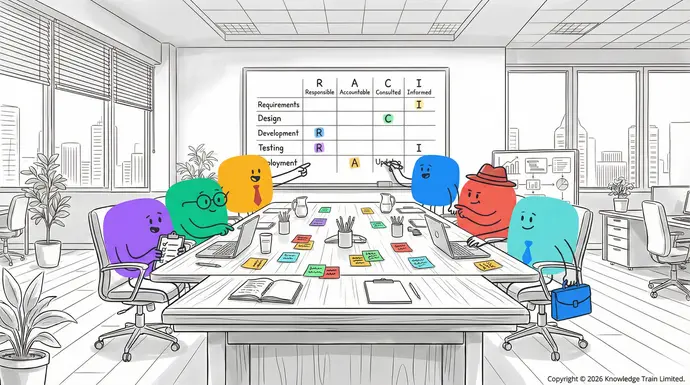
Understanding the RACI matrix
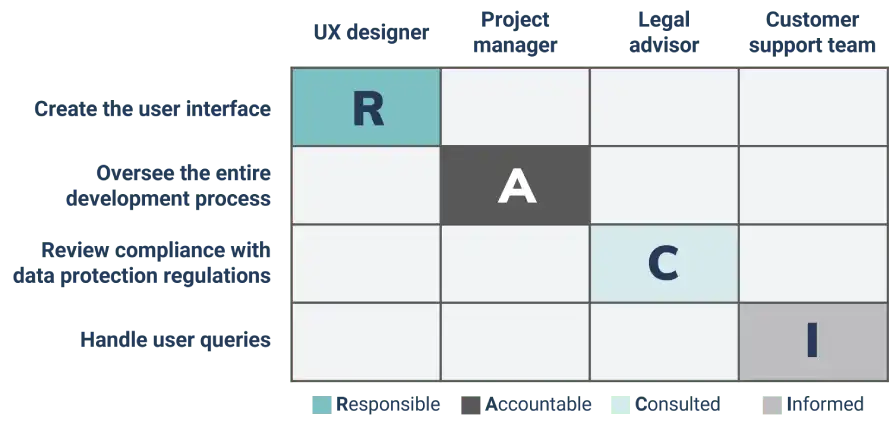
A RACI matrix is a chart that maps out roles and responsibilities for your projects and teams. It is based on a simple acronym: RACI, which stands for Responsible, Accountable, Consulted, and Informed. RACI as a framework is also sometimes known as the responsibility assignment matrix or RAM.
What does each letter stand for in RACI?
- Responsible: These are the people who actually do the work; they are the doers who are completing tasks and creating deliverables. For a task or deliverable, there can be one or more responsible people.
- Accountable: This person is ultimately answerable for the correct and timely completion of the task or deliverable. It is the only one who approves the work of the responsible people. For a task or deliverable, there can be one and only one accountable person.
- Consulted: These stakeholders have a role in providing information, inputs, or advice for the task or deliverable; they are consulted or actively involved in the discussion. But they are not the ones who do the work. For a task or deliverable, there can be one or more consulted people.
- Informed: These people need to be kept updated on progress and developments for the task or deliverable; they do not have a direct contribution but must be notified of outcomes or major decisions.
The main goal of RACI matrix is to improve project efficiency and communication. Here are some of the benefits of using RACI matrix:
- Defining roles
- Better accountability
- Smooth decision-making
- Minimising conflicts and duplications
- Optimising resource allocation.
You can effectively use RACI matrix in the following situations:
- Projects with many stakeholders
- Cross-functional teams working together
- Unclear or overlapping roles/responsibilities
- Organisational change or restructuring
- New team formation. Assigning a Responsible person.
In practice, the RACI matrix helps project managers to clearly assign each task to one or more Responsible persons. This helps to avoid confusion and ensure that everyone knows who is doing what. The matrix also helps in stakeholder engagement by identifying who needs to be consulted or informed at each stage of the project.
The RACI matrix is not always required, for example, for small and short-term projects or projects with a small team of stakeholders. In such cases, communication and coordination can be achieved in a less formal way. However, for most projects of medium and larger size, the use of a RACI matrix is a simple and effective way to organise work and improve communication.
Creating a RACI matrix
Six steps guide to building a RACI chart
The following are the steps to create a RACI matrix:
- Identify the tasks : List all the tasks and milestones of the project in the left column of the RACI matrix.
- Define the stakeholders : List all the project stakeholders in the top row of the matrix.
- Assign the roles : For each task, assign one of the four roles (R, A, C, I) to each stakeholder.
- Review and refine : Check that each task has at least one R and one A, and that there are no conflicts or ambiguities in the assignments.
- Validate : Confirm the RACI matrix with the team members and stakeholders to ensure accuracy and agreement.
- Distribute : Share the RACI matrix with all the stakeholders and make it accessible for reference and updates.
Best practices for assigning roles
The following are some tips for assigning roles in a RACI matrix:
- Make sure that all the team members understand the RACI definitions and agree on the roles.
- Assign roles based on the skills, authority, and availability of the team members, and not just on their positions.
- Avoid assigning too many Consulted and Informed roles, as this can lead to information overload and unnecessary communication.
- Consider the scope and complexity of the project when defining the tasks and assigning the roles.
- Update the RACI matrix as the project progresses or as changes occur in the team or the tasks.
Common mistakes to avoid
The following are some common mistakes to avoid when creating a RACI matrix:
- Including too many tasks or too many stakeholders : Focus on the most important tasks and stakeholders and avoid unnecessary details.
- Assigning multiple Rs or As to the same task : This can create confusion and conflict over responsibility. Ensure that each task has one and only one A and at least one R.
- Not getting buy-in from the stakeholders : Ensure that all the stakeholders agree on the roles and responsibilities assigned to them or to others.
- Not updating the RACI matrix : The RACI matrix should be a living document, not a static one. Review and update it as needed.
- Not using the RACI matrix consistently : Ensure that all the team members use the RACI matrix as a reference and respect the roles and responsibilities assigned.
RACI matrix templates and tools
A RACI matrix can be created using different tools and templates. Here are some of them:
- Spreadsheet software : You can use a simple Excel or Google Sheets template to create a RACI matrix, which allows you to customise and format the chart.
- Project management software : Many project management tools, such as Monday.com, offer built-in RACI matrix features, which allow you to create, share, and update the matrix along with other project elements.
- RACI matrix software : There are some specialised software that focus on creating and managing RACI matrices, which offer advanced features and integrations.
- Visual collaboration tools
Implementing RACI in project management
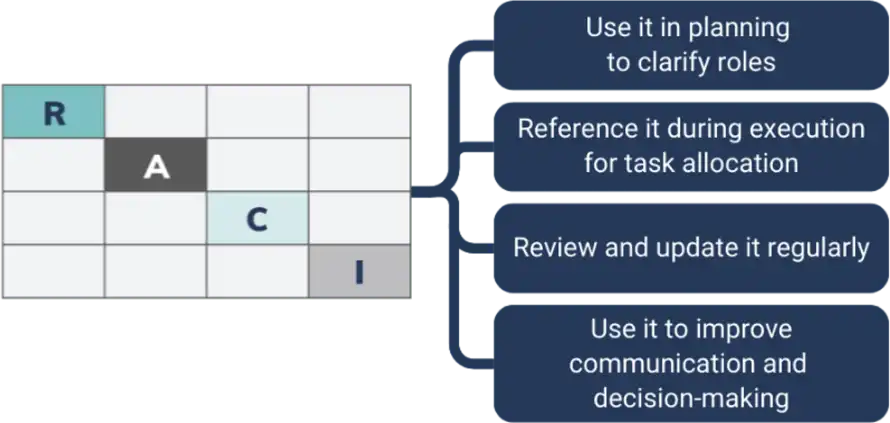
Integrating RACI with project lifecycles
To effectively integrate RACI into your project management approach, align it with the project lifecycle phases. Here’s how you can do it:
- Initiation : Identify key stakeholders and establish their high-level RACI roles for the project.
- Planning : Develop a detailed RACI matrix for all identified tasks and deliverables.
- Execution : Apply the RACI matrix to allocate tasks, facilitate communication, and ensure accountability.
- Monitoring : Continuously review and update RACI assignments as needed throughout the project.
- Closing : Evaluate the effectiveness of RACI for lessons learned and future projects .
Using RACI to enhance communication
RACI charts establish clear lines of communication by identifying who needs what information and when, Minimising unnecessary meetings and emails, clarifying decision-making processes, and ensuring all relevant parties are consulted.
Ask team members to consult the RACI matrix when sending updates or requesting input.
Resolving conflicts and ambiguities in RACI assignments
Facilitate discussions to resolve conflicts by reviewing the project scope and objectives, clarifying role definitions and expectations, considering team members’ skills and workloads, making necessary adjustments to balance responsibilities, and documenting and communicating any changes.
Team members should have regular discussions about their RACI roles to avoid misunderstandings and encourage collaboration.
RACI and Agile project management
Although RACI is a common tool in the traditional project management, it can be adapted and integrated with Agile methodologies as well. Here are some tips on how to do that:
- Use RACI for high-level project roles and responsibilities
- Adapt RACI for each sprint or iteration
- Focus on team roles instead of individual assignments
- Incorporate RACI discussions into sprint planning and retrospectives.
In Scrum , RACI can be used to define roles and responsibilities for each Scrum ceremony, epic, and user story. For example:
- A Product Owner is Accountable for prioritising and approving the product backlog items.
- A Scrum Master is Responsible for facilitating the Scrum process and addressing impediments.
- The Development Team is Responsible for delivering potentially shippable product increments.
By using RACI in Scrum, teams can achieve a balance between structure and flexibility.
RACI matrix variations and alternatives
In addition to the standard RACI matrix, there are several variations and alternatives that can be used for specific project needs. Here are a few examples:
RASCI (adding the ‘supportive’ role)
- Supportive : People who support the Responsible person in completing the task.
This could be useful for projects that have resource needs and specialist help.
CARS (Communicate, Approve, Responsible, Support)
CARS is a simplified version of RACI that uses only four roles:
- Communicate : Similar to Informed in RACI
- Approve : Equivalent to Accountable
- Responsible : Same as in RACI
- Support : Combines Consulted and Supportive roles.
This can help making communication and approval fast and efficient.
DACI (Driver, Approver, Contributor, Informed)
DACI is an alternative to RACI that focuses on decision-making:
- Driver : The person in charge of driving the initiative forward (similar to Responsible)
- Approver : The person who has the final decision-making authority (similar to Accountable)
- Contributor : The people who provide input and expertise (similar to Consulted)
- Informed : Same as in RACI.
DACI works well for projects where decision-making is complicated. Request a quote
Choosing the right model for your project
When choosing a RACI matrix model for your project, there are several factors to consider. Here are some key ones:
- The complexity and size of the project[email protected]
- The structure and culture of the team
- The decision-making processes in place +44 (0)207 148 5985
- The communication needs and preferencesCourses
- The level of involvement of the stakeholders.PROJECT MANAGEMENT
The key is to select the model that best fits your project requirements and helps to optimise clarity and efficiency.PRINCE2
Benefits and limitations of RACI®
Advantages of using RACI in project managementFoundation
RACI matrices provide several benefits for project management, including:Learn the fundamentals of the PRINCE2 method.
- ClarityPractitioner : Establishes clear roles and responsibilities for each task in a projectIncludes Foundation & Practitioner combined option.
- AccountabilityAssociation for Project Management (APM): Ensures that each task has an assigned responsible personProject Fundamentals Qualification (PFQ)
- EfficiencyStart your APM project management career.: Reduces duplication of work and confusion by defining rolesProject Management Qualification (PMQ)
- CommunicationAdvance your APM project management expertise.: Facilitates better information flow among team membersProject Risk Single Certificate Level 1
- Conflict resolutionEnhance your project risk management skills.: Provides a framework for addressing role-related conflictsAgilePM
- Workload management®: Identifies potential overloading of team members with multiple responsibilities. – Agile Project Management
These advantages make RACI matrices a valuable tool for smooth project execution and improved team performance.Foundation
Potential drawbacks and challengesLearn the key principles of Agile Project Management.
While RACI offers many benefits, some potential drawbacks and challenges may include:Practitioner
- Time-consumingIncludes Foundation & Practitioner combined option.: Creating and maintaining RACI matrices can be labor-intensive and time-consumingPRINCE2
