Establishing a solid project foundation
A successful project starts with a strong foundation. Let’s look at three elements that will set the stage for success: formal project structure, clear goals and objectives, and sponsor engagement.Self-paced
Formal project structureAgilePM Practitioner (with Foundation) self-paced online
The first element is a well-defined project structure, which provides a framework for project execution:
- Project charter£1,299 +vat: This document outlines the project purpose, scope and stakeholders.Beginner project management certifications
- Project planThis category includes only those certifications that have no entry requirements and are suitable for new project managers or those who have some prior experience in project management and want to gain their first certification.: This is a detailed plan that covers timelines, resources and expected deliverables.APM PFQ
- TeamThe Association for Project Management offers the excellent : Designate the team who will carry out the work and ensure they understand their roles and responsibilities.Project Fundamentals Qualification
Clear goals and objectives. The APM PFQ certification is for newcomers to project management.
Precise requirements are essential for successful project execution:Candidates gain the APM PFQ certificate by learning basic project management concepts and terminology which will help you make a positive contribution towards any project.
- Importance of clear goalsThis certificate is becoming very popular in the UK because it comes from the : Clear objectives help prevent misunderstandings, reduce the risk of scope creep and keep the project focused.APM
- Alignment with company objectives, the Chartered Institute for Project Management.: It’s important to ensure project goals support the broader goals and objectives of the company.To gain your APM PFQ certificate, the typical learning path is to take
- Documentation and approvalAPM PFQ training: Requirements should be documented and formally approved by all relevant stakeholders. which takes 2 days, or 25 hours if studying online.
| BenefitPRINCE2 Foundation | DescriptionIn the UK, a PRINCE2 certification is considered the industry standard in project management. The |
| FocusPRINCE2 Foundation | Guides team efforts towards specific outcomes certification tests your knowledge of the PRINCE2 principles, practices, processes, and terminology of the |
| MeasurementPRINCE2 methodology | Provides benchmarks for assessing progress. |
| ClarityThe certification is ideal for anyone who is new to project management making it a popular choice for employers and new project managers alike. | Reduces ambiguity in project executionThe PRINCE2 Foundation certificate is by far the most common project management certification in the UK. |
Project sponsor engagementTo gain your PRINCE2 Foundation certificate, the typical learning path is to take
The engagement of a project sponsor can be vital in delivering project success:PRINCE2 Foundation training
- Role which takes 2 days, or 20 hours if studying online.: Acts as the overall champion and supporter of the projectPRINCE2 Agile Foundation
- BenefitsIn the UK, PRINCE2 Agile certifications are becoming increasingly popular as more projects operate within an agile environment.: Ensures the availability of resources, removes roadblocks and promotes the project.PRINCE2 Agile Foundation certification is like PRINCE2 Foundation, except that it is aimed at people working in agile environments. The exam tests you on your knowledge of the core PRINCE2 methodology and agile concepts and terminology.
- StrategiesTo gain your PRINCE2 Agile Foundation certification, the typical learning path is : Stay updated, communicate clearly and involve the sponsor in key decisions.PRINCE2 Agile Foundation training
Defining these important fundamentals, which takes 2 days, or 12 hours if studying online.project managersAgilePM Foundation can lay a strong foundation for project success and delivery.Another UK certification which is suitable if you are working primarily in an agile environment is the AgilePM Foundation certification from the Agile Business Consortium. This is the most popular agile project management certification in the world, not just in the UK.
By effectively managing scope and changes, project managers can ensure projects remain on track while accommodating necessary adjustments. This balance promotes project success and stakeholder satisfaction.AgilePM is based upon DSDM, one of the first agile methodologies, and for this certification you are assessed on your knowledge of the underlying agile project framework.
Defining roles and responsibilitiesTo gain your AgilePM Foundation certification, the typical learning path is
Clearly defining roles and responsibilities within a project is essential for its success. This section will delve into aspects of team accountability and the role of the project manager.AgilePM Foundation training
Team accountability which takes 3 days, or 20 hours if studying online.
Creating accountability structures is important to ensure that each team member understands their responsibilities and expectations.PMI CAPM
RACI/RASCI matrixThe Project Management Institute offers the
RACICertified Associate in Project Management (Responsible, Accountable, Consulted, Informed) or (CAPM)® certification. This certificate tests your knowledge of the fundamentals of project management and common project terminology.RASCIEligibility for this certification requires that you already possess a secondary degree and requires that you attain at least 23 hours of project management education completed before the exam. This certificate needs to be renewed every 5 years. (with Sign-off) matrices are useful tools to clearly define roles and responsibilities for each task or decision in a project:It should be noted that the CAPM certification is mostly popular in the USA, Canada, Africa, and Asia, rather than the UK.
- ResponsibleTo gain your CAPM certificate, a typical learning path is : Who will do the task?CAPM training
- Accountable which takes 35 hours of online study.: Who is ultimately responsible for task completion?Intermediate project management certifications
- ConsultedIntermediate project certifications usually have some entry requirements. We’ll start with the easiest and make our way up to the hardest.: Whom should be consulted?Intermediate certifications require that you have a more detailed understanding of what project management is all about. These certifications test you on your ability to apply project management principles, practices, and techniques to life-like project scenarios.
- InformedAPM PMQ: Who else should be informed?The Association for Project Management offers the
- Sign-off Project Management Qualification(RASCI only): Who should sign off or approve? which tests whether you have a deeper understanding of project management. The
Stakeholder registerAPM PMQ
A certification is usually taken by students having a few years’ experience of project management.stakeholder registerThere is no prerequisite for this certification, so you do not need to hold the APM PFQ certificate already. is a document that contains all key information about project stakeholders, such as contact information, level of influence, communication preferences and engagement strategy.To gain your APM PMQ certificate, the typical learning path is
Project manager’s roleAPM PMQ training
The role of a project manager is diverse and critical for project success. which takes 5 days, or 35 hours if studying online.
Key responsibilitiesPRINCE2 Practitioner
- Planning and schedulingA
- Resource allocationPRINCE2 Practitioner
- Risk management certification requires that you first hold the PRINCE2 Foundation certificate. The Practitioner certification tests you on your ability to apply PRINCE2 to life-like project scenarios. More particularly, it tests whether you can apply the PRINCE2 principles, practices, and processes to a fictional project scenario.
- Budget oversightAfter PRINCE2 Foundation, the PRINCE2 Practitioner certification is probably the top project management certification in the UK.
- Quality assurance.To gain your PRINCE2 Practitioner certificate, the typical learning path is
Leadership and communication skillsPRINCE2 Practitioner training
Successful project managers often exhibit: which takes 2 days, or 15 hours if studying online. Training can also be combined with the Foundation certification. In this case, training takes 4 days, or 35 hours if studying online.
- Clear and concise communication skillsIt should be noted that since the release of
- Conflict resolution capabilitiesPRINCE2 7
- Motivational techniquesth
- Adaptability to change edition
- Strategic thinking., the prerequisites for the Practitioner certification have changed. You must now hold one of the following certificates:
Clearly defined roles and accountability improve the overall efficiency and effectiveness of a project team.PRINCE2 Foundation or PRINCE2 Practitioner (6
Managing project scope and changesAgilePM Practitioner
Managing project scope and change carefully helps you to manage change within your project.AgilePM Practitioner certification requires that you hold an AgilePM Foundation certificate. It is suitable if you want to apply the agile project framework on projects. AgilePM Practitioner is a popular choice for project managers working in an agile context.
Scope creep preventionTo gain your AgilePM Practitioner certification, the typical learning path is
Defining project boundariesAgilePM Practitioner training
It is important to clearly define project boundaries to avoid scope creep. To do this, one must document specific project deliverables, explicitly identify exclusions and set measurable acceptance criteria. which takes 1 day, or 15 hours if studying online. Training can also be combined with the AgilePM Foundation in which case, it takes 4 days, or 35 hours if studying online.
Change management processesCompTIA Project+
Robust CompTIA offers some of the leading IT qualifications in the world. CompTIA Project+change control® processes should be implemented, including: focuses on managing smaller, less complex projects within the IT industry. This certification tests student’s knowledge of the specific industry tools used for documentation and requirements analysis.
- Formal change request submissionsThis certification has no prerequisites, but without the recommended 135 hours of IT project development experience, you might find yourself a bit lost.
- Impact assessment (time, cost, resources)PMI PMP
- Stakeholder review and approvalPMI’s
- Documentation of approved changes.Project Management Professional
Adaptability in project management (PMP)
| If you want to gain your PMP certificate, a typical learning path is to take Aspect | StrategyPMP training |
| Scope which takes 35 hours of online study. | Prioritise changes based on value and impactChoose from these project management certifications |
| Schedule | Build buffer time into project timelines |
| Resources | Cross-train team members for versatilitySelf-paced |
| BudgetAPM PFQ blended online | Allocate contingency funds for unforeseen changes |
By carefully controlling scope and changes, project managers can keep £749 +vatprojects on track while allowing for necessary adjustments. This balance is key to project success and stakeholder satisfaction.
Risk management and mitigation
Successful project management also relies heavily on Self-pacedrisk managementPRINCE2 Agile Practitioner (with Foundation) self-paced online and mitigation strategies. Let’s talk about how to recognise, assess, and reduce risks.
Identifying and assessing risks£1,399 +vat
Risk categories
The following are some of the most common risk categories:
- Technical risks
- Financial risksSelf-paced
- Operational risksAgilePM Practitioner (with Foundation) self-paced online
- External risks (market, regulatory, etc.).
Risk assessment techniques£1,299 +vat
Use these techniques to identify and evaluate risks:Expert project management certifications
- Risk probabilityThere aren’t a lot of certifications more difficult than those already mentioned. If you want to work as a project manager or are already employed in a project manager, an intermediate certificate will be all you’ll ever need.
Developing risk mitigation strategies
Preventive measures
Effective communication and collaboration
Communication and collaboration are key success factors in project management. In this section, we will discuss how to develop communication plans and utilise collaboration tools.
Communication plan development
Stakeholder communication needsWhich project management qualification?
Identify and meet different stakeholder needs:
- Executive sponsors: Executive updatesSimon Buehring
- Team members: Detailed tasks20 Mar 2026
- Clients: Progress and milestones
- External partners: Relevant project details.Choosing the right project management qualification can be crucial. Learn about the options and which suits your career goals best.
Communication channels and frequency
Define appropriate channels and cadence:
| Stakeholder | Channel | Frequency |
| Executives | Email reports | Monthly |
- Virtual whiteboards and brainstorming tools
FAQs
What are the most important project management principles?
Some of the most important principles include clear goal setting, effective communication, risk management, and stakeholder engagement.
How can I improve communication in my project team?
Implement a structured communication plan, utilise collaboration tools, and foster a culture of open feedback and active listening.
What’s the difference between Agile and traditional project management?Give us a call
Agile is iterative and flexible, with an emphasis on collaboration, while traditional methods are linear and follow a planned approach.
How do I handle scope creep in my projects?
Define clear project boundaries, implement a change control process, and maintain regular communication and alignment with stakeholders.+44 (0)207 148 5985
What are some common project management challenges and how can I overcome them?
Common challenges include resource constraints, unclear objectives, and poor communication. Overcome them through careful planning, stakeholder engagement, and a focus on continuous improvement.Or chat with us using the link at the bottom of the screen.
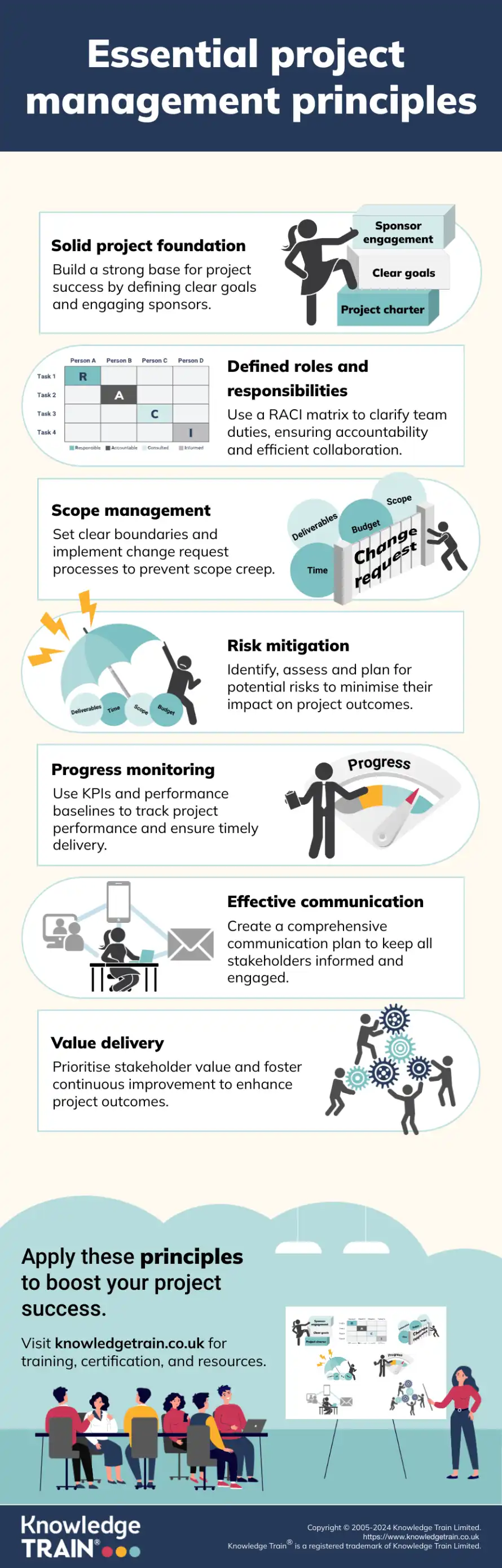
InfographicContact us with questions about the courses on this page, or about which project management certification or training is best for you.