Project management principlesbusiness analyst courses

Key takeawaysEnhance your skills with our expert-led courses
Strong delivery comes from clear foundations, disciplined control, and continuous learning.
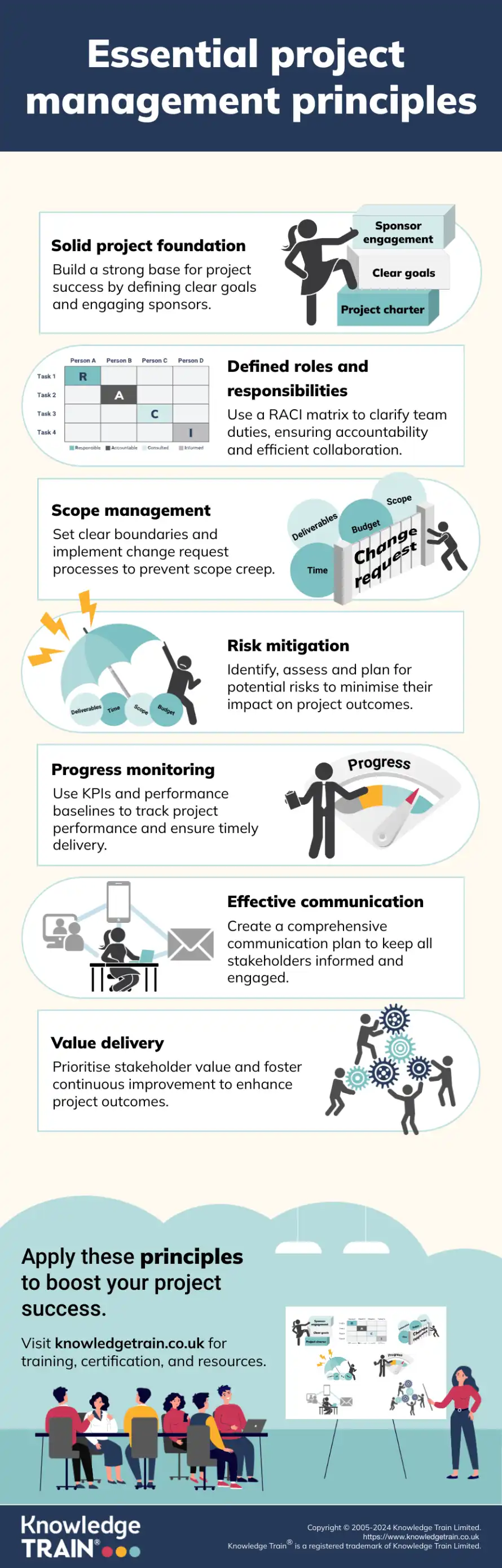
- Start with a formal project structure, agreed objectives, and an engaged sponsor who removes roadblocks.
- Define responsibilities early using tools like a RACI or RASCI matrix and a stakeholder register.
- Prevent scope creep by setting clear boundaries, acceptance criteria, and a documented change control process.Self-paced
- Identify and mitigate risks early using structured assessment and practical contingency planning.BCS Foundation Certificate in Business Analysis self-paced online
- Track performance with aligned KPIs, baselines, and regular reporting to support data-driven decisions.
- Improve outcomes through tailored communication, collaboration tools, value-led prioritisation, and post-project reviews.£499 +vat
IntroductionGood verbal skills are only half the puzzle, you’ll also need to be able to write clearly and concisely. Business analysts need to take a 300-page document and summarize it in a 1-page report that covers every bit of important information.
Project management3. Negotiation skills is the application of knowledge, skills, tools and techniques to meet project requirements. It’s a critical discipline that enables organisations to deliver value.Negotiation and communication skills go hand-in-hand. As a business analyst, you’ll not just talk with customers, but will have to negotiate tough deals with stakeholders that leave both parties satisfied with the arrangement.
Project management principlesYou’ll need to find compromises and talk your way out of sticky situations. Having a quick wit, good manners and knowledge of your trade are all part of what a BA needs to navigate some of the difficulties of the role. are fundamental guidelines and approaches that underpin effective project management practices. These principles provide a framework for project planning, execution and control. They are applicable across various industries and project types.4. Analytical skills
In this article, we’ll cover:This goes without saying – you need to be able to analyse information from multiple sources and then decide how to take appropriate action.
- Key project management principlesMore than just data, you’ll also need to look at your past performance, seeing which solutions worked as intended and which didn’t to improve your strategy in future.
- How to apply these principles5. Problem-solving skills
- How to overcome common project management challenges.Business analysts
Project management principles are essential for successful project outcomes. By understanding and applying these principles, are tasked with solving critical business problems and providing the best possible solution in any given context.project managersIt’s not always possible to deliver business needs easily and, given the complexity of many modern businesses, there’s rarely just one cause to any single problem. can enhance their effectiveness and deliver greater value to stakeholders. After reading this article, you may be interested in learning about the You’ll need to know how to address issues at all levels of business from customers all the way to upper management. You might even be called on to assume an HR role and sort out squabbles between individual team-members.PRINCE2 principles6. Technical know-how and what this widely used project management methodology says.All business analysts require some technical skills, as we’ve said, there’s a difference between data and business analysts, but you’ll still need to know how to use excel and other basic tools.
Establishing a solid project foundationIf you really want to impress recruiters, consider taking a technical course. Pair this knowledge with some visual design tools such as Microsoft Visio and perhaps a basic online management suite and you’re sure to draw attention to yourself!
A successful project starts with a strong foundation. Let’s look at three elements that will set the stage for success: formal project structure, clear goals and objectives, and sponsor engagement.Business analysis qualifications
Formal project structureThe reality of business analyst roles in that most people ‘fall into’ them. That is to say, most don’t actively seek BA roles, the position of a business analyst just happens to be the natural career progression path of many roles in the IT industry.
The first element is a well-defined project structure, which provides a framework for project execution:This makes sense when you consider the amount of industry-specific information required by BAs. Do a job long enough and you’ll have a good idea on how to help others do it just as good as you.
- Project charterIf you don’t want to work your way to a business analyst role from the bottom-up, you need a little something extra to show employers you have the necessary knowledge.: This document outlines the project purpose, scope and stakeholders.The good news is that you don’t need to spend years studying in tertiary education to qualify. There is no specific degree required to be a business analyst.
- Project planHaving said, if you have a computer science engineering degree, an MBA or, better yet, and Engineering (CSE) + MBA, you should easily land into a BA career.: This is a detailed plan that covers timelines, resources and expected deliverables.Lacking these, you can always opt for an accredited business analyst training course. These courses range from those that will teach you general information about the profession, to those that will walk you through individual practices and techniques used in business analysis.
- TeamHere at : Designate the team who will carry out the work and ensure they understand their roles and responsibilities.Knowledge Train
Clear goals and objectives, we offer a variety of
Precise requirements are essential for successful project execution:business analyst courses
- Importance of clear goals.: Clear objectives help prevent misunderstandings, reduce the risk of scope creep and keep the project focused.BCS Business Analysis
- Alignment with company objectivesThe popular : It’s important to ensure project goals support the broader goals and objectives of the company.BCS Business Analysis certifications
- Documentation and approval offers a structured path for career progression.: Requirements should be documented and formally approved by all relevant stakeholders.BCS Business Analysis certifications
Agileproject managers tends to focus on can lay a strong foundation for project success and delivery.project management
By effectively managing scope and changes, project managers can ensure projects remain on track while accommodating necessary adjustments. This balance promotes project success and stakeholder satisfaction., AgileBA takes agile concepts such as workshops, prioritization, timeboxes, modelling, prototyping and
Defining roles and responsibilitiesbusiness cases
Clearly defining roles and responsibilities within a project is essential for its success. This section will delve into aspects of team accountability and the role of the project manager., and frames them in relation to the business analyst role.
Team accountabilityPMI Professional in Business Analysis (PMI-PBA)
Creating accountability structures is important to ensure that each team member understands their responsibilities and expectations.®
RACI/RASCI matrixPMI-PBA
RACI® (Responsible, Accountable, Consulted, Informed) or is a popular certification in the US and covers the most essential RASCIbusiness analysis techniques (with Sign-off) matrices are useful tools to clearly define roles and responsibilities for each task or decision in a project:.
- ResponsibleWhile PMI-PBA: Who will do the task?®
- Accountable training has no prerequisites, to be eligible for the certification exam, candidates must possess several years of relevant work experience. As such, many : Who is ultimately responsible for task completion?business analysts
- Consulted return to formal education later in their career to attain this qualification.: Whom should be consulted?Enhance your skills with our expert-led courses
- Informed : Who else should be informed?
- Sign-off (RASCI only): Who should sign off or approve?Self-paced
Stakeholder registerBCS Foundation Certificate in Business Analysis self-paced online
A stakeholder register£499 +vat is a document that contains all key information about project stakeholders, such as contact information, level of influence, communication preferences and engagement strategy.
Project manager’s role
The role of a project manager is diverse and critical for project success.
Key responsibilitiesSelf-paced
- Planning and schedulingBCS International Diploma in Business Analysis self-paced online
- Resource allocation
- Risk management£2,199 +vat
- Budget oversight
- Quality assurance.
Leadership and communication skills
Successful project managers often exhibit:Self-paced
- Clear and concise communication skillsBCS Business Analysis Practice self-paced online
- Conflict resolution capabilities
- Motivational techniques£749 +vat
- Adaptability to changeThe next steps
- Strategic thinking.Now that you have a rough understanding of what makes a good BA candidate, we can plan the next steps towards your first business analyst role.
Clearly defined roles and accountability improve the overall efficiency and effectiveness of a project team.1. Involve yourself in projects today!
Managing project scope and changesHere are just a few questions you might be asked when being interviewed for a BA role. Understand these and you’ll not only get a good understanding of what knowledge is typically required by a BA, but if you’re stumped, that’s a good sign there are some areas of your own understanding that need improvement!
Managing project scope and change carefully helps you to manage change within your project.These questions may seem a little intimidating, but if you successfully acquire a BA qualification by attending a
Scope creep preventionbusiness analyst course
Defining project boundaries, you’ll be more than ready!
It is important to clearly define project boundaries to avoid scope creep. To do this, one must document specific project deliverables, explicitly identify exclusions and set measurable acceptance criteria.Q1. What tools would you use a business analyst to do your job well?
Change management processesThis is a common question designed to test your basic technical skills and familiarity with standard BA software tools. Tailor your answer to highlight your own unique experience and skills.
Robust Sample answer:change control processes should be implemented, including:“I use tools like the Microsoft Publishing suite Word, Excel, PowerPoint, and Visio. I also understand SQL which is helpful when I need to analyse data that would overwhelm Excel.”
- Formal change request submissionsQ2. How would you handle a difficult stakeholder?
- Impact assessment (time, cost, resources)Another common question to test your ability to communicate and negotiate compromise. Contextual questions like this also measure your problem-solving skills.
- Stakeholder review and approval When answering, always include an example you’ve faced at work. You can also use frameworks such as STAR interview responses to structure your answers:
- Documentation of approved changes.Situation
Adaptability in project management: Briefly explain the problem you were dealing with.
Flexibility in project lifecycleTask
Flexibility should be built into the project lifecycle to allow for necessary changes:: Explain your role.
- Use Actioniterative methods: Explain what you did to resolve the problem. when applicableResult
- Conduct regular project reviews: Explain how your actions resulted in a positive result.
- Maintain open communication.Sample answer:
Balancing change and stability“I once had a client that felt they had received the incorrect data. My role was to collect said data. I decided to bring the problem to the attention of my superiors. After further discussion, we established a weekly workshop with our business consultants to help our client interpret said data over the remainder of the project.”
Finding a balance between adaptability and project stability is important.Q3. Explain your understanding of SQL queries
| AspectSQL is the standard language of relational databases. Though a BA doesn’t need to have advanced technical skills, some skills are seen as mandatory (depending on the business or industry). | Strategy You may be asked to explain the elements of SQL statements during an interview. Use the opportunity to demonstrate your knowledge and providing an example of how you have used SQL to aid you in previous tasks. |
| ScopeSample answer: | Prioritise changes based on value and impact“SQL statements include the DDL (Data Definition Language), the DML (Data Manipulation Language), the DCL (Data Control Language), and the TCL (Transactional Control Language) used to control access to, insert, delete and modify data. I have used SQL to track client purchases, helping my business make important decisions about future products.” |
| ScheduleQ4. What are the pros and cons of analytical reporting? | Build buffer time into project timelinesAs a BA, you need to understand the benefits and limitations of analytical reporting. |
| Resources Use this question to demonstrate your critical thinking and analytical skills, showing how you use data to create recommendations. | Cross-train team members for versatilitySample answer: |
| Budget“The most important aspect of analytical reporting is the ability to solve problems and make decisions based on empirical information. Data itself cannot solve problems, but it can equip you to make the right business decisions when analysed. Even if certain decisions do not produce the desired results, data allows you to learn from mistakes and continue improving. Analytical reporting provides tangible information with which to create a strategy.” | Allocate contingency funds for unforeseen changesQ5. Name two useful diagrams you might use as a BA and how they affect your work. |
By carefully controlling scope and changes, project managers can keep This is a fairly basic question asked to ensure you are familiar with standard BA documentation. Again, use the STAR response framework to structure your answer for bonus points!projectsSample answer: on track while allowing for necessary adjustments. This balance is key to project success and stakeholder satisfaction.“I prefer to use Activity Diagrams and Use Case Diagrams. Activity Diagrams help visualize the activities that take place across different departments. I use these to show who interacts with any given system and what they achieve through this. Use Case Diagrams are useful when I need to display the functional requirements of a given system, this allows me to make informed decisions when designing development priorities.”
Risk management and mitigationEnhance your skills with our expert-led courses
Successful project management also relies heavily on risk management and mitigation strategies. Let’s talk about how to recognise, assess, and reduce risks.
Identifying and assessing risks
Develop
Effective communication and collaboration
CommunicationUltimate guide to business analysis careers and collaborationSimon Buehring are key success factors in project management. In this section, we will discuss how to develop communication plans and utilise collaboration tools.19 Feb 2026
Communication plan development
Stakeholder communication needsExplore the various career paths in business analysis, from entry-level to senior roles. Understand salary prospects and job roles by reading further.
Identify and meet different stakeholder needs:
- Document management and version control.
Team collaboration platforms
Implement team collaboration platforms that support features like:
- Real-time messaging and chat
19 Feb 2026
Value delivery and continuous improvement
Focus on stakeholder valueDiscover how fishbone diagrams can help identify root causes of complex issues. Read on to gain insights and practical tips for using this essential problem-solving tool effectively.
Prioritising value-driven tasks
Prioritise tasks that deliver the most value to stakeholders. This includes conducting regular stakeholder interviews, mapping value streams, and implementing Agile methodologies to accelerate value delivery.
Aligning deliverables with stakeholder expectations
Align project deliverables with stakeholder needs and expectations. Develop clear acceptance criteria, conduct regular stakeholder reviews, and be flexible to adapt the project scope based on feedback.
Lessons learned and project evaluation
Post-project review processUnlocking potential with SMART goals in goal setting
Conduct a comprehensive project retrospective, which includes analysing project successes and challenges. Gather feedback from team members and stakeholders and document key learnings and recommendations.
Implementing improvements in future projectsSimon Buehring
FAQs
What are the most important project management principles?Or chat with us using the link at the bottom of the screen.
Some of the most important principles include clear goal setting, effective communication, risk management, and stakeholder engagement.Contact us with questions about the courses on this page, or about which project management certification or training is best for you.
How can I improve communication in my project team?Finance FAQs
Implement a structured communication plan, utilise collaboration tools, and foster a culture of open feedback and active listening.Contact
What’s the difference between Agile and traditional project management?Cookies
Agile is iterative and flexible, with an emphasis on collaboration, while traditional methods are linear and follow a planned approach.Privacy