Project management principles

IntroductionScope change control
Project management: Establish a process for handling changes to is the application of knowledge, skills, tools and techniques to meet project requirements. It’s a critical discipline that enables organisations to deliver value.
Project management principles are fundamental guidelines and approaches that underpin effective project management practices. These principles provide a framework for project planning, execution and control. They are applicable across various industries and project types.
In this article, we’ll cover:the project scope.
- Key project management principlesMonitor for scope creep
- How to apply these principles: Regularly review project requirements to ensure they align with the defined scope.
- How to overcome common project management challenges.Prioritisation
Project management principles are essential for successful project outcomes. By understanding and applying these principles, : Use a prioritisation method, such as project managersMoSCoW can enhance their effectiveness and deliver greater value to stakeholders. After reading this article, you may be interested in learning about the , to determine which features are essential, desirable, optional, or not required.PRINCE2 principles and what this widely used project management methodology says.Time management approaches
Establishing a solid project foundationWhen managing project time, you can try these tips:
A successful project starts with a strong foundation. Let’s look at three elements that will set the stage for success: formal project structure, clear goals and objectives, and sponsor engagement.Critical path
Formal project structure: Identify the tasks that must be completed on time for the project to stay on schedule.
The first element is a well-defined project structure, which provides a framework for project execution:Resource leveling
- Project charter: Optimise the use of resources to avoid overloading or underutilisation.: This document outlines the project purpose, scope and stakeholders.Timeboxing
- Project plan: Set a fixed time period for specific tasks or project phases.: This is a detailed plan that covers timelines, resources and expected deliverables.Agile sprints
- Team: Break the project into short, focused work cycles with specific goals.: Designate the team who will carry out the work and ensure they understand their roles and responsibilities.Cost control methods
Clear goals and objectivesWhen managing project cost, you can try these tips:
Precise requirements are essential for successful project execution:Earned value management
- Importance of clear goals: Track the project’s progress in relation to its budget and schedule.: Clear objectives help prevent misunderstandings, reduce the risk of scope creep and keep the project focused.Cost baseline
- Alignment with company objectives: Create a detailed budget for each phase of the project.: It’s important to ensure project goals support the broader goals and objectives of the company.Forecasting
- Documentation and approval: Regularly estimate the future costs of the project based on current performance and trends.: Requirements should be documented and formally approved by all relevant stakeholders.Vendor management
| Benefit: Negotiate favourable terms and monitor supplier costs. | DescriptionQuality assurance practices |
| FocusWhen managing project quality, you can try these tips: | Guides team efforts towards specific outcomesQuality standards |
| Measurement: Define specific, measurable quality criteria for the project deliverables. | Provides benchmarks for assessing progressContinuous testing |
| Clarity: Implement regular quality checks throughout the project lifecycle. | Reduces ambiguity in project executionPeer review |
Project sponsor engagement: Leverage the expertise of team members to identify and address quality issues.
The engagement of a project sponsor can be vital in delivering project success:Customer feedback
- Role: Regularly collect and incorporate stakeholder feedback on project deliverables.: Acts as the overall champion and supporter of the projectThrough the implementation of these methods, project managers can successfully navigate and mitigate trade-offs between the competing constraints of scope, time, cost, and quality. However, it is important to note that constraint management is an iterative process that necessitates continuous monitoring and adjustment in response to changing project dynamics.
- BenefitsTools for managing the project management triangle: Ensures the availability of resources, removes roadblocks and promotes the project.Software can help you keep track of the project management triangle and ensure your project management is top-notch. Here are some of the best project management software to consider:
- StrategiesProject management software options: Stay updated, communicate clearly and involve the sponsor in key decisions.Monday.com
Defining these important fundamentals, : A flexible platform suitable for multiple project types and management styles. With Visual boards for easy task tracking and prioritisation, it’s one of the best software for project management, and it also has customisable workflows for specific project requirements.project managersClickUp can lay a strong foundation for project success and delivery.: A feature-rich tool with robust Agile project support and time tracking and resource management features. ClickUp also provides multiple view options (list, board, Gantt, calendar) to cater to different preferences and project needs.
risk management
Team accountability and issue tracking tools for comprehensive project management.
Creating accountability structures is important to ensure that each team member understands their responsibilities and expectations.Key features to look for in project management tools
RACI/RASCI matrixWhen choosing a project management tool, consider these vital features and capabilities:
RACIConstraint tracking (Responsible, Accountable, Consulted, Informed) or : The ability to track and manage scope, time and cost constraints concurrentlyRASCIResource allocation (with Sign-off) matrices are useful tools to clearly define roles and responsibilities for each task or decision in a project:: Features and tools to optimise team and resource utilisation
- ResponsibleReporting and analytics: Who will do the task?: Real-time project status and insights through intuitive dashboards and analytics
- AccountableCollaboration features: Who is ultimately responsible for task completion?: Shared workspaces, integrated communication tools and file-sharing capabilities for effective teamwork
- ConsultedIntegration capabilitie: Whom should be consulted?s: Compatibility with other software and tools used within your organisation
A With the right tool and these essential features, project managers will be in a much better position to maintain the constraints of the project management triangle. Software solutions can enhance project visibility, foster better communication and support data-driven decisions throughout the project lifecycle.stakeholder registerEnhance your skills with our expert-led courses is a document that contains all key information about project stakeholders, such as contact information, level of influence, communication preferences and engagement strategy.
Project manager’s role
The role of a project manager is diverse and critical for project success.
Key responsibilitiesInstructor-led
- Planning and schedulingIntroduction to Project Management course
- Resource allocation
- Risk management£499 +vat
- Budget oversight
| Review the project plan on a regular basis. This will help you to stay on track and make changes as necessary. | Cross-train team members for versatilityAdjust the plan when necessary. If you find that you are off track, you can always make adjustments to get back on track. |
| BudgetDecisions based on information to revise project plans. | Allocate contingency funds for unforeseen changesTeam collaboration and accountability |
By carefully controlling scope and changes, project managers can keep Project managers can also foster collaboration and teamwork among team members by holding them accountable for their part of the work. When team members know that they will be held accountable for their work, they are more likely to collaborate with others to complete the project successfully. There are several best practices for collaborating and holding team members accountable, including the following:projectsAssign clear roles and responsibilities to each team member. This will help everyone to understand what they need to do and be held accountable for their part of the project. on track while allowing for necessary adjustments. This balance is key to project success and stakeholder satisfaction.Encourage team members to collaborate with each other. This can be done by setting up regular team meetings and encouraging team members to communicate with each other.
Risk management and mitigationTrack team members’ progress and hold them accountable for their work. This can be done by regularly reviewing each team member’s progress and providing feedback.
Successful project management also relies heavily on Recognise and reward efforts that support successful constraint management.risk managementContinuous improvement and mitigation strategies. Let’s talk about how to recognise, assess, and reduce risks.Adopt a culture of
Identifying and assessing riskscontinuous improvement
Risk categories when working with the project triangle.
The following are some of the most common risk categories:Review the project after completion to determine lessons learned
- Technical risksEvaluate what worked and didn’t work for finding the balance between the constraints
- Financial risksPromote team members to share ideas for process improvements
- Operational risksStay updated on emerging project management methodologies and tools.
- External risks (market, regulatory, etc.).Incorporating these best practices can help project managers to learn the project management triangle. However, success will depend on dedication, flexibility, and the ability to learn from both successes and failures.
Risk assessment techniquesApplying the project management triangle
Use these techniques to identify and evaluate risks:To help us see how we can do this, it’s worth looking at some examples of best practice in real-world situations. We will take three case studies below and see how things were managed in each of them.
- Risk probabilityLarge-scale IT project A global corporation launched a and impact matrixworldwide ERP implementation
- SWOT analysis. The Project Manager in this case struggled to ensure the best balance between the different project triangle dimensions. (Strengths, Weaknesses, Opportunities, Threats)Key measures include prioritised the most important core functionalities to manage scope, implemented a phased rollout to manage time and cost constraints, and utilised change management processes to assess and evaluate new requirements.
- Delphi technique (expert consensus)Result
- Fault tree analysis.: The project delivered under budget, with minimal impact on time, and fulfilled all essential business requirements.
Developing risk mitigation strategiesConstruction project
Preventive measuresA commercial
Take the following proactive actions to reduce the likelihood of risk occurrence:skyscraper building construction
- Regular risk reviews project faced unexpected geological conditions which created a major risk to the project triangle.
- Clear communication channelsKey measures include reallocated budget from non-essential features to resolve foundation issues, accelerated other construction phases to make up for initial delays, and negotiated with stakeholders to adjust project scope without compromising quality.
- Quality assurance processesResult
- Ongoing staff training.: The building was completed safely, with a minor delay and a slight increase in the budget.
Contingency planningProduct development initiative
Develop A tech startup wanted to launch a contingency plansnew software product for the following identified risks: in a highly competitive market, but it struggled to strike the right balance between innovation and the pressure to get the product to market in time.
Selecting appropriate KPIs
Selecting the right KPIs is important to ensure effective monitoring and measuring of project progress. The KPIs should be aligned with the project objectives and should provide insights into the project’s performance. Some of the commonly used KPIs include:
- Schedule Performance IndexSee all dates (SPI)
- Cost Performance Index (CPI)
- Quality metricsInstructor-led
- Stakeholder satisfaction scoresProject Management Essentials.
Tracking and reporting methods£999 +vat
Once the KPIs are selected, it is important to have effective tracking and reporting mechanisms in place. This can include:
- Regular status meetingsSee all dates
- Automated dashboardsConclusion
- Earned Value Management (EVM)The project management triangle is a simple yet powerful tool for understanding and managing project constraints such as
- Milestone tracking.scope
Performance management baseline,
Integrating cost, schedule, and scopetime
Develop an integrated baseline that blends the projects:, and
- Work Breakdown Structurecost (WBS). By learning this concept, project managers can make informed decisions when trade-offs are required and ensure that they deliver high-quality results.
- ScheduleWe hope that our blog post on the project management triangle has provided you with a clear and concise understanding of the concept. Remember, project management is not just about executing tasks but also involves communication with stakeholders, ongoing monitoring and adjustment of project parameters, team collaboration, and accountability, and continuous process improvement. Balancing these constraints is critical for project success, regardless of the industry or project type. As the case studies have shown, the effective application of the project management triangle can lead to exceptional outcomes.
| Daily | ||
| Clients | ||
Post-project review process
Conduct a comprehensive project retrospective, which includes analysing project successes and challenges. Gather feedback from team members and stakeholders and document key learnings and recommendations.Simon Buehring
Implementing improvements in future projects19 Feb 2026
Apply the lessons learnedConfused between PRINCE2, Agile, or PRINCE2 Agile? Discover their distinctions and how they can be effectively combined in projects by reading on. to future projects to improve performance. Establish a knowledge repository, update project management processes , and incorporate key insights into training programmes.
Conclusion
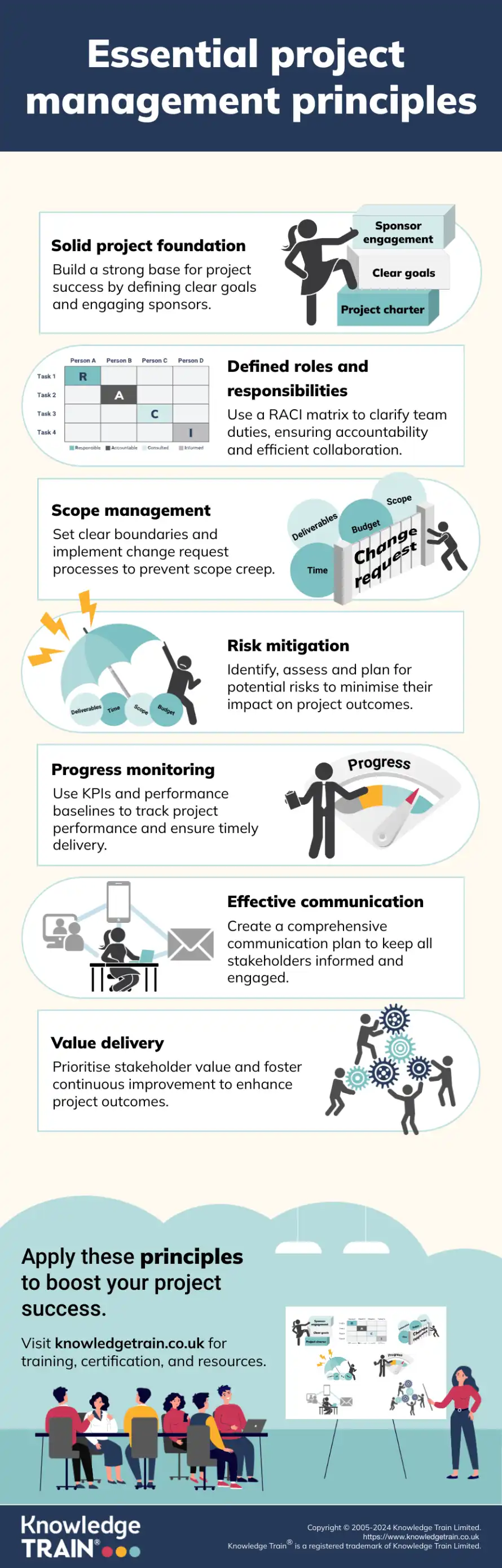
Project management principles are the guiding concepts that contribute to successful project delivery. Some of the most important principles include setting up a strong project foundation, defining roles and responsibilities, and managing the project scope and changes. Effective risk management, KPI and baseline tracking, communication and collaboration, and a focus on value delivery and continuous improvement are also crucial. These principles are not exhaustive, and as the field of project management continues to evolve, it is important to remain committed to ongoing learning and improvement. By consistently applying these principles and continuously enhancing project management skills and knowledge, practitioners can successfully overcome challenges and achieve exceptional outcomes in an ever-changing business environment.
Some of the most important principles include clear goal setting, effective communication, risk management, and stakeholder engagement.
How can I improve communication in my project team?
Implement a structured communication plan, utilise collaboration tools, and foster a culture of open feedback and active listening.
What’s the difference between Agile and traditional project management?
Agile is iterative and flexible, with an emphasis on collaboration, while traditional methods are linear and follow a planned approach.PRINCE2 Foundation exam mock questions
How do I handle scope creep in my projects?
Define clear project boundaries, implement a change control process, and maintain regular communication and alignment with stakeholders.Simon Buehring
What are some common project management challenges and how can I overcome them?19 Feb 2026
Common challenges include resource constraints, unclear objectives, and poor communication. Overcome them through careful planning, stakeholder engagement, and a focus on continuous improvement.
InfographicAccess a full PRINCE2 Foundation exam sample for free. Perfect for assessing your readiness for the actual exam.