Project management principlesKnowledge Train is a Change Management Accredited Training Organization.

Key takeawaysLatest educational technology.
Strong delivery comes from clear foundations, disciplined control, and continuous learning.
- Start with a formal project structure, agreed objectives, and an engaged sponsor who removes roadblocks.BUSINESS SOLUTIONS
- Define responsibilities early using tools like a RACI or RASCI matrix and a stakeholder register.
- Prevent scope creep by setting clear boundaries, acceptance criteria, and a documented change control process.
- Identify and mitigate risks early using structured assessment and practical contingency planning.TO HELP ORGANISATIONS IMPROVE
- Track performance with aligned KPIs, baselines, and regular reporting to support data-driven decisions.We offer solutions to help improve team performance including:
- Improve outcomes through tailored communication, collaboration tools, value-led prioritisation, and post-project reviews.Consultancy services
Introduction
Project managementSubmit is the application of knowledge, skills, tools and techniques to meet project requirements. It’s a critical discipline that enables organisations to deliver value.
Project management principles are fundamental guidelines and approaches that underpin effective project management practices. These principles provide a framework for project planning, execution and control. They are applicable across various industries and project types.OUR VALUES
In this article, we’ll cover:Our 6 core values are everything we do. They include:
- Key project management principlesIntegrity
- How to apply these principlesDiversity
- How to overcome common project management challenges.Fairness
Project management principles are essential for successful project outcomes. By understanding and applying these principles, Qualityproject managersInnovation can enhance their effectiveness and deliver greater value to stakeholders. After reading this article, you may be interested in learning about the Social responsibilityPRINCE2 principles and what this widely used project management methodology says.SOCIAL RESPONSIBILITY
Establishing a solid project foundationSome of the charities we have helped over the years:
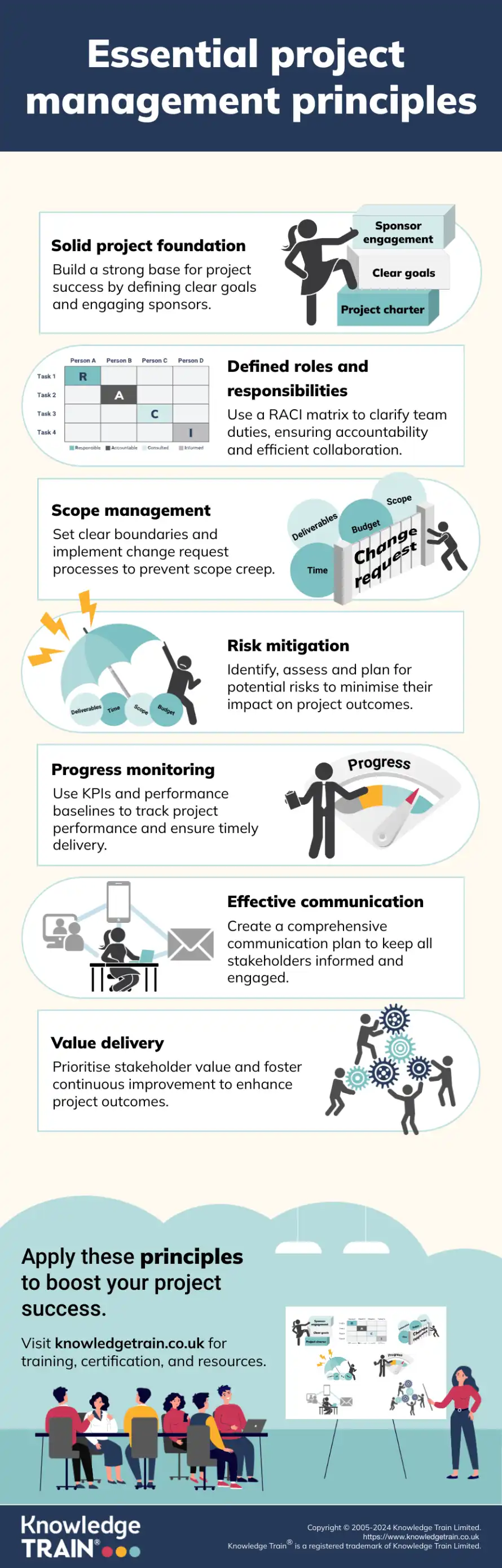
A successful project starts with a strong foundation. Let’s look at three elements that will set the stage for success: formal project structure, clear goals and objectives, and sponsor engagement.
Formal project structure
The first element is a well-defined project structure, which provides a framework for project execution:
- Project charter : This document outlines the project purpose, scope and stakeholders.
- Project plan : This is a detailed plan that covers timelines, resources and expected deliverables.AWARDS
- TeamWe don’t go seeking awards, but here are two of the awards we have received for our training.: Designate the team who will carry out the work and ensure they understand their roles and responsibilities.
Clear goals and objectives
Precise requirements are essential for successful project execution: Request a quote
- Importance of clear goals : Clear objectives help prevent misunderstandings, reduce the risk of scope creep and keep the project focused.
- Alignment with company objectives : It’s important to ensure project goals support the broader goals and objectives of the company.
- Documentation and approval+44 (0)207 148 5985: Requirements should be documented and formally approved by all relevant stakeholders.
| Benefit[email protected] | Description |
| Focus | Guides team efforts towards specific outcomes |
| Measurement | Provides benchmarks for assessing progress |
| Clarity | Reduces ambiguity in project execution |
Project sponsor engagementUnited Kingdom
The engagement of a project sponsor can be vital in delivering project success:
- Role : Acts as the overall champion and supporter of the project
- Benefits : Ensures the availability of resources, removes roadblocks and promotes the project.
- Strategies : Stay updated, communicate clearly and involve the sponsor in key decisions.Search
Defining these important fundamentals, project managers can lay a strong foundation for project success and delivery.
By effectively managing scope and changes, project managers can ensure projects remain on track while accommodating necessary adjustments. This balance promotes project success and stakeholder satisfaction.
Defining roles and responsibilities
Clearly defining roles and responsibilities within a project is essential for its success. This section will delve into aspects of team accountability and the role of the project manager.United Kingdom
Team accountabilityAustria
Creating accountability structures is important to ensure that each team member understands their responsibilities and expectations.Belgium
RACI/RASCI matrixBulgaria
RACICroatia (Responsible, Accountable, Consulted, Informed) or CyprusRASCICzech Republic (with Sign-off) matrices are useful tools to clearly define roles and responsibilities for each task or decision in a project:Denmark
- ResponsibleEstonia: Who will do the task?Finland
- AccountableFrance: Who is ultimately responsible for task completion?Germany
- ConsultedGreece: Whom should be consulted?Ireland
- InformedItaly: Who else should be informed?Latvia
- Sign-off Lithuania(RASCI only): Who should sign off or approve?Luxemburg
- Spain
- Resource allocationSweden
- Risk managementOther countries
- Budget oversightHome
- Quality assurance.Project Management
Leadership and communication skillsProject management triangle
Successful project managers often exhibit:
- Clear and concise communication skills{"@context":"http://schema.org","@type":"BreadcrumbList","itemListElement":[{"@type":"ListItem","position":1,"name":"Home","item":"https://www.knowledgetrain.co.uk/"},{"@type":"ListItem","position":2,"name":"Project Management","item":"https://www.knowledgetrain.co.uk/project-management"},{"@type":"ListItem","position":3,"name":"Project management triangle","item":"https://www.knowledgetrain.co.uk/project-management/project-management-triangle"}]}
- Conflict resolution capabilities
- Motivational techniques
- Adaptability to change
- Strategic thinking.Project management triangle
Clearly defined roles and accountability improve the overall efficiency and effectiveness of a project team.
Effective communication and collaborationrisk management
Communication plan and should include:collaborationIdentification of risks that could impact any of the constraints are key success factors in project management. In this section, we will discuss how to develop communication plans and utilise collaboration tools.Risk scoring based on probability and impact
Communication plan developmentDetailed contingency plans for high-priority risks
Stakeholder communication needsA monitoring process to reassess risks throughout the project.
Identify and meet different stakeholder needs:Risk management
- Executive sponsors: Executive updates ensures prevention of imbalances before they happen.
- Team members: Detailed tasksCreate a change management plan
- Clients: Progress and milestonesChange is inevitable on projects. A
- External partners: Relevant project details.change management plan
Communication channels and frequency provides a process for considering how changes impact the constraints. A plan should include:
Define appropriate channels and cadence:A system for submitting, reviewing, and approving changes
| StakeholderProcedures for assessing change impact on each constraint | ChannelApproval thresholds based on change type and size | |
- : Establish a process for handling changes to Document management and version control.
Team collaboration platforms
Implement team collaboration platforms that support features like:
- Real-time messaging and chatthe project scope.
- Virtual whiteboards and brainstorming toolsMonitor for scope creep
- Simultaneous document editing and collaboration: Regularly review project requirements to ensure they align with the defined scope.
- Integrated video conferencing and meetings.Prioritisation
Effective communication plans and collaboration tools not only facilitate team communication and increase efficiency but also contribute to project success through strategic stakeholder engagement.: Use a prioritisation method, such as
Value delivery and continuous improvementMoSCoW
Focus on stakeholder value, to determine which features are essential, desirable, optional, or not required.
Prioritising value-driven tasksTime management approaches
Earned value managementproject management processes: Track the project’s progress in relation to its budget and schedule., and incorporate key insights into training programmes.Cost baseline
Conclusion: Create a detailed budget for each phase of the project.
Project management principles are the guiding concepts that contribute to successful project delivery. Some of the most important principles include setting up a strong project foundation, defining roles and responsibilities, and managing the project scope and changes. Effective risk management, KPI and baseline tracking, communication and collaboration, and a focus on value delivery and continuous improvement are also crucial. These principles are not exhaustive, and as the field of project management continues to evolve, it is important to remain committed to ongoing learning and improvement. By consistently applying these principles and continuously enhancing Forecastingproject management: Regularly estimate the future costs of the project based on current performance and trends. skills and knowledge, practitioners can successfully overcome challenges and achieve exceptional outcomes in an ever-changing business environment.Vendor management
: Negotiate favourable terms and monitor supplier costs.
FAQsKey features to look for in project management tools
What are the most important project management principles?When choosing a project management tool, consider these vital features and capabilities:
Some of the most important principles include clear goal setting, effective communication, risk management, and stakeholder engagement.Constraint tracking
How can I improve communication in my project team?: The ability to track and manage scope, time and cost constraints concurrently
Implement a structured communication plan, utilise collaboration tools, and foster a culture of open feedback and active listening.Resource allocation
What’s the difference between Agile and traditional project management?: Features and tools to optimise team and resource utilisation
Agile is iterative and flexible, with an emphasis on collaboration, while traditional methods are linear and follow a planned approach.Reporting and analytics
How do I handle scope creep in my projects?: Real-time project status and insights through intuitive dashboards and analytics
Define clear project boundaries, implement a change control process, and maintain regular communication and alignment with stakeholders.Collaboration features
What are some common project management challenges and how can I overcome them?: Shared workspaces, integrated communication tools and file-sharing capabilities for effective teamwork
Common challenges include resource constraints, unclear objectives, and poor communication. Overcome them through careful planning, stakeholder engagement, and a focus on continuous improvement.Fishbone Diagram Technique | Knowledge TrainIntegration capabilitie
Infographics: Compatibility with other software and tools used within your organisation