Project management principles®

Key takeaways®
Strong delivery comes from clear foundations, disciplined control, and continuous learning.Foundation
- Start with a formal project structure, agreed objectives, and an engaged sponsor who removes roadblocks.Learn the fundamentals of ITIL service management.
- Define responsibilities early using tools like a RACI or RASCI matrix and a stakeholder register.Strategist DPI
- Prevent scope creep by setting clear boundaries, acceptance criteria, and a documented change control process.3-day ITIL Strategist: Direct, Plan & Improve (DPI) course.
- Identify and mitigate risks early using structured assessment and practical contingency planning.Specialist: DSV
- Track performance with aligned KPIs, baselines, and regular reporting to support data-driven decisions.3-day ITIL Specialist: Drive Stakeholder Value (DSV) course.
- Improve outcomes through tailored communication, collaboration tools, value-led prioritisation, and post-project reviews.
IntroductionAGILE PROJECT MANAGEMENT COURSES
Project managementSelect your preferred training course below: is the application of knowledge, skills, tools and techniques to meet project requirements. It’s a critical discipline that enables organisations to deliver value.
Project management principlesPRINCE2 AGILE COURSES
- Project charterAGILE PROJECT MANAGEMENT COURSES: This document outlines the project purpose, scope and stakeholders.Select your preferred training course below:
- Project plan : This is a detailed plan that covers timelines, resources and expected deliverables.PRINCE2 AGILE COURSES
- : Designate the team who will carry out the work and ensure they understand their roles and responsibilities.SCRUM COURSES
Clear goals and objectivesSelect your preferred training course below:
Precise requirements are essential for successful project execution:
- Importance of clear goalsAGILE BUSINESS ANALYSIS COURSES: Clear objectives help prevent misunderstandings, reduce the risk of scope creep and keep the project focused.Select your preferred training course below:
- Alignment with company objectives : It’s important to ensure project goals support the broader goals and objectives of the company.BUSINESS ANALYSIS QUALIFICATIONS
- Documentation and approvalSelect your preferred qualification.: Requirements should be documented and formally approved by all relevant stakeholders.
| BenefitBCS BUSINESS ANALYSIS COURSES | DescriptionSelect your preferred training course below: |
| Focus | Guides team efforts towards specific outcomes |
| MeasurementAGILE BUSINESS ANALYSIS COURSES | Provides benchmarks for assessing progressSelect your preferred training course below: |
| Clarity | Reduces ambiguity in project executionCHANGE MANAGEMENT QUALIFICATIONS |
Project sponsor engagementSelect your preferred qualification.
The engagement of a project sponsor can be vital in delivering project success:
- RoleAPMG CHANGE MANAGEMENT COURSES: Acts as the overall champion and supporter of the projectSelect your preferred training course below:
- Benefits : Ensures the availability of resources, removes roadblocks and promotes the project.PROGRAMME MANAGEMENT QUALIFICATIONS
- StrategiesSelect your preferred qualification.: Stay updated, communicate clearly and involve the sponsor in key decisions.
project managersPMI COURSES can lay a strong foundation for project success and delivery.Select your preferred training course below:
By effectively managing scope and changes, project managers can ensure projects remain on track while accommodating necessary adjustments. This balance promotes project success and stakeholder satisfaction.
Defining roles and responsibilitiesPMI COURSES
Clearly defining roles and responsibilities within a project is essential for its success. This section will delve into aspects of team accountability and the role of the project manager.Select your preferred training course below:
Team accountability
Creating accountability structures is important to ensure that each team member understands their responsibilities and expectations.PRINCE2 COURSES
RACI/RASCI matrixSelect your preferred training course below:
RACI (Responsible, Accountable, Consulted, Informed) or APM COURSESRASCISelect your preferred training course below: (with Sign-off) matrices are useful tools to clearly define roles and responsibilities for each task or decision in a project:
- ResponsibleAGILE PROJECT MANAGEMENT COURSES: Who will do the task?Select your preferred training course below:
- Accountable : Who is ultimately responsible for task completion?PRINCE2 AGILE COURSES
- ConsultedSelect your preferred training course below:: Whom should be consulted?
- InformedBUSINESS CASE COURSES: Who else should be informed?Select your preferred training course below:
- Sign-off (RASCI only): Who should sign off or approve?AGILE COURSES
Stakeholder registerSelect your self-paced training course topic.
A stakeholder registerAGILE PROJECT MANAGEMENT COURSES is a document that contains all key information about project stakeholders, such as contact information, level of influence, communication preferences and engagement strategy.Select your preferred training course below:
Project manager’s role
The role of a project manager is diverse and critical for project success.PRINCE2 AGILE COURSES
Key responsibilitiesSelect your preferred training course below:
- Planning and scheduling
- Resource allocationSCRUM COURSES
- Risk managementSelect your preferred training course below:
- Budget oversight
- Quality assurance.LEAN SIX SIGMA COURSES
Leadership and communication skillsSelect your preferred training course below:
Successful project managers often exhibit:
- Clear and concise communication skillsBUSINESS ANALYST COURSES
- Conflict resolution capabilitiesSelect your self-paced training course topic.
- Motivational techniques
- Adaptability to changeBCS BUSINESS ANALYST COURSES
- Strategic thinking.Select your preferred training course below:
Clearly defined roles and accountability improve the overall efficiency and effectiveness of a project team.
Managing project scope and changesSelect your preferred training course topic.
Managing project scope and change carefully helps you to manage change within your project.
Scope creep preventionAI QUALIFICATIONS & WORKSHOPS
Defining project boundariesSelect your preferred qualification or workshop.
It is important to clearly define project boundaries to avoid scope creep. To do this, one must document specific project deliverables, explicitly identify exclusions and set measurable acceptance criteria.
Change management processesAIPGF COURSES
Robust Select your preferred training course below:change control processes should be implemented, including:
| Monitor and reassess periodicallyWHAT YOU WILL GET | |
| MediumOur courses and workshops include: | Develop specific response strategiesCertification exam(s) where applicable |
| HighAccredited training course materials | Create detailed action plans and allocate resourcesExpert, experienced trainers to support you |
Ongoing Course manual where applicable.risk management is critical for successful outcomes. It involves careful tracking and refinement of the risk management process. Identifying and addressing project risks early can significantly improve project resilience and success rates.SELF-PACED ONLINE TRAINING COURSES
Monitoring and measuring project progressSelf-paced online training courses (e-learning) include:
Monitoring and measuring progress are crucial aspects of project management that help ensure project success. This section will cover various aspects of monitoring and measuring project progress, including the use of key performance indicators (KPIs) and performance management baselines.Certification exam(s) where applicable
Key Performance Indicators (KPIs)Accredited training course materials
Selecting appropriate KPIsSupport from expert, experienced trainers
Selecting the right KPIs is important to ensure effective monitoring and measuring of project progress. The KPIs should be aligned with the project objectives and should provide insights into the project’s performance. Some of the commonly used KPIs include:Latest educational technology.
- Schedule Performance Index (SPI)BUSINESS SOLUTIONS
- Cost Performance Index (CPI)
- Quality metricsTO HELP ORGANISATIONS IMPROVE
- Stakeholder satisfaction scoresWe offer solutions to help improve team performance including:.Consultancy services
Tracking and reporting methodsStaff development
| Integration method | |
| Cost | Map budget to WBS elements |
| Schedule | Link timeline to WBS deliverables |
| ScopeName | Align WBS with project objectivesEmail |
Using baselines for decision-making
Utilise baselines to:
- Spot variances earlyPhone
- Predict project results
- Rationale corrective actions
- Assess change requests.How can we help?
Setting clear KPIs and performance baselines enables project managers to track progress and make data-driven decisions.
Effective communication and collaborationWe don’t go seeking awards, but here are two of the awards we have received for our training.
Communication and collaboration Request a quote are key success factors in project management. In this section, we will discuss how to develop communication plans and utilise collaboration tools.
Communication plan development
Stakeholder communication needs
Identify and meet different stakeholder needs:
- Executive sponsors: Executive updates+44 (0)207 148 5985
- Team members: Detailed tasks
- Clients: Progress and milestones[email protected]
- External partners: Relevant project details.
Communication channels and frequency
Define appropriate channels and cadence:
| Stakeholder | Channel | Frequency |
| Executives | Email reportsUnited Kingdom | Monthly |
| Team | Stand-up meetings | Daily |
| Clients | Video conferences | |
IrelandValue delivery and continuous improvement
Focus on stakeholder valueItaly
Prioritising value-driven tasksLatvia
Prioritise tasks that deliver the most value to stakeholders. This includes conducting regular stakeholder interviews, mapping value streams, and implementing LithuaniaAgile methodologiesLuxemburg to accelerate value delivery.Malta
Aligning deliverables with stakeholder expectationsNetherlands
Align project deliverables with stakeholder needs and expectations. Develop clear acceptance criteria, conduct regular stakeholder reviews, and be flexible to adapt the project scope based on feedback.Poland
Lessons learned and project evaluationPortugal
Post-project review processRomania
Conduct a comprehensive project retrospective, which includes analysing project successes and challenges. Gather feedback from team members and stakeholders and document key learnings and recommendations.Slovakia
Implementing improvements in future projectsSlovenia
Apply the Spainlessons learnedSweden to future projects to improve performance. Establish a knowledge repository, update Other countriesproject management processesHome, and incorporate key insights into training programmes.Project Management
ConclusionProject management principles
Project management principles are the guiding concepts that contribute to successful project delivery. Some of the most important principles include setting up a strong project foundation, defining roles and responsibilities, and managing the project scope and changes. Effective risk management, KPI and baseline tracking, communication and collaboration, and a focus on value delivery and continuous improvement are also crucial. These principles are not exhaustive, and as the field of project management continues to evolve, it is important to remain committed to ongoing learning and improvement. By consistently applying these principles and continuously enhancing project management{"@context":"http://schema.org","@type":"BreadcrumbList","itemListElement":[{"@type":"ListItem","position":1,"name":"Home","item":"https://www.knowledgetrain.co.uk/"},{"@type":"ListItem","position":2,"name":"Project Management","item":"https://www.knowledgetrain.co.uk/project-management"},{"@type":"ListItem","position":3,"name":"Project management principles","item":"https://www.knowledgetrain.co.uk/project-management/project-management-principles"}]} skills and knowledge, practitioners can successfully overcome challenges and achieve exceptional outcomes in an ever-changing business environment.
FAQs
What are the most important project management principles?
Some of the most important principles include clear goal setting, effective communication, risk management, and stakeholder engagement.
How can I improve communication in my project team?
Implement a structured communication plan, utilise collaboration tools, and foster a culture of open feedback and active listening.Copied!
What’s the difference between Agile and traditional project management?Key takeaways
Agile is iterative and flexible, with an emphasis on collaboration, while traditional methods are linear and follow a planned approach.Strong delivery comes from clear foundations, disciplined control, and continuous learning.
How do I handle scope creep in my projects?Start with a formal project structure, agreed objectives, and an engaged sponsor who removes roadblocks.
Define clear project boundaries, implement a change control process, and maintain regular communication and alignment with stakeholders.Define responsibilities early using tools like a RACI or RASCI matrix and a stakeholder register.
What are some common project management challenges and how can I overcome them?Prevent scope creep by setting clear boundaries, acceptance criteria, and a documented change control process.
Common challenges include resource constraints, unclear objectives, and poor communication. Overcome them through careful planning, stakeholder engagement, and a focus on continuous improvement.Identify and mitigate risks early using structured assessment and practical contingency planning.
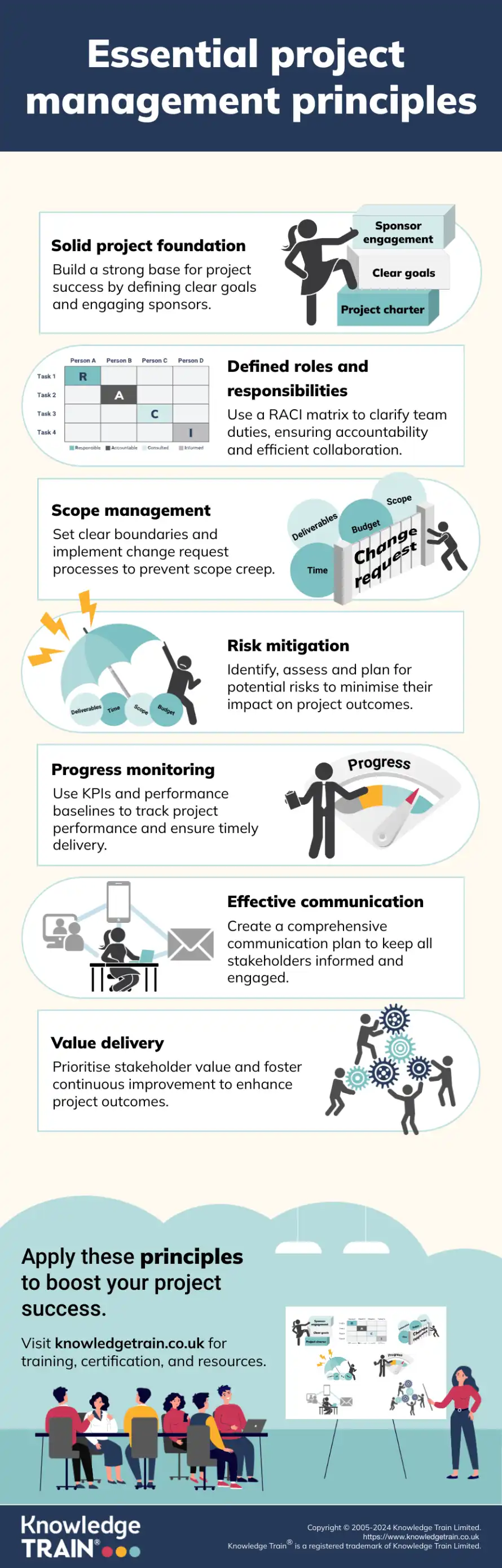
InfographicTrack performance with aligned KPIs, baselines, and regular reporting to support data-driven decisions.