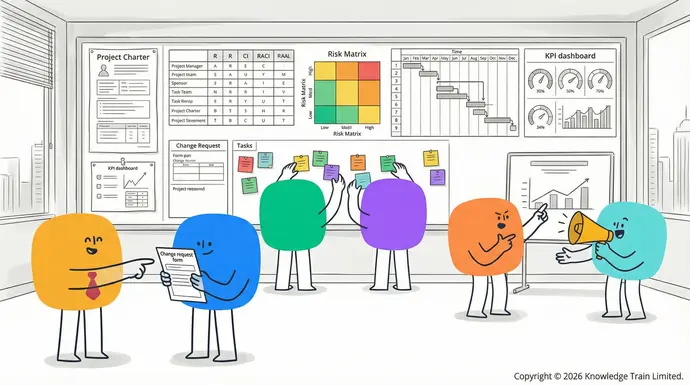
Strong delivery comes from clear foundations, disciplined control, and continuous learning.
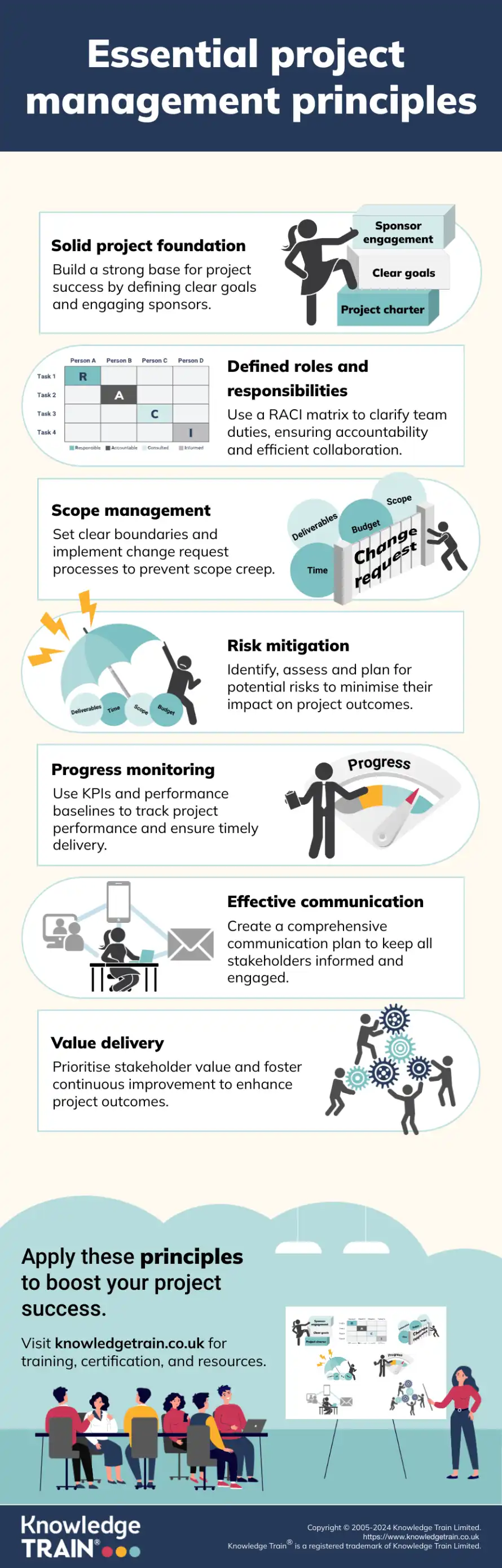
- Start with a formal project structure, agreed objectives, and an engaged sponsor who removes roadblocks.
- Define responsibilities early using tools like a RACI or RASCI matrix and a stakeholder register.
- Prevent scope creep by setting clear boundaries, acceptance criteria, and a documented change control process.
- Identify and mitigate risks early using structured assessment and practical contingency planning.
- Track performance with aligned KPIs, baselines, and regular reporting to support data-driven decisions.
- Improve outcomes through tailored communication, collaboration tools, value-led prioritisation, and post-project reviews.
can enhance their effectiveness and deliver greater value to stakeholders. After reading this article, you may be interested in learning about the PRINCE2 principles and what this widely used project management methodology says.
Establishing a solid project foundation
A successful project starts with a strong foundation. Let’s look at three elements that will set the stage for success: formal project structure, clear goals and objectives, and sponsor engagement.
Formal project structure
The first element is a well-defined project structure, which provides a framework for project execution:
- Project charter : This document outlines the project purpose, scope and stakeholders.
- Project plan : This is a detailed plan that covers timelines, resources and expected deliverables.
- Team : Designate the team who will carry out the work and ensure they understand their roles and responsibilities.
Clear goals and objectives
Precise requirements are essential for successful project execution:
- Importance of clear goals : Clear objectives help prevent misunderstandings, reduce the risk of scope creep and keep the project focused.
- Alignment with company objectives : It’s important to ensure project goals support the broader goals and objectives of the company.
- Documentation and approval : Requirements should be documented and formally approved by all relevant stakeholders.
- Planning and scheduling
- Resource allocation
- Risk management
- Budget oversight
- Quality assurance.
Leadership and communication skills
Successful project managers often exhibit:
- Clear and concise communication skills
- Conflict resolution capabilities
- Motivational techniques
- Adaptability to change
- Strategic thinking.
Take the following proactive actions to reduce the likelihood of risk occurrence:PRINCE2
- Regular risk reviews®
- Clear communication channels Agile
- Quality assurance processesFoundation
- Ongoing staff training.Learn the fundamentals of the PRINCE2 Agile method.
Contingency planningPractitioner
Develop Includes Foundation & Practitioner combined option.contingency plansAI Project Governance Framework (AIPGF)Practitioner
| Risk levelIncludes Foundation & Practitioner combined option. | ActionBetter Business Cases |
| Low™ | Monitor and reassess periodicallyP3O |
| Medium® | Develop specific response strategiesFoundation |
| HighLearn the fundamentals of the P3O project management office. | Create detailed action plans and allocate resourcesPractitioner |
Ongoing Includes Foundation & Practitioner combined option.risk managementWorkshops is critical for successful outcomes. It involves careful tracking and refinement of the risk management process. Identifying and addressing project risks early can significantly improve project resilience and success rates.Introduction to Project Management
Monitoring and measuring project progress1-day workshop to learn the basics of project management.
Monitoring and measuring progress are crucial aspects of project management that help ensure project success. This section will cover various aspects of monitoring and measuring project progress, including the use of key performance indicators (KPIs) and performance management baselines.Project Management Essentials
Key Performance Indicators (KPIs)2-day workshop to learn how to manage projects without getting certified.
Selecting appropriate KPIsWriting Business Cases
Selecting the right KPIs is important to ensure effective monitoring and measuring of project progress. The KPIs should be aligned with the project objectives and should provide insights into the project’s performance. Some of the commonly used KPIs include:Half-day workshop to learn to write robust business cases.
- Schedule Performance IndexAI in Project Management (SPI)Learn how to use AI tools in everyday project work.
- Cost Performance IndexARTIFICIAL INTELLIGENCE (AI) (CPI)BCS AI
- Quality metricsFoundation
- Stakeholder satisfaction scoresLearn the fundamentals of artificial intellegence..AI Project Governance Framework (AIPGF)
Tracking and reporting methodsFoundation
Once the KPIs are selected, it is important to have effective tracking and reporting mechanisms in place. This can include:Learn the fundamentals of the governance framework.
- Regular status meetingsPractitioner
- Automated dashboardsIncludes Foundation & Practitioner combined option.
- Earned Value Management (EVM)Workshops
- Milestone tracking.AI in Project Management
Performance management baselineLearn how to use AI tools in everyday project work.
Integrating cost, schedule, and scopeAGILE
Develop an integrated baseline that blends the projects:AgilePM
- Work Breakdown Structure® (WBS) – Agile Project Management
- ScheduleFoundation
- Budget.Learn the key principles of Agile Project Management.
| ElementPractitioner | Integration methodIncludes Foundation & Practitioner combined option. |
| CostPRINCE2 | Map budget to WBS elements® |
| Schedule Agile | Link timeline to WBS deliverablesFoundation |
| ScopeLearn the fundamentals of the PRINCE2 Agile method. | Align Practitioner WBSIncludes Foundation & Practitioner combined option. with project objectivesScrum |
Using baselines for decision-makingScrum Essentials
Utilise baselines to:Self-paced training course to learn the essentials of Scrum.
- Spot variances earlyScrum Master
Effective communication and collaborationGain practitioner certificate in modelling business processes.
CommunicationBusiness Analysis Practices and Gain practitioner certificate in business analysis practices.collaborationRequirements Engineering are key success factors in project management. In this section, we will discuss how to develop communication plans and utilise collaboration tools.Gain practitioner certificate in requirements engineering.
Communication plan developmentBusiness Analysis International Diploma
Stakeholder communication needsAll 4 courses bundled into this Diploma certification package.
Identify and meet different stakeholder needs:AgileBA
- Executive sponsors: Executive updates®
- Team members: Detailed tasks – Agile Business Analysis
- Clients: Progress and milestonesFoundation training
- External partners: Relevant project details.Learn the fundamentals of Agile Business Analysis.
Communication channels and frequencyPractitioner
Define appropriate channels and cadence:4-day course including Foundation.
| StakeholderPMI | Channel® | FrequencyPMI-PBA |
- Includes Foundation & PractGantt charts for visual timeline management
- Task assignment and tracking capabilitiesitioner combined option.
- Resource allocation and budget managementINFORMATION TECHNOLOGY (IT)
- Document management and version control.ITIL
Team collaboration platforms®
Implement team collaboration platforms that support features like:Foundation
- Real-time messaging and chatLearn the fundamentals of ITIL service management.
- Virtual whiteboards and brainstorming toolsStrategist DPI
- Simultaneous document editing and collaboration3-day ITIL Strategist: Direct, Plan & Improve (DPI) course.
- Integrated video conferencing and meetings.Specialist: DSV
Effective communication plans and collaboration tools not only facilitate team communication and increase efficiency but also contribute to project success through strategic stakeholder engagement.3-day ITIL Specialist: Drive Stakeholder Value (DSV) course.
Value delivery and continuous improvementSpecialist: CDS
Post-project review processBusiness solutions
Conduct a comprehensive project retrospective, which includes analysing project successes and challenges. Gather feedback from team members and stakeholders and document key learnings and recommendations._blank
Implementing improvements in future projectsAbout
Apply the _blanklessons learnedBlog to future projects to improve performance. Establish a knowledge repository, update project management processesEXPLORE SUBJECTS, and incorporate key insights into training programmes.Select your preferred subject.
FAQsAGILE PROJECT MANAGEMENT COURSES
What are the most important project management principles?Select your preferred training course below:
Some of the most important principles include clear goal setting, effective communication, risk management, and stakeholder engagement.
How can I improve communication in my project team?PRINCE2 AGILE COURSES
Implement a structured communication plan, utilise collaboration tools, and foster a culture of open feedback and active listening.Select your preferred training course below:
What’s the difference between Agile and traditional project management?
Agile is iterative and flexible, with an emphasis on collaboration, while traditional methods are linear and follow a planned approach.SCRUM COURSES
How do I handle scope creep in my projects?Select your preferred training course below:
Define clear project boundaries, implement a change control process, and maintain regular communication and alignment with stakeholders.
What are some common project management challenges and how can I overcome them?AGILE BUSINESS ANALYSIS COURSES
Common challenges include resource constraints, unclear objectives, and poor communication. Overcome them through careful planning, stakeholder engagement, and a focus on continuous improvement.Select your preferred training course below:
Infographic