Key takeawaysProjects deliver defined outputs, while programmes coordinate multiple projects to realise strategic benefits.
Strong delivery comes from clear foundations, disciplined control, and continuous learning.Project management focuses on scope, time, and cost to deliver agreed deliverables to a set standard.
- Start with a formal project structure, agreed objectives, and an engaged sponsor who removes roadblocks.Programme management aligns interrelated projects to organisational strategy and tracks benefits realisation over time.
- Define responsibilities early using tools like a RACI or RASCI matrix and a stakeholder register.Programme timelines and plans remain flexible to adapt to changing priorities while maintaining strategic direction.
- Prevent scope creep by setting clear boundaries, acceptance criteria, and a documented change control process.Stakeholder, risk, and change management become broader and more complex at programme level due to dependencies.
- Identify and mitigate risks early using structured assessment and practical contingency planning.Strong governance, clear reporting, and cross-team collaboration improve resource use, buy-in, and organisational agility.
- Track performance with aligned KPIs, baselines, and regular reporting to support data-driven decisions.
- Improve outcomes through tailored communication, collaboration tools, value-led prioritisation, and post-project reviews.
Characteristics of projectsEstablishing a solid project foundation
A successful project starts with a strong foundation. Let’s look at three elements that will set the stage for success: formal project structure, clear goals and objectives, and sponsor engagement.
Formal project structureDefined scope
The first element is a well-defined project structure, which provides a framework for project execution:: Projects have clear boundaries and deliverables
- Project charterTemporary nature: This document outlines the project purpose, scope and stakeholders.: Projects have fixed start and end dates
- Project planUnique output: This is a detailed plan that covers timelines, resources and expected deliverables.: The end product or result is distinct from routine operations
- TeamResource constraints: Designate the team who will carry out the work and ensure they understand their roles and responsibilities.: Projects are typically limited by budget, time, and personnel.
Clear goals and objectivesProject objectives and constraints
Precise requirements are essential for successful project execution:Projects are designed to achieve specific objectives or goals within certain constraints. The
- Importance of clear goalstriple constraint
- Project management: Whom should be consulted?Project management is defined by the creation of
- Informedspecific deliverables: Who else should be informed? within a defined scope and set of constraints. The emphasis is placed on achieving measurable objectives, completing tasks efficiently, and producing tangible results.
- Sign-off Project managers(RASCI only): Who should sign off or approve? are focused on delivering according to predetermined quality standards while optimising resource use.
Stakeholder registerProgramme management
A Programme management, on the other hand, has a wider perspective and is oriented towards stakeholder registerlong-term value is a document that contains all key information about project stakeholders, such as contact information, level of influence, communication preferences and engagement strategy. creation. Aspects such as aligning multiple projects with organisational strategy, maximising benefits across interrelated initiatives, and adapting to changing business needs are central to programme management.
Project manager’s roleProgramme managers focus on the overall outcomes and results that align with strategic objectives.
The role of a project manager is diverse and critical for project success.Time frame and duration
Key responsibilitiesProjects
- Planning and scheduling
- Resource allocationProjects are
- Risk managementtime-bound activities
- Budget oversight. They typically have fixed start and end dates and a defined project lifecycle. Milestones and deadlines are established to track progress, and projects are often closed once the deliverables are completed.
- Quality assurance.Project managers are primarily concerned with adhering to the schedule and delivering on time.
Leadership and communication skillsProgrammes
Successful project managers often exhibit:Programmes
- Clear and concise communication skills, in contrast, can span
- Conflict resolution capabilitieslonger timeframes
- Motivational techniques. They often have more fluid timelines that can adapt to shifts in strategy and priorities. Evaluation and adjustment are ongoing processes, and programmes may continue for as long as they are delivering benefits.
- Adaptability to changeProgramme managers have a long-term perspective and balance short-term project requirements with future opportunities.
- Strategic thinking.Stakeholder management
Clearly defined roles and accountability improve the overall efficiency and effectiveness of a project team.Project level
change control. Programmes embrace change as an opportunity for improvement and benefit maximisation. Programme managers may encourage adaptive responses to shifting priorities, realign processes should be implemented, including:projects
- Formal change request submissions to capitalise on new opportunities, and continuously optimise the programme’s outcomes.
- Impact assessment (time, cost, resources)Programme managers leverage change to drive value creation across the programme.
- Stakeholder review and approvalUnderstanding these core differences allows organisations to take full advantage of both project and programme management.
- Documentation of approved changes.Enhance your skills with our expert-led courses
Adaptability in project management
Flexibility in project lifecycle
Flexibility should be built into the project lifecycle to allow for necessary changes:
- Use Self-pacediterative methodsAPM PFQ blended online when applicable
- Conduct regular project reviews£749 +vat
- Maintain open communication.
Balancing change and stability
Finding a balance between adaptability and project stability is important.
| AspectSelf-paced | StrategyPRINCE2 Agile Practitioner (with Foundation) self-paced online |
| Scope | Prioritise changes based on value and impact£1,399 +vat |
| Schedule | Build buffer time into project timelines |
| Resources | Cross-train team members for versatilitySelf-paced |
| BudgetAgilePM Practitioner (with Foundation) self-paced online | Allocate contingency funds for unforeseen changes |
By carefully controlling scope and changes, project managers can keep £1,299 +vatprojectsRoles and responsibilities on track while allowing for necessary adjustments. This balance is key to project success and stakeholder satisfaction.Project and programme managers play pivotal roles in the success of organisational initiatives. This section provides an overview of their key responsibilities, the essential skills they should possess, and the dynamics of their collaboration for optimal results.
Risk management and mitigationProject manager
Successful project management also relies heavily on Key responsibilitiesrisk managementSkills and competencies and mitigation strategies. Let’s talk about how to recognise, assess, and reduce risks.Defining project scope and objectives
Identifying and assessing risksStrong leadership and team management
Risk categoriesCreating and managing
The following are some of the most common risk categories:project plans
- Technical risksExcellent communication and negotiation abilities
- Financial risksAllocating resources effectively
- Operational risksAnalytical and problem-solving capabilities
- External risks (market, regulatory, etc.).Monitoring progress and ensuring timely completion
Risk assessment techniquesTime management and organisational proficiency
Use these techniques to identify and evaluate risks:Managing project risks and issues
- Risk probabilityTechnical knowledge relevant to the project domain. Communicating with stakeholders.and impact matrixProgramme manager
- SWOT analysisKey responsibilities (Strengths, Weaknesses, Opportunities, Threats)Skills and competencies
- Delphi technique (expert consensus)Aligning programme objectives with organisational strategy
- Fault tree analysis.Vision and strategic thinking
Developing risk mitigation strategiesOverseeing multiple project managers and their projects
Preventive measuresChange management expertise
Take the following proactive actions to reduce the likelihood of risk occurrence:Managing interdependencies between projects
- Regular risk reviewsAdvanced stakeholder management skills
- Clear communication channelsEnsuring overall programme benefits realisation
- Quality assurance processesFinancial acumen and budget oversight
- Ongoing staff training.Adapting the programme to changing business needs
Contingency planningRisk management
Develop across multiple projectscontingency plansEngaging with senior stakeholders and executives. for the following identified risks:Leadership in complex, ambiguous environments.
Once the KPIs are selected, it is important to have effective tracking and reporting mechanisms in place. This can include:
- Regular status meetingstools and techniques
- Automated dashboards to guide them through the stages of project management. These include:
- Earned Value Management (EVM)Gantt charts
- Milestone tracking.: A visual way to schedule and track project tasks over time.
Performance management baselineWork Breakdown Structure
Integrating cost, schedule, and scope (
Develop an integrated baseline that blends the projects:WBS
- Work Breakdown Structure) (WBS): A hierarchical decomposition of the project’s deliverables.
- ScheduleCritical Path Method (CPM)
- Budget.: A technique for identifying the most important project activities.
| ElementResource levelling | Integration method: A method for optimising the allocation of resources across different project tasks. |
| CostEarned Value Management (EVM) | Map budget to WBS elements: A process for measuring project performance and progress. |
| ScheduleRisk registers | Link timeline to WBS deliverables: A document that lists potential project risks and their impacts. |
| ScopeMicrosoft Project, Asana, and Trello are examples of | Align softwareWBS commonly used for project management. with project objectivesProgramme management tools and techniques |
Using baselines for decision-makingProgramme managers use a different set of tools that allow them to oversee multiple projects and align them with the strategic goals. Some of the techniques include:
Utilise baselines to:Portfolio management software
- Spot variances early: Software to help manage multiple projects and programmes.
- Predict project resultsBenefits realisation tracking
- Rationale corrective actions: Tracking and measuring the outcomes of a programme.
- Assess change requests.Dependency mapping
Setting clear KPIs and performance baselines enables project managers to track progress and make data-driven decisions.: Mapping the relationships between different projects and initiatives.
Effective communication and collaborationProgramme increment planning
Communication: Coordinating multiple Agile teams within a programme. and These tools and methodologies empower project and programme managers to thrive in complex and dynamic environments, ensuring successful outcomes.collaborationBenefits of effective programme management are key success factors in project management. In this section, we will discuss how to develop communication plans and utilise collaboration tools.Effective programme management can provide significant benefits to organisations. Here are four benefits that can contribute to the overall success of a business:
Communication plan developmentImproved strategic alignment
Stakeholder communication needsWhen programmes are well-managed, it can help ensure that projects and initiatives are aligned with
Identify and meet different stakeholder needs:organisational goals
- Executive sponsors: Executive updates. This can lead to improved focus on long-term objectives, better prioritisation of projects and resources, and a greater likelihood of achieving desired outcomes.
- Team members: Detailed tasksProgramme managers take a holistic view to ensure that individual projects are contributing towards common strategic targets.
- Clients: Progress and milestonesBetter resource management
- External partners: Relevant project details.Programme management
Communication channels and frequency can also help
Define appropriate channels and cadence:optimise the use of resources
| Stakeholder across multiple projects. This can include personnel, budget, and equipment. When managed effectively, resources are used more efficiently and effectively across the board. | ChannelProgramme management also helps to reduce the potential for conflicts between projects for resources and better aligns capacity planning and utilisation. | FrequencyEnhanced stakeholder engagement |
| ExecutivesEffective programme management also allows for enhanced | Email reportsstakeholder relationships | Monthly. This is because stakeholders see a consistent approach to communications across all |
| Teamprojects | Stand-up meetings. | DailyProgramme management helps to keep all stakeholders informed of the benefits they can expect to see from the delivery of the projects that make up a programme. This increased visibility of expected benefits can lead to increased stakeholder buy-in and support. |
| ClientsIncreased organisational agility | Video conferencesBy taking an effective programme management approach, an organisation can also become more agile. In other words, they can be able to | Fortnightlyrespond more quickly to changes |
| Programme management also helps with enabling quicker decision-making, as an organisation can gain valuable insights from taking a programme view to achieve its strategy. | Shared dashboardsIn conclusion, effective programme management can lead to a range of benefits for organisations. These include improved strategic alignment, better resource management, enhanced stakeholder engagement, and increased organisational agility. | As neededEnhance your skills with our expert-led courses |
Collaboration tools and techniques
Project management software
Use comprehensive project management tools that offer features such as:
- Gantt charts
- Self-pacedVirtual whiteboards and brainstorming tools
- Simultaneous document editing and collaborationPRINCE2 Agile Practitioner (with Foundation) self-paced online
- Integrated video conferencing and meetings.
Effective communication plans and collaboration tools not only facilitate team communication and increase efficiency but also contribute to project success through strategic stakeholder engagement.£1,399 +vat
Value delivery and continuous improvement
Focus on stakeholder value
Prioritising value-driven tasks
Prioritise tasks that deliver the most value to stakeholders. This includes conducting regular stakeholder interviews, mapping value streams, and implementing Self-pacedAgile methodologiesAgilePM Practitioner (with Foundation) self-paced online to accelerate value delivery.
Aligning deliverables with stakeholder expectations£1,299 +vat
Align project deliverables with stakeholder needs and expectations. Develop clear acceptance criteria, conduct regular stakeholder reviews, and be flexible to adapt the project scope based on feedback.Challenges in programme management
Lessons learned and project evaluationIn the world of
Post-project review processprogramme management
Conduct a comprehensive project retrospective, which includes analysing project successes and challenges. Gather feedback from team members and stakeholders and document key learnings and recommendations., there are a variety of challenges that programme managers face. It is important to understand the most common challenges to have the best chance at overcoming them. Here are the top four challenges to be aware of.
Implementing improvements in future projectsBalancing multiple projects and priorities
Apply the In any given programme, it is important to lessons learnedkeep track of and prioritise to future projects to improve performance. Establish a knowledge repository, update multiple project management processesprojects, and incorporate key insights into training programmes.. This means that resources must be allocated appropriately across projects, different project timelines and milestones must be managed, and project objectives need to be met.
ConclusionManaging complexity and uncertainty
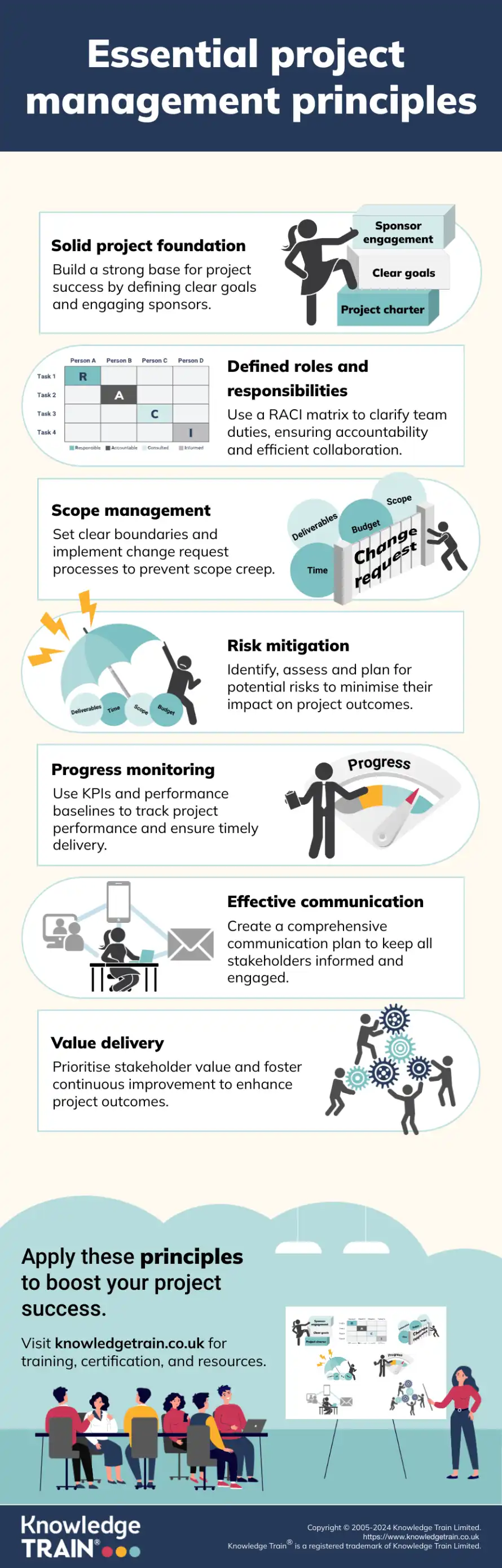
Project management principles are the guiding concepts that contribute to successful project delivery. Some of the most important principles include setting up a strong project foundation, defining roles and responsibilities, and managing the project scope and changes. Effective risk management, KPI and baseline tracking, communication and collaboration, and a focus on value delivery and continuous improvement are also crucial. These principles are not exhaustive, and as the field of project management continues to evolve, it is important to remain committed to ongoing learning and improvement. By consistently applying these principles and continuously enhancing Programmeproject management managers often have to manage a variety of different, skills and knowledge, practitioners can successfully overcome challenges and achieve exceptional outcomes in an ever-changing business environment.complex projects
. These can include projects with interdependencies and business environments that are constantly changing. As a result, there are risks involved with each project that must be mitigated.
FAQsFostering collaboration between project and programme teams
What are the most important project management principles?Effective teamwork
Some of the most important principles include clear goal setting, effective communication, risk management, and stakeholder engagement. is essential for programme success. This can be achieved by encouraging open communication channels between project and programme teams, facilitating regular cross-project meetings and knowledge-sharing sessions, implementing collaborative tools and platforms for seamless information exchange, and recognising and rewarding cross-team collaboration and problem-solving.
How can I improve communication in my project team?Strong collaboration and communication help enhance overall programme performance and minimise conflicts.
Implement a structured communication plan, utilise collaboration tools, and foster a culture of open feedback and active listening.Implementing effective reporting and monitoring systems
What’s the difference between Agile and traditional project management?Robust
Agile is iterative and flexible, with an emphasis on collaboration, while traditional methods are linear and follow a planned approach.reporting and monitoring
How do I handle scope creep in my projects? mechanisms are vital for effective programme oversight. This involves, developing standardised reporting templates to ensure consistent and structured information collection, implementing real-time dashboards to track programme progress and key performance indicators, setting up regular review cycles to assess programme health and alignment, and utilising data analytics to identify trends and potential issues in a timely manner.
Define clear project boundaries, implement a change control process, and maintain regular communication and alignment with stakeholders.With these systems in place, organisations can make informed decisions and manage their programmes proactively.
What are some common project management challenges and how can I overcome them?Organisations can benefit greatly by adopting these best practices to enhance their programme management and achieve success.
Common challenges include resource constraints, unclear objectives, and poor communication. Overcome them through careful planning, stakeholder engagement, and a focus on continuous improvement.Conclusion
InfographicA clear distinction between project and programme management is essential for achieving success in organisational objectives. While