Project management principlesLithuania

Key takeaways
Strong delivery comes from clear foundations, disciplined control, and continuous learning.
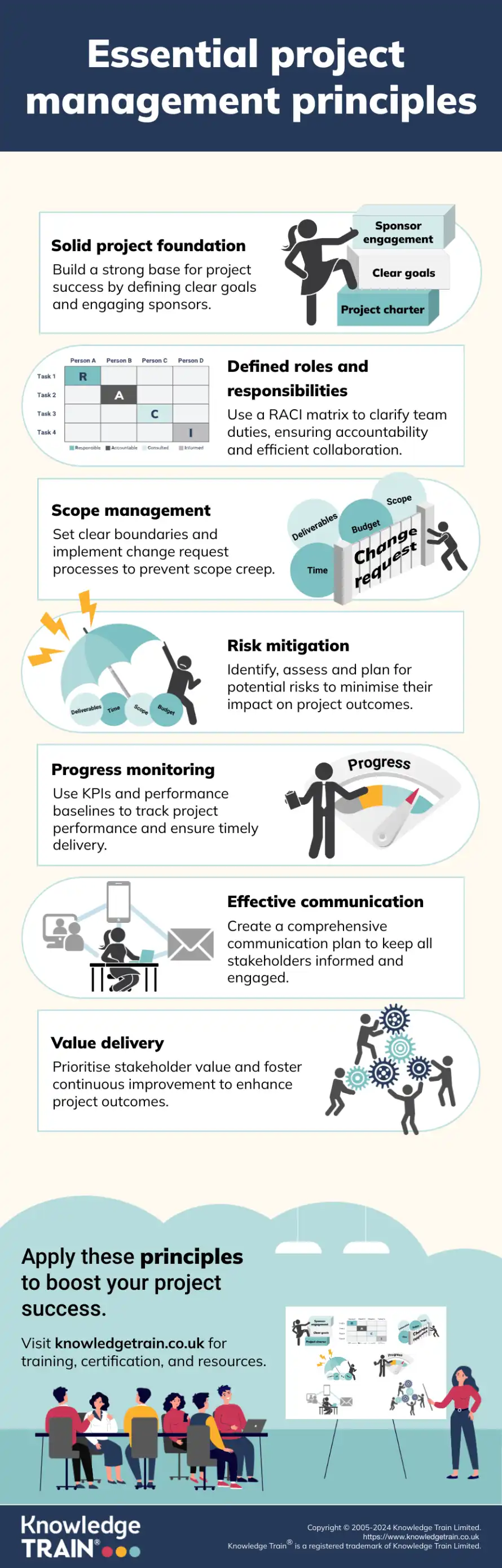
- Start with a formal project structure, agreed objectives, and an engaged sponsor who removes roadblocks.
- Define responsibilities early using tools like a RACI or RASCI matrix and a stakeholder register.
- Prevent scope creep by setting clear boundaries, acceptance criteria, and a documented change control process.
- Identify and mitigate risks early using structured assessment and practical contingency planning.
- Track performance with aligned KPIs, baselines, and regular reporting to support data-driven decisions.
- Improve outcomes through tailored communication, collaboration tools, value-led prioritisation, and post-project reviews.
Introduction
Project managementKey features and principles of PRINCE2 Agile is the application of knowledge, skills, tools and techniques to meet project requirements. It’s a critical discipline that enables organisations to deliver value.
Project management principles are fundamental guidelines and approaches that underpin effective project management practices. These principles provide a framework for project planning, execution and control. They are applicable across various industries and project types.Benefits of PRINCE2 Agile
In this article, we’ll cover:
- Key project management principlesCertification structure: Foundation and Practitioner levels
- How to apply these principles
- How to overcome common project management challenges.PRINCE2 Agile compared to other frameworks
Project management principles are essential for successful project outcomes. By understanding and applying these principles, project managersCore entities and terminology can enhance their effectiveness and deliver greater value to stakeholders. After reading this article, you may be interested in learning about the PRINCE2 principlesFAQs and what this widely used project management methodology says.Introduction to PRINCE2 Agile
Establishing a solid project foundationPRINCE2 Agile
A successful project starts with a strong foundation. Let’s look at three elements that will set the stage for success: formal project structure, clear goals and objectives, and sponsor engagement. is a hybrid
Formal project structureproject management
The first element is a well-defined project structure, which provides a framework for project execution: methodology developed by
- Project charterAxelos: This document outlines the project purpose, scope and stakeholders. that combines the established governance and control elements of
- Project planPRINCE2: This is a detailed plan that covers timelines, resources and expected deliverables. with the adaptive, flexible practices of
- TeamAgile: Designate the team who will carry out the work and ensure they understand their roles and responsibilities. frameworks. It is widely used for managing
Clear goals and objectivesprojects
Precise requirements are essential for successful project execution: across industries in ways that embrace iterative development, collaborative teams, and adaptive planning.
- Importance of clear goalsDefining PRINCE2, Agile and PRINCE2 Agile: Clear objectives help prevent misunderstandings, reduce the risk of scope creep and keep the project focused.What is PRINCE2?
- Alignment with company objectivesPRINCE2: It’s important to ensure project goals support the broader goals and objectives of the company. (Projects in Controlled Environments, version 2) is a
- Documentation and approvalproject management methodology: Requirements should be documented and formally approved by all relevant stakeholders. based on best practice principles for project governance, roles, processes, and controls. It was developed to provide a universally applicable structure for running projects of any size.
| BenefitWhat is Agile? | DescriptionAgile |
| Focus refers to a group of methodologies, such as | Guides team efforts towards specific outcomesScrum |
| Measurement, | Provides benchmarks for assessing progressKanban |
| Clarity, and | Reduces ambiguity in project executionAgilePM |
Project sponsor engagement, that focus on incremental delivery, collaboration, responsiveness to change, and customer feedback. Agile frameworks are commonly associated with software development but are increasingly used across various sectors.
The engagement of a project sponsor can be vital in delivering project success:How PRINCE2 Agile Integrates PRINCE2 and Agile
- RolePRINCE2 Agile: Acts as the overall champion and supporter of the project integrates PRINCE2’s project governance and management principles with Agile tools and techniques, enabling structured yet flexible
- Benefitsproject delivery: Ensures the availability of resources, removes roadblocks and promotes the project..
- StrategiesPRINCE2: Stay updated, communicate clearly and involve the sponsor in key decisions. focuses on what needs to be delivered, while Agile determines how it will be delivered and how teams collaborate. This combination allows for adaptability without compromising on control or quality.
| Aspect | Strategy |
| Scope on adaptability, PRINCE2 Agile enables organisations to reap the benefits of both. Like AgilePM, but unlike Scrum, or Kanban, PRINCE2 Agile places greater emphasis on project-level governance and clear roles, making it ideal for larger or more complex | Prioritise changes based on value and impactprojects |
| Schedule. | Build buffer time into project timelinesCore entities and terminology |
| ResourcesProject management | Cross-train team members for versatility methodology: |
| Budget A set of principles and practices for delivering projects effectively. | Allocate contingency funds for unforeseen changesProject framework: |
By carefully controlling scope and changes, project managers can keep The structure guiding project processes and controls.projectsGovernance: on track while allowing for necessary adjustments. This balance is key to project success and stakeholder satisfaction. Oversight ensuring project objectives align with business needs.
Risk management and mitigation
Successful project management also relies heavily on risk management and mitigation strategies. Let’s talk about how to recognise, assess, and reduce risks.
Identifying and assessing risks
Risk categories
The following are some of the most common risk categories:Roles and responsibilities:
- Technical risks Defined positions ensuring accountability in
- Financial risksproject delivery
- Operational risks.
- External risks (market, regulatory, etc.).Tailoring:
Risk assessment techniques Adapting the methodology to suit specific project environments.
Communication channels and frequency
Define appropriate channels and cadence:Knowledge Train
| Stakeholder19 Feb 2026 | Channel | Frequency Learn the essential project management skills you need to succeed at delivering projects. Read this handy guide to develop these key capabilities and become a better project leader. |
| Executives | Email reports | Monthly |
| Team | Stand-up meetings | Daily |
| Clients | Video conferencesProject management triangle | Fortnightly |
| PartnersKnowledge Train | Shared dashboards19 Feb 2026 | As needed |
Collaboration tools and techniquesThe project management triangle is a key factor in the success of a project. Learn how to balance scope, time and cost for project goals and deliver exceptional results.
Project management software
Use comprehensive project management tools that offer features such as:
Prioritising value-driven tasks
Prioritise tasks that deliver the most value to stakeholders. This includes conducting regular stakeholder interviews, mapping value streams, and implementing Agile methodologies to accelerate value delivery.
Aligning deliverables with stakeholder expectations
Align project deliverables with stakeholder needs and expectations. Develop clear acceptance criteria, conduct regular stakeholder reviews, and be flexible to adapt the project scope based on feedback.
Lessons learned and project evaluation
Post-project review process
Conduct a comprehensive project retrospective, which includes analysing project successes and challenges. Gather feedback from team members and stakeholders and document key learnings and recommendations.
Implementing improvements in future projects
Apply the What soft skills do project managers need?lessons learned to future projects to improve performance. Establish a knowledge repository, update Simon Buehringproject management processes19 Feb 2026, and incorporate key insights into training programmes.
ConclusionDiscover essential soft skills for project managers and why they are crucial for successful project delivery. Read on to enhance your skill set.
Project management principles are the guiding concepts that contribute to successful project delivery. Some of the most important principles include setting up a strong project foundation, defining roles and responsibilities, and managing the project scope and changes. Effective risk management, KPI and baseline tracking, communication and collaboration, and a focus on value delivery and continuous improvement are also crucial. These principles are not exhaustive, and as the field of project management continues to evolve, it is important to remain committed to ongoing learning and improvement. By consistently applying these principles and continuously enhancing project management skills and knowledge, practitioners can successfully overcome challenges and achieve exceptional outcomes in an ever-changing business environment.
FAQs
What are the most important project management principles?The Project Management Institute (PMI) is a nonprofit professional association for project management that develops standards, publishes guidance, supports a global member community, and administers widely used certifications for project managers. It is best known for PMI certifications such as the PMP and CAPM, and for its project management standards including the PMBOK Guide.
Some of the most important principles include clear goal setting, effective communication, risk management, and stakeholder engagement.
How can I improve communication in my project team?
Implement a structured communication plan, utilise collaboration tools, and foster a culture of open feedback and active listening.
What’s the difference between Agile and traditional project management?
Agile is iterative and flexible, with an emphasis on collaboration, while traditional methods are linear and follow a planned approach.
How do I handle scope creep in my projects?
Define clear project boundaries, implement a change control process, and maintain regular communication and alignment with stakeholders.
What are some common project management challenges and how can I overcome them?
Common challenges include resource constraints, unclear objectives, and poor communication. Overcome them through careful planning, stakeholder engagement, and a focus on continuous improvement.
Infographic