Introduction
Project management is the application of knowledge, skills, tools and techniques to meet project requirements. It’s a critical discipline that enables organisations to deliver value.
Project management principles are fundamental guidelines and approaches that underpin effective project management practices. These principles provide a framework for project planning, execution and control. They are applicable across various industries and project types.
In this article, we’ll cover:
- Key project management principles
- How to apply these principles
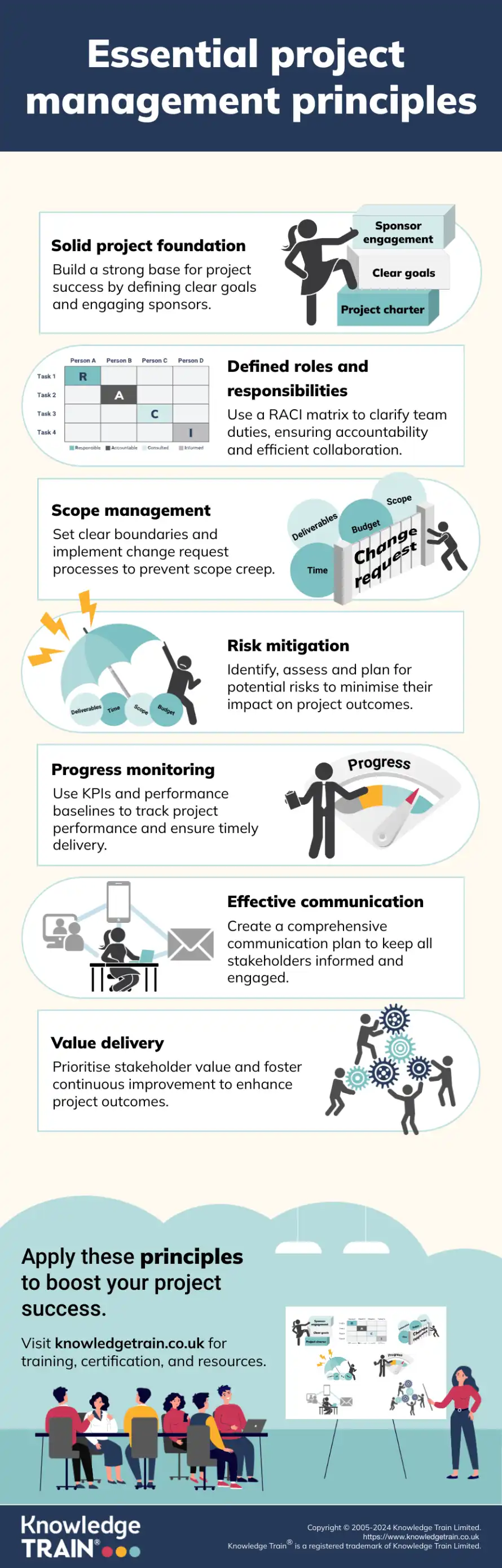
(Responsible, Accountable, Consulted, Informed) or RASCI (with Sign-off) matrices are useful tools to clearly define roles and responsibilities for each task or decision in a project:
- Responsible : Who will do the task?
- Accountable : Who is ultimately responsible for task completion?
- Consulted : Whom should be consulted?
- Informed : Who else should be informed?
- Sign-off (RASCI only): Who should sign off or approve?
Stakeholder register
A stakeholder register is a document that contains all key information about project stakeholders, such as contact information, level of influence, communication preferences and engagement strategy.
Project manager’s role
The role of a project manager is diverse and critical for project success.
Key responsibilities
- Planning and scheduling
- Resource allocation Request a quote
- Risk management
- Budget oversight
- Quality assurance.[email protected]
Leadership and communication skills
Successful project managers often exhibit: +44 (0)207 148 5985
- Clear and concise communication skillsCourses
- Conflict resolution capabilitiesPROJECT MANAGEMENT
- Motivational techniquesPRINCE2
- Adaptability to change®
- Strategic thinking.Foundation
Clearly defined roles and accountability improve the overall efficiency and effectiveness of a project team.Learn the fundamentals of the PRINCE2 method.
Managing project scope and changesIncludes Foundation & Practitioner combined option.
Managing project scope and change carefully helps you to manage change within your project.AI Project Governance Framework (AIPGF)
Scope creep preventionFoundation
Defining project boundariesLearn the fundamentals of the governance framework.
It is important to clearly define project boundaries to avoid scope creep. To do this, one must document specific project deliverables, explicitly identify exclusions and set measurable acceptance criteria.Practitioner
Change management processesIncludes Foundation & Practitioner combined option.
Robust Better Business Caseschange control™ processes should be implemented, including:Foundation
- Formal change request submissionsLearn the fundamentals of Better Business cases.
- Impact assessment (time, cost, resources)Practitioner
- Stakeholder review and approvalIncludes Foundation & Practitioner combined option.
- Documentation of approved changes.P3O
Adaptability in project management®
Flexibility in project lifecycleFoundation
Flexibility should be built into the project lifecycle to allow for necessary changes:Learn the fundamentals of the P3O project management office.
- Use Practitioner iterative methodsIncludes Foundation & Practitioner combined option. when applicableWorkshops
- Conduct regular project reviewsIntroduction to Project Management
- Maintain open communication.1-day workshop to learn the basics of project management.
Balancing change and stabilityProject Management Essentials
Finding a balance between adaptability and project stability is important.2-day workshop to learn how to manage projects without getting certified.
| AspectWriting Business Cases | StrategyHalf-day workshop to learn to write robust business cases. |
| ScopeAI in Project Management | Prioritise changes based on value and impactLearn how to use AI tools in everyday project work. |
| ScheduleARTIFICIAL INTELLIGENCE (AI) | Build buffer time into project timelinesBCS AI |
| ResourcesFoundation | Cross-train team members for versatilityLearn the fundamentals of artificial intellegence. |
| BudgetAI Project Governance Framework (AIPGF) | Allocate contingency funds for unforeseen changesFoundation |
By carefully controlling scope and changes, project managers can keep Learn the fundamentals of the governance framework.projectsPractitioner on track while allowing for necessary adjustments. This balance is key to project success and stakeholder satisfaction.Includes Foundation & Practitioner combined option.
Risk management and mitigationWorkshops
Successful project management also relies heavily on AI in Project Management risk managementLearn how to use AI tools in everyday project work. and mitigation strategies. Let’s talk about how to recognise, assess, and reduce risks.AGILE
Identifying and assessing risksAgilePM
Risk categories®
The following are some of the most common risk categories: – Agile Project Management
- Technical risksFoundation
- Financial risksLearn the key principles of Agile Project Management.
- Operational risksPractitioner
- External risks (market, regulatory, etc.).Includes Foundation & Practitioner combined option.
Risk assessment techniquesPRINCE2
Use these techniques to identify and evaluate risks:®
- Risk probability Agile Foundation and impact matrixLearn the fundamentals of the PRINCE2 Agile method.
- SWOT analysisPractitioner (Strengths, Weaknesses, Opportunities, Threats)Includes Foundation & Practitioner combined option.
- Delphi technique (expert consensus)Scrum
- Fault tree analysis.Scrum Essentials
Developing risk mitigation strategiesSelf-paced training course to learn the essentials of Scrum.
Preventive measuresScrum Master
Take the following proactive actions to reduce the likelihood of risk occurrence:Choose Scrum Alliance or Scrum.org Scrum Master training courses.
- Regular risk reviewsScrum Product Owner
- Clear communication channelsChoose Scrum Alliance or Scrum.org Product Owner training courses.
- Quality assurance processesAgileBA
- Ongoing staff training.®
Contingency planning – Agile Business Analysis
Develop Foundation contingency plansLearn the fundamentals of Agile Business Analysis. for the following identified risks:Practitioner
| Risk level4-day course including Foundation. | ActionLean Six Sigma |
| LowYellow Belt | Monitor and reassess periodicallyAgile Learning Library (ALL)™ |
| MediumBUSINESS ANALYSIS | Develop specific response strategiesBCS Business Analysis |
| HighBusiness Analysis Foundation | Create detailed action plans and allocate resourcesLearn the fundamentals of business analysis. |
Ongoing Modelling Business Processes risk managementGain practitioner certificate in modelling business processes. is critical for successful outcomes. It involves careful tracking and refinement of the risk management process. Identifying and addressing project risks early can significantly improve project resilience and success rates.Business Analysis Practices
Monitoring and measuring project progressGain practitioner certificate in business analysis practices.
Monitoring and measuring progress are crucial aspects of project management that help ensure project success. This section will cover various aspects of monitoring and measuring project progress, including the use of key performance indicators (KPIs) and performance management baselines.Requirements Engineering
Key Performance Indicators (KPIs)Gain practitioner certificate in requirements engineering.
Selecting appropriate KPIsBusiness Analysis International Diploma
Selecting the right KPIs is important to ensure effective monitoring and measuring of project progress. The KPIs should be aligned with the project objectives and should provide insights into the project’s performance. Some of the commonly used KPIs include:All 4 courses bundled into this Diploma certification package.
- Schedule Performance IndexAgileBA (SPI)®
- Cost Performance Index – Agile Business Analysis (CPI)Foundation training
- Quality metricsLearn the fundamentals of Agile Business Analysis.
- Stakeholder satisfaction scoresPractitioner .4-day course including Foundation.
Tracking and reporting methodsPMI
Once the KPIs are selected, it is important to have effective tracking and reporting mechanisms in place. This can include:®
- Regular status meetingsPMI-PBA
- Automated dashboardsSelf-paced course to prepare you for the exam (exam not included).
- Specialist: DSV Predict project results
- Rationale corrective actions
- Assess change requests.
Setting clear KPIs and performance baselines enables project managers to track progress and make data-driven decisions.
Effective communication and collaboration
CommunicationPRINCE2 COURSES and Select your preferred training course below:collaboration are key success factors in project management. In this section, we will discuss how to develop communication plans and utilise collaboration tools.APM COURSES
Communication plan developmentSelect your preferred training course below:
Stakeholder communication needs
Identify and meet different stakeholder needs:AGILE PROJECT MANAGEMENT COURSES
- Executive sponsors: Executive updatesSelect your preferred training course below:
- Team members: Detailed tasks
- Clients: Progress and milestonesPRINCE2 AGILE COURSES
- External partners: Relevant project details.Select your preferred training course below:
Communication channels and frequency
Define appropriate channels and cadence:BETTER BUSINESS CASES COURSES
| StakeholderSelect your preferred training course below: | Channel | FrequencyP3O COURSES |
| ExecutivesSelect your preferred training course below: | Email reports | MonthlyWORKSHOPS |
| TeamSelect your preferred workshop below: | Stand-up meetings | DailyAGILE QUALIFICATIONS |
| ClientsSelect your preferred qualification. | Video conferences | FortnightlyAGILE PROJECT MANAGEMENT COURSES |
| PartnersSelect your preferred training course below: | Shared dashboards | As neededPRINCE2 AGILE COURSES |
Collaboration tools and techniquesSelect your preferred training course below:
Project management software
Use comprehensive project management tools that offer features such as:SCRUM COURSES
- Gantt chartsSelect your preferred training course below: for visual timeline management
- Task assignment and tracking capabilitiesAGILE BUSINESS ANALYSIS COURSES
- Resource allocation and budget managementSelect your preferred training course below:
- Document management and version control.
Team collaboration platformsBUSINESS ANALYSIS QUALIFICATIONS
Implement team collaboration platforms that support features like:Select your preferred qualification.
- Real-time messaging and chat
- Virtual whiteboards and brainstorming toolsBCS BUSINESS ANALYSIS COURSES
- Simultaneous document editing and collaborationSelect your preferred training course below:
- Integrated video conferencing and meetings.
Effective communication plans and collaboration tools not only facilitate team communication and increase efficiency but also contribute to project success through strategic stakeholder engagement.AGILE BUSINESS ANALYSIS COURSES
Value delivery and continuous improvementSelect your preferred training course below:
Focus on stakeholder value
Prioritising value-driven tasksCHANGE MANAGEMENT QUALIFICATIONS
Prioritise tasks that deliver the most value to stakeholders. This includes conducting regular stakeholder interviews, mapping value streams, and implementing Select your preferred qualification.Agile methodologies
Select your preferred training course below:
Some of the most important principles include clear goal setting, effective communication, risk management, and stakeholder engagement.
How can I improve communication in my project team?LEAN SIX SIGMA COURSES
Implement a structured communication plan, utilise collaboration tools, and foster a culture of open feedback and active listening.Select your preferred training course below:
What’s the difference between Agile and traditional project management?
Agile is iterative and flexible, with an emphasis on collaboration, while traditional methods are linear and follow a planned approach.BUSINESS ANALYST COURSES
How do I handle scope creep in my projects?Select your self-paced training course topic.
Define clear project boundaries, implement a change control process, and maintain regular communication and alignment with stakeholders.
What are some common project management challenges and how can I overcome them?BCS BUSINESS ANALYST COURSES
Common challenges include resource constraints, unclear objectives, and poor communication. Overcome them through careful planning, stakeholder engagement, and a focus on continuous improvement.Select your preferred training course below:
Infographic