Project management principles

Formal project structure
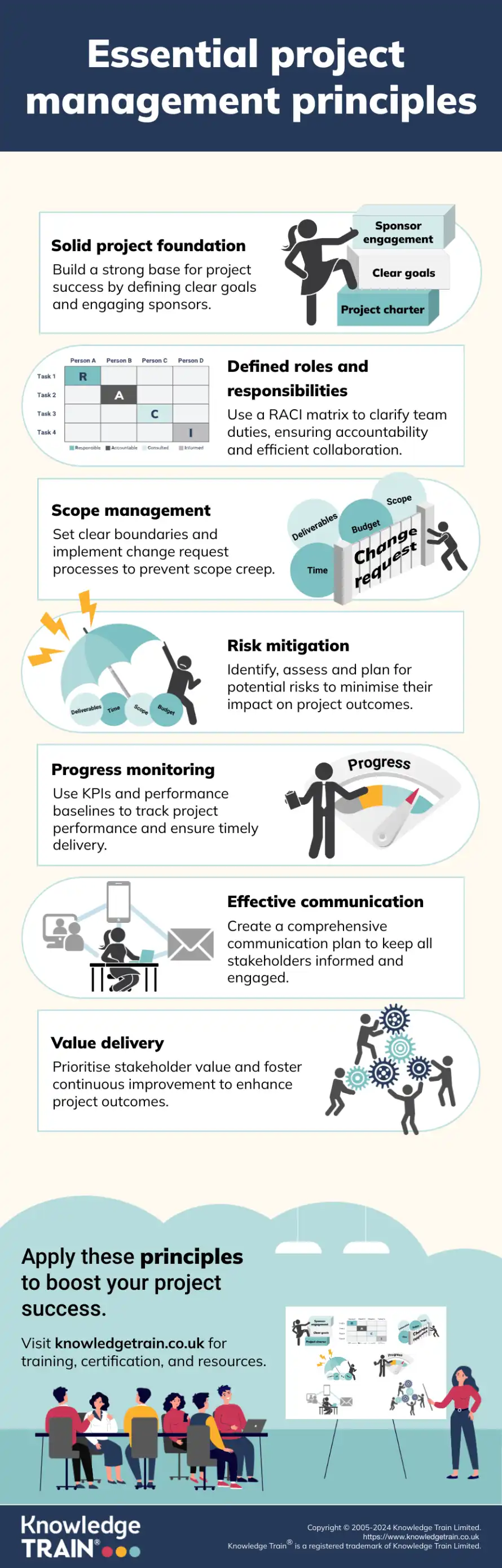
The first element is a well-defined project structure, which provides a framework for project execution:
| Benefit | DescriptionSee all dates |
| FocusTop 10 project tracker tools and templates | Guides team efforts towards specific outcomes1. |
| MeasurementMonday.com | Provides benchmarks for assessing progressMonday.com provides an easy-to-use work management platform that can be used to track project progress and facilitate collaboration among team members. It is designed for teams of all sizes and offers a flexible and customisable interface and workflows. |
| ClarityKey features | Reduces ambiguity in project executionMultiple project views including Gantt, Kanban, and Timeline |
Project sponsor engagementResource management and time tracking
The engagement of a project sponsor can be vital in delivering project success:Automations and integrations with other tools
- RoleMobile app for on-the-go access. : Acts as the overall champion and supporter of the project2.
- BenefitsSmartsheet: Ensures the availability of resources, removes roadblocks and promotes the project.Smartsheet is a spreadsheet-like work operating system that allows teams to create and manage projects effectively. It is designed to be easy to use, even for those who may be new to project management.
- StrategiesKey features: Stay updated, communicate clearly and involve the sponsor in key decisions.Customisable templates
Defining these important fundamentals, Real-time collaborationproject managersAutomated workflows can lay a strong foundation for project success and delivery.Robust reporting and analytics.
By effectively managing scope and changes, project managers can ensure projects remain on track while accommodating necessary adjustments. This balance promotes project success and stakeholder satisfaction.3.
Defining roles and responsibilitiesEtsy project management templates
Clearly defining roles and responsibilities within a project is essential for its success. This section will delve into aspects of team accountability and the role of the project manager.Etsy is an online marketplace that sells handcrafted and vintage items and materials from all over the world. You can find numerous customisable
Team accountabilityproject management templates
Creating accountability structures is important to ensure that each team member understands their responsibilities and expectations. there as well.
RACI/RASCI matrixKey features
RACIOffers a diverse collection of beautiful designs and layouts (Responsible, Accountable, Consulted, Informed) or Available in printable and digital formatsRASCITemplates can be easily tailored to suit specific project requirements (with Sign-off) matrices are useful tools to clearly define roles and responsibilities for each task or decision in a project:One-time purchase with lifetime access.
- Responsible4. : Who will do the task?Adobe Acrobat project management templates
- AccountableAdobe Acrobat provides a set of professionally designed project management templates. You can easily edit them with Acrobat Reader.: Who is ultimately responsible for task completion?Key features
- ConsultedHigh-quality, professionally designed templates: Whom should be consulted?Easy to edit and customise
- InformedCompatible with Adobe Acrobat Reader: Who else should be informed?Suitable for various project types and industries.
- Sign-off 5. (RASCI only): Who should sign off or approve?Wellingtone project management templates
Stakeholder registerWellingtone is a knowledge-based solution in the field of project management. Their website provides users with a set of fully featured templates for different project types.
A Key featuresstakeholder registerTemplates are created based on is a document that contains all key information about project stakeholders, such as contact information, level of influence, communication preferences and engagement strategy.PMI
Project manager’s role,
The role of a project manager is diverse and critical for project success.PRINCE2
Key responsibilities, and other standard industry guidelines
- Planning and schedulingCovers all areas of project management
- Resource allocationUpdated regularly to reflect industry changes
- Risk managementSuitable for both beginner and experienced
- Budget oversightproject managers
- Quality assurance..
Leadership and communication skills6.
Successful project managers often exhibit:Asana
- Clear and concise communication skillsAsana is a
- Conflict resolution capabilitiesproject management software
- Motivational techniques that provides teams with a visual way to plan, organise, and track work. It offers a user-friendly interface, flexible features, and integrations with many other apps.
- Adaptability to changeKey features
- Strategic thinking.Task dependencies and milestones
Clearly defined roles and accountability improve the overall efficiency and effectiveness of a project team.Team collaboration tools
Managing project scope and changesAgile project management capabilities
Managing project scope and change carefully helps you to manage change within your project.Customisable workflows and issue tracking
Scope creep preventionVast integration ecosystem
Defining project boundariesAdvanced search and filtering.
It is important to clearly define project boundaries to avoid scope creep. To do this, one must document specific project deliverables, explicitly identify exclusions and set measurable acceptance criteria.10.
Change management processesNotion
Robust Notion is a versatile workspace that combines note-taking, databases, and project management functionalities.change controlKey features processes should be implemented, including:Extremely flexible and customisable workspace
- Formal change request submissionsAll-in-one platform for multiple tools
- Impact assessment (time, cost, resources)Collaboration through editing and sharing
- Stakeholder review and approvalVariety of templates for different project needs.
- Documentation of approved changes.How to choose the right project tracker
Adaptability in project managementCriteria for selecting a project tracker:
Flexibility in project lifecycleSize and composition of the project team
Flexibility should be built into the project lifecycle to allow for necessary changes:Type, complexity and expected duration of the project
- Use Financial resources available to the projectiterative methodsDesired features and capabilities (e.g. time tracking, resource allocation, task management) when applicableIntegrations with other tools and systems
- Conduct regular project reviewsUser-friendliness and training requirements.
- Maintain open communication.Enhance your skills with our expert-led courses
Balancing change and stability
Finding a balance between adaptability and project stability is important.
| Aspect | StrategyInstructor-led |
| ScopeIntroduction to Project Management course | Prioritise changes based on value and impact |
| Schedule£499 +vat | Build buffer time into project timelines |
| ResourcesSee all dates | Cross-train team members for versatility |
| Budget | Allocate contingency funds for unforeseen changes |
By carefully controlling scope and changes, project managers can keep Instructor-ledprojectsProject Management Essentials on track while allowing for necessary adjustments. This balance is key to project success and stakeholder satisfaction.
Risk management and mitigation£999 +vat
Successful project management also relies heavily on risk managementSee all dates and mitigation strategies. Let’s talk about how to recognise, assess, and reduce risks.Implementing your project tracker
Identifying and assessing risksAfter selecting a project tracker, follow these five steps to implement it successfully:
Risk categoriesDefine clear objectives and milestones for your project
The following are some of the most common risk categories:Set up your project structure and workflows within the tracker
- Technical risksTrain your team members on how to use the tool effectively
- Financial risksRegularly update and maintain your project tracker with accurate data
- Operational risksReview and adjust your processes as needed to optimise productivity and efficiency.
- External risks (market, regulatory, etc.).Conclusion
Risk assessment techniquesChoosing and implementing the right project tracker can make a significant difference in your team’s productivity. Whether you opt for a robust software solution or a simple template, select a tool that aligns with your unique needs and use it consistently throughout your
Use these techniques to identify and evaluate risks:projects
- Risk probability for best results.and impact matrixFAQs
- SWOT analysisHow often should I update my project tracker? (Strengths, Weaknesses, Opportunities, Threats)You should update your project tracker daily or weekly, depending on the speed and complexity of your project.
- Delphi technique (expert consensus)Can I use multiple project trackers for different aspects of my project?
- Fault tree analysis.Although it is technically possible, it is better to use one detailed project tracker for all aspects of your project. This will help to prevent inconsistencies between different trackers.
Developing risk mitigation strategiesAre free project trackers as effective as paid ones?
Preventive measuresFree project trackers can be effective for smaller and simpler projects. Paid project trackers usually have more features and are better for more complex projects.
Take the following proactive actions to reduce the likelihood of risk occurrence:How can I encourage my team to use the project tracker consistently?
- Regular risk reviewsSet an example and provide training. Show your team the benefits of using the tracker. Make it a regular part of your team’s workflow and meetings.
- Clear communication channelsCan project trackers help with remote team management?
- Quality assurance processesYes, many project trackers have features that can help with managing a remote team. These features include real-time updates and communication tools.
- Ongoing staff training.Subscribe to our exclusive offers and promotions
Contingency planning
Develop Subscribe nowcontingency plans for the following identified risks:
- Understand the validity of your PRINCE2 qualification and how AXELOS membership can benefit your career. Learn more about renewal processes by reading oClients: Progress and milestones
- External partners: Relevant project details.
FAQs
What are the most important project management principles?
Some of the most important principles include clear goal setting, effective communication, risk management, and stakeholder engagement.
How can I improve communication in my project team?Give us a call
Implement a structured communication plan, utilise collaboration tools, and foster a culture of open feedback and active listening.
What’s the difference between Agile and traditional project management?
Agile is iterative and flexible, with an emphasis on collaboration, while traditional methods are linear and follow a planned approach.+44 (0)207 148 5985
How do I handle scope creep in my projects?
Define clear project boundaries, implement a change control process, and maintain regular communication and alignment with stakeholders.Or chat with us using the link at the bottom of the screen.
What are some common project management challenges and how can I overcome them?Contact us with questions about the courses on this page, or about which project management certification or training is best for you.
Common challenges include resource constraints, unclear objectives, and poor communication. Overcome them through careful planning, stakeholder engagement, and a focus on continuous improvement.Finance FAQs
InfographicContact