Project management principles

Key takeaways
Strong delivery comes from clear foundations, disciplined control, and continuous learning.
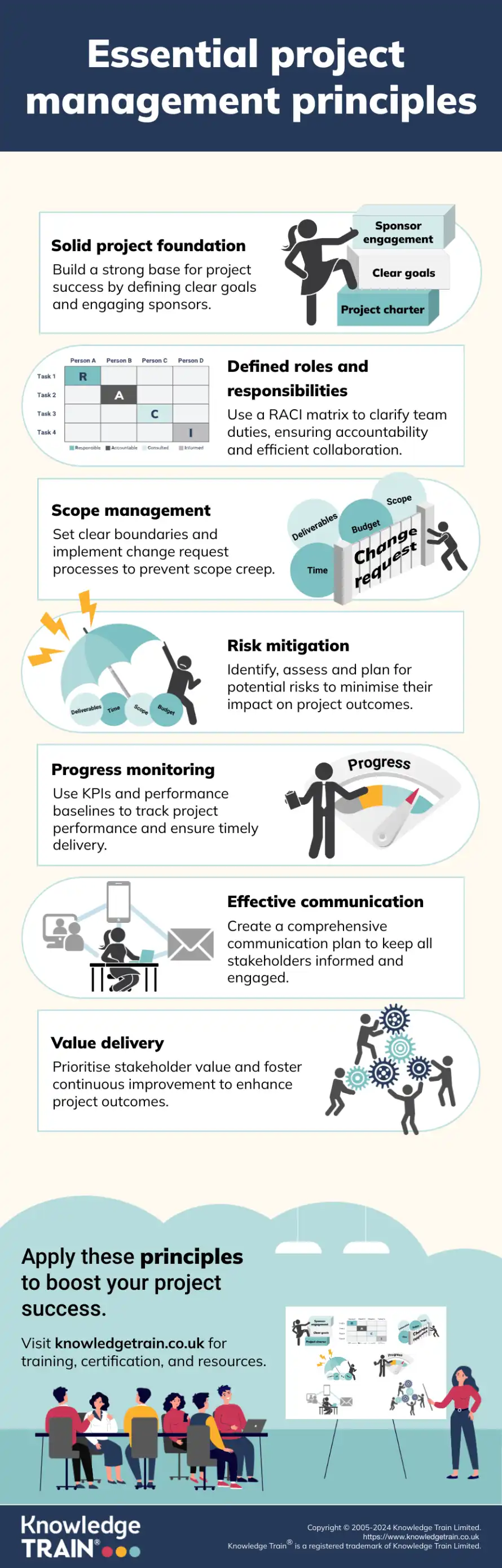
- Start with a formal project structure, agreed objectives, and an engaged sponsor who removes roadblocks.
- Define responsibilities early using tools like a RACI or RASCI matrix and a stakeholder register.
- Prevent scope creep by setting clear boundaries, acceptance criteria, and a documented change control process.
- Identify and mitigate risks early using structured assessment and practical contingency planning.
- Track performance with aligned KPIs, baselines, and regular reporting to support data-driven decisions.
- Improve outcomes through tailored communication, collaboration tools, value-led prioritisation, and post-project reviews.
Project management principles are essential for successful project outcomes. By understanding and applying these principles, project managers can enhance their effectiveness and deliver greater value to stakeholders. After reading this article, you may be interested in learning about the PRINCE2 principles and what this widely used project management methodology says.
Establishing a solid project foundation
A successful project starts with a strong foundation. Let’s look at three elements that will set the stage for success: formal project structure, clear goals and objectives, and sponsor engagement.
Formal project structure
The first element is a well-defined project structure, which provides a framework for project execution:
Ongoing risk management is critical for successful outcomes. It involves careful tracking and refinement of the risk management process. Identifying and addressing project risks early can significantly improve project resilience and success rates.
Monitoring and measuring project progress
Monitoring and measuring progress are crucial aspects of project management that help ensure project success. This section will cover various aspects of monitoring and measuring project progress, including the use of key performance indicators (KPIs) and performance management baselines.
Key Performance Indicators (KPIs)
Selecting appropriate KPIs
Selecting the right KPIs is important to ensure effective monitoring and measuring of project progress. The KPIs should be aligned with the project objectives and should provide insights into the project’s performance. Some of the commonly used KPIs include:
- Schedule Performance Index (SPI)
- Cost Performance Index (CPI)
- Quality metrics
- Stakeholder satisfaction scores .
Tracking and reporting methods
Once the KPIs are selected, it is important to have effective tracking and reporting mechanisms in place. This can include:
- Regular status meetings
| Learn the key principles of Agile Project Management. | FrequencyPractitioner | |
| ExecutivesIncludes Foundation & Practitioner combined option. | Email reportsPRINCE2 | Monthly® |
| Team Agile | Stand-up meetingsFoundation | DailyLearn the fundamentals of the PRINCE2 Agile method. |
| ClientsPractitioner | Video conferencesIncludes Foundation & Practitioner combined option. | FortnightlyAI Project Governance Framework (AIPGF) |
| PartnersFoundation | Shared dashboardsLearn the fundamentals of the governance framework. | As neededPractitioner |
FAQs – Agile Business Analysis
What are the most important project management principles?Foundation
Some of the most important principles include clear goal setting, effective communication, risk management, and stakeholder engagement.Learn the fundamentals of Agile Business Analysis.
How can I improve communication in my project team?Practitioner
Implement a structured communication plan, utilise collaboration tools, and foster a culture of open feedback and active listening.4-day course including Foundation.
What’s the difference between Agile and traditional project management?Lean Six Sigma
Agile is iterative and flexible, with an emphasis on collaboration, while traditional methods are linear and follow a planned approach.Yellow Belt
How do I handle scope creep in my projects?Self-paced training course to gain LSS Yellow Belt.
Define clear project boundaries, implement a change control process, and maintain regular communication and alignment with stakeholders.PMI
What are some common project management challenges and how can I overcome them?®
Common challenges include resource constraints, unclear objectives, and poor communication. Overcome them through careful planning, stakeholder engagement, and a focus on continuous improvement.PMI-ACP
InfographicSelf-paced course to prepare you for the exam (exam not included).